Category Archives: 21st Century Marketing

Three Ways AI Will Start Impacting Marketing in 2024

Wave Images - Free Download on Freepik

As the old quip goes, “predictions are difficult, especially about the future.” That witticism serves to remind us of the hazards of predicting the future of AI and its impact on marketing. But there are three outcomes that seem self-evident as we witness the early applications of AI to the marketing toolkit.

The size of marketing and agency staffs will decline

There are debates about whether AI will inspire more or less creativity. On one hand, AI is a great enabler that will allow ideas to develop with less constraints on executional limits on bringing them to life. On the other hand, AI is a great imitator that will respond to prompts with a tedious recycling of what’s already been done. Agency viewpoints have tended to emphasize the second view as a basis for saying that the creativity they bring to clients will be in more demand than ever. Whether most agencies actually are truly a source of creativity or are just human recyclers is beside the point. The point is that the business model of agencies is based on the executional effort rather than the intellectual effort of marketing. Most agencies have an hours or people-based model similar to that of a law firm. They may attract clients through the strength of their creative ideas, but they make money from those clients by how many bodies they can assign to produce and distribute those ideas. Clients may value the “big ideas” of the agencies even more in an AI world, but they won’t need large staffs to produce the marketing materials, create the media plan, and optimize media channels.  Agencies have given lip service to getting paid for their ideas in the past. But they’ve never convinced clients or themselves to adopt that model. The role of agencies may be enhanced or degraded by AI, but their billable revenue will decline as more human tasks become automated.

For the same reasons, company marketing departments should grow smaller in number as well. The relative scale of the ipact will depend on how they were organized. Marketers than built large in-house teams to handle creative and media tasks will shrink in line with agencies. Brand managers will be less affected but their skill set and responsibilites will change as they spend less time and task management and more on true brand development.

The best marketers will shift their focus from local optima to global optima

That’s an admittedly jargon-filled phrase. But these mathematical terms do the right job for describing the main marketing challenge of the early AI era. The figure below illustrates the general idea. Imagine you’re kicking off a marketing campaign represented by the blue dot. As you move to optimize your messaging, target, and channels, you move nicely along increasing your performance until you get to the top of the first curve. As you move beyond that peak, the metrics will tell you that you are going in the wrong direction and push you back to the first peak. But there may be a new audience, a new selling point, or a new channel strategy further down the path that would actually get you to an even higher maximum return. But the data won’t take you there incrementally. You’ll have to push past the optimization signals to move from a local optimization to a global optimization.
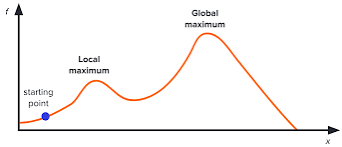
The challenge is that you’ll never know if you’re at a global maximum or a local maximum. You can’t tweak yourself to the highest outcome. Marketers will rely more and more on AI to get them to an optimal local maximum. But to unlock superior performance, they’ll have to explore ideas that are beyond the A/B testing mentality to constantly explore whether there is a better outcome than the current approach can give you.

The best job of humans will be to interface with other humans

There has been a lot of conversation around the jobs that will be lost to AI. If historical trends are a meaningful precedent, AI will eliminate many jobs and create many others. But of course, the losses and gains will be spread unequally. Middle-skilled physical laborers bore the brunt of machines and manufacturing robots. Similarly, middle-skilled and many high-skilled administrative jobs will quickly fall away in AI. Media planning, optimization and reporting will become mostly automated. A good portion of pre- and post-production workers will also be replaced by AI. The jobs that will survive or even grow are those related to human tastes and connections. Humans are a mess of reason, emotions, and instinctual quirks. How we react to things is difficult to interpret or predict. Taylor Swift was not named Person of the Year because of the accuracy of her pitch and efficiency of her lyrics. She created a cultural moment that people wanted to be a part of. The ultimate goal of any brand is to create a human connection that transcends the attributes of the product. The nature of that connection is elusive. But humans recognize when it happens and, more importantly, are the mechanism by which it happens. The people who can inject humanity into customer service, product design, and marketing strategy will always be in demand. To the extent that AI frees up people for more human-centered thinking, there is even potential for growth.

1 Comment

Filed under 21st Century Marketing, Artificial Intelligence, Innovation

The Omnichannel Trap

Related image[as originally appeared in Marketing Insider)

No word falls more trippingly off the tongue in marketing circles than “omnichannel.” It’s the stated ambition of many a marketer, and taken as a given among the conferences, summits, and pundits beckoning to marketers. The need for brands to take an omnichannel approach is unquestioned, although there’s much to question about it.

That’s because an omnichannel strategy is overly ambitious and lazy at the same time. It’s overly ambitious because it injects complexity and strain into marketing systems that already require far more layers of infrastructure and effort than they did 10 years ago. On a purely practical basis, an omnichannel mindset is a game that can never be won. The new marketing ecosystem generates a constant introduction of new channels and sub-channels. If marketers try to keep a hand in them all, resources will be stretched to the point of ineffectiveness. It’s lazy because it neglects the strategic effort required to understand what combination of channels are most essential to the audience, objectives and advantages of the brand. It takes work to understand the ways people come to a brand, and to prioritize where to excel, where to participate, and where not to play at all. So savvy marketers should think about their communications channels the same way they think about their new products. Nobody would seriously propose an “omniproduct” strategy.

In that light, it’s clear that omnichannel starts at the wrong end of a strategic marketing process. It’s like collecting as many tools as possible and then figuring out what to build from them. Strategy is deciding what you want to build, and then assembling the tools most critical to its construction. It’s true that consumers insist on more immediacy and more control of their brand interactions. But the answer to that demand cannot be to attempt to be everywhere the consumer could possibly be. Rather, the challenge is to be where you can most impact a positive customer experience. Being in more places won’t help if it comes at the cost of strong execution and integration.

Several have tried coining the term “optichannel” to replace “omnichannel.” To the extent buzzwords are useful, optichannel at least implies the need for making strategic choices. It requires finding the balance between what a customer wants, what the brand delivers, and what your budget can afford.

Consider these useful questions to develop more strategic channel choices:

  1. How well defined is my audience? Is it mass or niche? Is it easy to identify by demographic, behavior or location?
    • To gauge how much additional value you can derive from an addressable audience vs. a mass audience.
  1. What are the key elements of your customer Journey? Is it a high consideration purchase? How often is the customer in market?
    • To weigh the relative importance of creating deep highly integrated experiences vs a breadth of highly visible touchpoints.
  1. Are there common triggers to purchase? (e.g., a life event, a problem, a seasonal need, a cultural cue)
    • To identify the times and places most conducive to a brand interaction.
  1. What are the key incentives and barriers to brand consideration? (e.g., understanding how it works, knowing what others think of it, seeing what it looks like, being easy to purchase)
    • To understand the channels that are best equipped to drive your strategic marketing challenges
  1. What’s the value of a new customer? How frequently is your product/service purchased and what’s the retention/loyalty rate?
    • To prioritize the channel spend based on expected return on investment
  1. What emotional reward are people expecting from the brand? (e.g., empowerment, connection, status, escape, etc.)
    • To align with the channel environments most appropriate to the brand.

It’s reasonable to suspect that the fervor for the omnichannel gospel comes less from marketers and more from those striving for the marketer’s budget. Omnichannel thinking drives a FOMO mentality that drives spending. More channels, after all, means more to buy: more media, more technology, and more services to execute across them all. The omnichannel trap is rooted in the notion that doing more things does better. The optichannel approach posits that doing things better does more.

1 Comment

Filed under 21st Century Marketing, Channel Strategy, Innovation

The Rise of Access Over Ownership

modular houseThere’s an old saying that if you like sailing, don’t buy a boat, just make friends with someone who owns one. That saying goes a long way towards describing one of the most interesting long-term cultural shifts underway. Ownership is becoming less of a benefit across a variety of goods and services. That’s particularly interesting because ownership used to seem like such a bedrock of our genetic makeup. Like a toddler proclaiming “mine,” it’s deep in the human psychology to declare what’s ours.

Yet the trend away from ownership is unmistakable. The valuation of Uber isn’t based on replacing taxis but on replacing car ownership. With an increasing percentage of the world’s population moving into cities, there’s less appetite for the rising costs of individual car ownership. Pride of ownership has been deeply rooted in our homes for generations.  Yet home ownership is falling among millennials. The recession and related mortgage crisis were the original explanation, but rental prices have risen significantly in the past two years and the trend continues. Airbnb is focused on vacation and short-term rentals for now, but it’s clear long-term mission is the Uberization of housing as well.

The trend trickles down through numerous categories. The rise of the cloud has made software ownership obsolete. Businesses and consumers alike now see it as less useful to have software on their own computers. The ability to access software from anywhere and avoid the hassle of upgrades and backups make it a preferred option. Music is yet another example. iTunes is scrambling to develop their own streaming Beats service as they’ve watched their once revolutionary purchase model lose share to Pandora and Spotify users. The benefits of ownership have been supplanted by the benefits of access. Being able to get a ride in minutes to wherever I want to go is more important than owning a car. Being able to listen to my favorite band whenever I want is more important than having them in my personal music collection.

Interestingly, this is a trend that often moves from the bottom up economically. The path to Uber started with car leasing in the 1980s as a way to give people the means to drive cars they otherwise couldn’t afford. But when the trend moves up to premium items, it’s less about avoiding cost constraints than avoiding the constraints of ownership. One source calculates that it takes a family over three years (600 loads) to justify purchasing a washer and dryer. If companies make it cheaper and more convenient to do your laundry on their machines, why bother? This hints at how this trend will impact every consumer durable. In this light, we’ll see access overtake ownership in appliances (Lavanda), clothing (Crossroads Trading), and furniture (Furlenco). People will increasingly switch among homes and the things in them with the same mindset they apply to switching tracks on their Pandora soundtrack.

2 Comments

Filed under 21st Century Marketing, Innovation

The Two Most Important Words in Marketing

if-then*The most dramatic advances in human development over the past century can be summed up in two words: “if then.” That phrase sums up all the power unleashed by the age of computing. Fueled by Moore’s law, the path from the Babbage Machine curiosity of 1822 to IBM’s Watson is an exponential acceleration in the if/then processes we can manipulate in a given time. The algorithm, or the ability to perform complex tasks with a cascade of simpler If/Then actions, has yielded stunning advances in machinery, medicine, communications and artificial intelligence that are redefining our lives on several levels.

It may seem a stretch to tie those lofty heights to the earthier world of marketing. Yet it’s as true for marketing as it is for any human endeavor that future advances lie in more fully harnessing the force of If/Then. We see the early effects in the rise of programmatic media. Programmatic advertising allows marketers to perform instantaneous if/then decisions across millions of potential customers and thousands of destinations. It is now a question of when, not if, all media will be programmatic. As significant as that is, media purchase and delivery is not the full extent of its impact.

With only a small degree of oversimplification, all marketing can be translated into the If/Then processes. In fact, it harnesses the two areas that are currently most at the tip of every CMO’s tongue: Data and Content. That’s because Data feeds the If, and Content provides the Then. Data signals the people and the context around them that spur an adept marketer to act. Content is the action the marketer takes to react to that signal. So if Home Depot sees a suburban homeowner within a mile of their store on a warm April day, then it forwards Spring planting tips and an offer from their Gardening Center. The response generates data that sets up the follow-on If/Then. If the Spring planting tips led to a purchase, then gauge their interest in a Loyalty program for the summer ahead. The effectiveness of the marketing correlates with the depth and breadth of If/Then branches the marketer can meaningfully define.

The Art vs. Science group might argue that applying the If/Then paradigm to its logical extreme overlooks the human factor that underlies the best marketing. In that view, the most successful brands, the ones that inspire deep-seated passion and loyalty like Harley Davidson and Nike, exist in an emotional territory above the mechanical abilities of If/Then algorithms. And of course, they’d be wrong. If/Then unleashes creativity rather than constrains it. It’s true that you’ll get mechanical transactional marketing if all you feed into the If is mechanical transactional data. But if you feed individual interests and passions into the Ifs, you uncover ways to forge even more meaningful human connections. Imagine how much more value a marketer could deliver to a runner who just had a child, or who’s on a business trip away from their regular running route, then it could to just a runner who is due for a new pair of shoes. The If/Then approach allows marketers to deliver on that kind of potential at a scale and sophistication that evades today’s most intimate marketer.

* this topic was inspired by a discussion with Baba Shetty, a brilliant thinker on various topics including commercial media

1 Comment

Filed under 21st Century Marketing, Digital Marketing, Innovation

Marketers’ Quest for the Infinite Conversation

conversationThe most important dynamics of the modern marketplace flow from our moving ever closer to a world of infinite choice. As consumers, we’re both overwhelmed and delighted by the expanding ability to obtain whatever we want, at almost every possible time and place. As marketers, we’re both overwhelmed and delighted by the expanding ability to connect with whomever we want, at almost every possible time and place. So consumers and marketers alike face the conundrum of a world of infinite choice – infinite channels, infinite competitors, infinite sources of influence, and infinite decisions.

In that context, we see a marketing universe still defined by the finite thinking of campaigns. It’s become embedded in our culture. It’s not an unusual cocktail party topic to recall “that great campaign that so-and-so did” back in the day. Lord knows marketers think in campaigns too. We give each other awards for campaigns; nominate colleagues to various Hall of Fames based on their association with great campaigns. Even sophisticated marketers think this way most times, referring to the launch of social programs much like most do about TV shows.  A campaign is a natural way for us to talk about what we do because it fits an easy narrative arc – it has a beginning and an end.  But that is why campaigns have become less useful as the way to think about marketing. They come from a time when the brand was the sole storyteller – deciding the story, the pace, and the order of the narrative arc.

But if you look at the marketers who are succeeding in our evolved marketplace, they’re not bound by a campaign mentality. They’re crafting their stories to come from many places besides directly from the brand. Brands like Zappos, Heineken, and Über are benefitting in different ways from  surprise and serendipity more than from crafting clear consistent narratives. Their stories unfold on different threads spread across time and channels that defy neat categorization into well-defined beginnings and ends.  As the different authors intersect, contradict, and overlap each other, the metaphor of Brand as Storyteller falls short.  Stories are still an essential part of brand building, but the emphasis is on the plural.  Brands are drawing power from the energy generated by the exchange of new stories  from multiple sources.  When you exchange stories, and share your reactions to them, that is more than storytelling. For the brands that do it best, it’s a conversation that never stops, that is constantly building on itself and moving in different directions.  In today’s environment, it turns out the power of stories to build brands is as much in the sharing as in the telling.

So, adroit marketers push to build and refresh a continuous conversation for the brand. Their real measure of success is not in the initial impact of what they put out into the world, but in the total amount of interactions, sharing or responses that it provokes. We too often only measure the initial impact of a message delivered  (ASI score, 2+ Reach, Ad Views) when we should be measuring the total impact of the secondary effects it generates. The goal is to create and shape a growing stream of exchanges that make the brand the subject of an infinite conversation. In this model, the best marketer is not the one who creates the biggest splash but the one who consistently makes the most waves.

Leave a comment

Filed under 21st Century Marketing, Innovation, Uncategorized

The Dumbing Down of Online Video Advertising

dumb-and-dumber1In the past week’s NewFront gathering in NYC, AOL, Hulu, YouTube and Yahoo all bragged on their new measurement offerings with some combination of comScore and Nielsen. The common message is that advertisers can now evaluate online and offline video in an apples-to-apples comparison. There is a decades long history of buying TV based on ratings. So the online video giants who want to tap into those enormous TV budgets are giving those buyers what they need to switch offline dollars to online.

The only problem is that it takes the industry backwards.  TV ratings are the vestige of 1950’s technology. It measures that the TV was on a certain channel at a certain time. There’s no measure of whether the ads were watched, let alone engaged with in some fashion.  As Baba Shetty puts it, we need HPAs (Humans Paying Attention) more than GRPs (Gross Rating Points). The recent New York Times article about how few online video ads are even visible aptly reinforces the point. Whether an ad runs alongside some content is at best a rough measure and at worst a deceit. Advertisers should push traditional TV networks to smarten their measures rather than reward online networks for dumbing theirs down.

Leave a comment

Filed under 21st Century Marketing, Digital Marketing

Has Marketing Truly Changed?

Retro-Telephone-And-Charger-For-Smartphone-Amazon-460x3842014 has brought the usual proclamations of  trends and predictions for marketers in the year ahead. Most of them take the tack of asserting how the world will be transformed and marketing forever changed.  There are, of course, the contrarians who dismiss everything as hype, asserting that the only thing that has changed is the buzzwords.

As always, there is truth in both views when viewed in the proper context. Here is a short list of what isn’t changing and what has changed for marketers across every industry.

WHAT ISN’T CHANGING

1. The Importance of Emotional Connections

The best brands foster an emotional connection with people that transcends product attributes. We are emotional animals in the end, and we want to feel an attachment with the things we use and own. It does not matter how quickly a brand adopts the latest social network if it doesn’t have a reason people want to connect.

2. The Discipline of Strategic Brand Behavior

People want their brands to stay in character. The tactics can be wide-ranging and innovative as long as they are rooted in what people come to the brand for in the first place. I don’t want my sportscar fantasy interrupted by a message of responsibility and I don’t want my warm family moment put off by a sexy flirtation. Regardless of the venue, a brand still needs to be rooted in a strategic reason for being.

3. The Quest for Differentiation

No matter what media we pursue, the marketing environment is characterized by clutter. The noise of life  creates the constant challenge to find ways to meaningfully stand out not just from competitors but from the hum we’ve taught ourselves to ignore.

WHAT HAS CHANGED

1. Consumer Expectations

We expect far more interaction with the companies we transact with. We expect them to respond in individualized ways . We expect to them to be where we are instead of searching out where they are. We bring an attitude to all our brand interactions that we used to only  bring  to our calls to customer service.

2. Performance Expectations

The rise of addressable media has increased the emphasis on measurement. Quarterly awareness tracking is increasingly inadequate for both marketers and the people they’re accountable too. Understanding and weighing the contribution of the marketing mix will continue to get more sophisticated and rigorous.

3. Expanding Toolsets

The explosion of channels has created a nearly infinite toolset for marketers. This will only continue. The idea of 360 marketing will be rendered increasingly irrelevant for its sheer impossibility. Marketers will need to strategically identify the tools and channels that make the most sense for them and their customers.

4. The Demands of Me.Here. Now

The world will keep speeding up on every level. On the cultural level, brands wanting to tap into social trends will require the means to respond in days not weeks. On the individual level, we’ll grow increasingly impatient with companies that don’t respond to us immediately. The continued rise of mobile technology will march hand-in-hand with a rising demand to engage when and where we want.

In short, the principles of brand marketing remain intact. The value of clear brand vision and a rich customer understanding is eternal. But the application of those principles demands a new mode of action that is rooted less in an architectural mindset (plan, design, build) and more in a software development mindset (build, learn, rebuild).

Leave a comment

Filed under 21st Century Marketing, Innovation, Market Strategy, Mobile, Uncategorized

Good vs. Great Brands = To vs. Through

HD TattooWe in the marketing game are constantly looking for ways to attract people to brands. Yet when you look at the brands that are the most successful and most enduring, a subtle truth emerges. People connect to good brands, but they connect through great brands.

Many marketers fantasize about having an asset that’s as iconic as the Harley Davidson brand. The ultimate success, many say, is when your customers are willing to tattoo your logo onto their bodies.  It’s worth thinking for a moment about why they are doing that. Is it to commemorate the great relationship they’ve developed with the brand? Are they doing it as a tribute to the Harley worker or dealer who made their great ride possible? Of course not. They do it to signal to other people.  The brand becomes a way for them to define themselves to others. They are going through the brand to connect with other people about what matters to them.

The Apple logo on the Powerbook computer is an apt metaphor. There was an extensive debate among Apple designers as to the best orientation for the logo on the computer.  Because of Apple’s emphasis on the user experience, the logo was originally placed on the computer so that it was right side up to the user as the computer was opened. But after a few years, the logo was flipped. They decided it was more important for others to see the logo right side up when the computer was opened. Apple recognized that the relationship between the user and the product was less important than the relationship between the user and other people.

This truth is especially applicable as brands continue to adapt to the world of social media. Ambitious marketers should look beyond metrics that measure direct interactions with the brand and strive to enable interactions people can have with others through their brand.  For example, in this framework, Pinterest repins are far more valuable than visits and even more than clickthroughs. In this context, the most important role of the brand is not the direct relationship it develops with the customer, but the relationships it helps that person define with others.

2 Comments

Filed under 21st Century Marketing, Branding, Innovation

Real-Time Marketing Takes Real Character

Open 24 HoursReal-time Marketing is a catch phrase of the moment. There are arguments as to what it means and how far it will go, but no one can argue with these basic premises:

  • Response times are shrinking for marketers who want to play in the currents of popular culture. The velocity of change in everything from bestseller lists to tourist destinations has accelerated the cycle from up-and-comer to has-been. Marketers have to act more quickly, frequently, and astutely to earn cultural relevance.
  • People expect brands to respond to them in multiple forums of their choosing. Today’s marketers can look with jealously at the ancient world where customer interactions were handled primarily in-store or through 800 numbers. People now assume that companies will respond to them wherever they happen to be – In-store, Facebook, Twitter, website, etc
  • People tap into a wider spectrum of company behaviors in forming their brand perceptions. While advertising still commands considerable power, people are increasingly influenced by a broader range of company activities. Apple suppliers’ working conditions, Chick-A-Fils political views, and Zappo’s sales agents have exhibited powerful affects on their brands.

These trends affect the most primary foundations of successful brand building. More specifically, they shed a new perspective on the concept of brand storytelling.  Any student of marketing knows that great brands are built on great stories. Stories are the means by which we understand, remember, and connect with things that are important to us. When we recall great people or great events, we do so with stories. It’s why American Idol and its variants don’t use their airtime to merely judge the talent. What draws viewers in are the stories they construct about what got them there (the obstacles they overcame, the people who inspired them, the dreams they’re chasing) and the stories that unfold as they progress through the natural drama provided by the multiple rounds of competition.

Traditional advertising rightly celebrates well-crafted stories. From Mean Joe Green and the kid with a Coke to Nike’s Jogger.  successful brands have harnessed stories to conjure the highest level of connection with their audience. Yet these tight, well-contained, highly produced stories don’t mesh easily with the trends we just described. How do you craft stories in the world of tweets, snapchats and user-generated content?

The answer is that today’s brand stories must rely more on characters than on plot. Stories that rely on plots don’t have the malleability to meet the emerging forms of marketing.  One can think of a movie like The Sixth Sense, composed with precision to deliver a steady dose of suspense that ends in a wonderful collision of surprise and inevitability. Compare that to a James Bond movie. Outside of a few twists, we already know how it is going to turn out in the end. Yet we embrace the ride in order to revel in experiencing the character we love. That is the advantage of character-based stories. They lend themselves to endless sequels.  No one is pressing for Sixth Sense II but the James Bond franchise keeps churning on.  Characters allow the stories to pour out in endless variation. They inspire Fan Fiction and fierce loyalties.  The common quality in people’s passionate embrace of Star Trek, Sex in the City, House of Cards, and similar properties is not in the plots, but in the characters.

This is not the “brand character” often listed on a standard marketing brief. Those usually list a short collection of well-worn adjectives. Character needs to be richer than that. We feel genuine attachment for entirely opposite types:  because they are the same as us, because they are different from us, because of their glamour, because of their humanity, because of their goodness, because of their badness.  We are drawn less by type than by depth. A real character is the fuller expression of the drives, instincts and world view that shape how you act in the world.  We want to be in the company of that kind of character, to interact with it, even to add to it. With this character firmly in place, a brand can more easily weave stories across channels, and let people tell stories on its behalf. This is the character that brands require to prosper in today’s real-time marketing environment.

(This topic was inspired by a discussion with Mark Figliulo on the nature of character in stories).

Leave a comment

Filed under 21st Century Marketing, Digital Marketing, Innovation

Meet the New Boss, Same as the Old Boss

iPad and 50s TVThe Digital NewFronts have exploded over the past two years. What used to be a 2-day affair among digital specialists has become a weeklong extravaganza for a mainstream marketing audience. AOL, Google, Hulu, Yahoo and others hosted events worthy of the television upfronts featuring celebrities, deal announcements, and dramatic unveilings of coming attractions.

The YouTube Brandcast event was one of the marquee gatherings of the week. Complete with performances by Snoop Lion and Macklemore, the 2-hour presentation conceded nothing to the star-studded fests of the television networks. Interestingly, that was not the only nod to the television titans. The essence of the entire sales pitch was in terms any TV buyer would understand. The selling point repeated by every presenter was the huge number of impressions that YouTube is now generating.  There was some passing reference to the long tail appeal of their wide offering, but the main thrust was all about eyeballs. Numbers in the billions were flashed again and again. The production values of the featured channels were lauded for the television-like quality. Over in the AOL meeting, a partnership with Nielsen Online Ratings was announced that would measure reach and frequency for their library of premium videos. So buyers could look at GRPs both offline and online.

The advertisers in attendance were encouraged to tap into this vast viewership with sponsorships and pre-rolls. In other words, they were selling adjacencies to their content just like TV. There was little talk of special engagement opportunities or unique connections available through digital. The message was about content generating massive impressions and running ads next to their content. Like the Goths invading Rome, it turns out their objective was not to destroy the empire, it was to supplant the Emperor.  Traditional television networks may be losing, but traditional television business models are winning.

Leave a comment

Filed under 21st Century Marketing