Category Archives: 21st Century Marketing

From Mobile First to Moment First

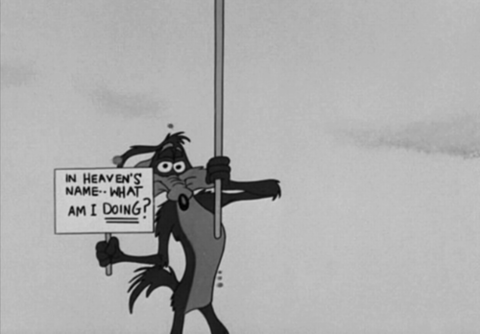
Wile E. Coyote in heaven's name what am I doingMobile First is the mantra currently dominating the design and development community, including mine. The truth is that the Mobile First is a much better guess about what I want, but it is still a guess. Assumptions about what Mobile means are increasingly cloudy. As smartphones and tablets come to dominate the device landscape, their usage is expanding beyond the simple “on the go” assumption typically associated with mobile.

People are increasingly using these devices as substitutes for the PC. Recent statistics suggest that over 80% of tablet usage occurs at home.  Another study estimates that 68% percent of smartphone usage is at home. Based on these figures, it is perhaps unsurprising that 1 out of 3 users prefer to use the full site on their mobile devices when given a choice. So it is increasingly hard to characterize mobile device usage as an “on the go” experience. To assume it is more time-constrained and transaction-oriented will become less true as these devices continue to replace PCs as the primary Internet device.

The real goal for developers should be to work towards Moment First design. The principles surrounding Adaptive Design and the Contextual Web point to the next challenge in experience design. Being in the moment requires making better use of the multiple hints we can gather about how people are engaged when they look for content. It will take into account more than the device, but also the location, time, behavior patterns and other situational clues that can gear the content to the best perceived need for that moment. Building a Moment First architecture will continue a pattern in which the technical development for content delivery becomes increasingly more complicated so that the experience itself can be simpler and more intuitive. This provides an opportunity for toolmakers and experience designers to find ways to harness that complexity in new development models.

Leave a comment

Filed under 21st Century Marketing, Innovation, Mobile

Is this the New Apple?

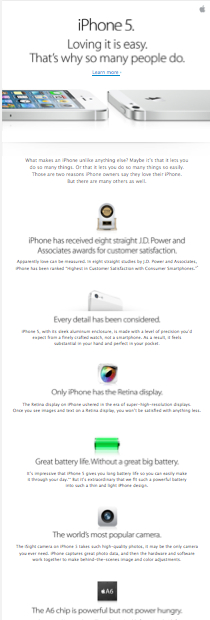
Apple eMailI recently received this promotional email from Apple for the iPhone 5. It brought to mind some of the recent chatter about Apple’s legacy and future. I’ve tended to dismiss the talk from naysayers who’ve said the Apple reign appears over. This pronouncement has been made many times over many years, and their culture, values, and willingness to take risks has consistently brought them back from the inevitable setbacks.

But this email gave me pause. Its content and tone made me think there may be a turning point afoot after all. I couldn’t recall seeing something from Apple that was working so hard to sell. Obviously, few companies have mastered the art of selling better than Apple, but the best of their work did it in a way that was less about selling and more about enticing you to buy. It wasn’t going after you as much as it was inviting you to come to them. This email has none of that flirtatious quality. It is selling and selling hard.

It lists multiple features, and the word “lists” is intentional. Feature after feature scrolls by like a spec sheet. The Apple way had been to romance a particular feature to give you a sense of what wonder lay in store for the lucky user. No such alluring Fan Dance here. Every distinguishing feature is laid out with nothing left to the imagination. Yet the most telling indicator to me is the headline – “Loving it is easy. That’s why so many people do.” I’ve never seen Apple proclaim it’s popularity. Even as it came to dominate the smartphone market, it always carried the sense of being a club for the discerning person who appreciated design and creativity. This line brings them a step closer to the car companies and other  product makers who revel in claims about “best-selling” and “most popular.” Forget the club, bring on the bandwagon. I tempered my initial reaction to this shift in tone by arguing that it may be a by-product of the email channel. Maybe they gave themselves permission to go a little bit more hardsell in a direct response oriented channel. But the iPhone website has the same line so it seems it’s the basis of a broader campaign, not just email copy. If so, this signifies a different approach than we are used to experiencing from Apple, and makes the talk of a turning point for Apple a lot more credible.

1 Comment

Filed under 21st Century Marketing, Branding, Mobile

Big Data Meets the Zombies

The field of robotics and 3D animation generated a counter-intuitive theory in the 1970’s called the Uncanny Valley. The premise was that as non-human things, like robots and cartoons,  initially  become more human in their appearance and behavior, people tended to empathize with them and enjoy interacting with them more. But as they became very close but not quite human, a creep factor comes in that actually generates a feeling of revulsion. So things that are 100% human or 60% human get a warm positive reaction, while things that are 90% human get a strongly negative reaction.

Things that fall into the Uncanny Valley include corpses, zombies, and Polar Express-like animations. Early previews of the Shrek movie actually led the makers to make the Princess Fiona character less realistic and more cartoony to avoid falling into the Uncanny Valley. The effect has been noted many times, and various theories abound as to what causes it. The most popular explanation is that it triggers our evolutionary impulse to identify unhealthy humans. Our genes don’t want to mate with or catch a contagious disease from a sick human. So when we sense something that’s really close but not quite human, it triggers an instinctual reaction to avoid it.

Big Data is about to enter an Uncanny Valley of its own. As we get better at tracking people’s behavior and interests, the potential is to create an individualized experience. We can be more relevant, responsive, and more human. But the better we get at doing that, the closer we get to the creep out factor.  An experience that falls in-between partially individualized and entirely individualized will likely generate the most negative reaction.  Ironically, this pattern would predict the complaints around data-based marketing will increase as we get better at creating more human interactions. To avoid falling into the Uncanny Valley, marketers will have to take a lesson from Dreamworks, and focus less on what the technology can do and more on how people truly experience it.

Leave a comment

Filed under 21st Century Marketing

The Four Tenets of A Digital Mindset

The Digital New Fronts showed another maturing stage in the development of online content. It demonstrated the continued blurring of the offline and online worlds. Television series and web series are increasingly utilizing the same talent, pursuing the same audience, and selling to the same advertisers. This blurring will continue as advances in addressable television, tablets, and over-the-top video make the distinction between digital and broadcast content disappear.

This represents both a victory and a conundrum for proponents of digital marketing. The victory rests in the growing importance of social, mobile, and online marketing in the plans of even the most traditional marketers. Several global brands are being built almost entirely on digital marketing strategies.  So, as far as rising to the ranks of market importance, digital has “won.”  But the conundrum is rooted in this same success for digital practitioners of every stripe.  When everything and everyone is using digital, is there any meaningful distinction left in being a digital marketer?

Digital marketers used to distinguish themselves based on their mastery of channels that most other people didn’t understand. They knew how to design websites, build rich media banners, and bid on search terms. That knowledge is both more widespread and easier to tap into than ever before.  That said, there is still something quite valuable about true digital marketing. It’s not about the toolset; it’s about the mindset. What is still lacking for many marketers and agencies is the mindset that comes from a digital way of looking at that world.  There are four core tenets underlying the digital mindset:

Everything is Connected

The digital imperative is to constantly seek new points of connection. In marketing, digital brands find new ways to connect across multiple levels.  Those connections can be made across time, people, information, and interests.  In that way, it can connect brand building with sales, existing customers with potential customers, R&D with Customer Service, etc. Where traditional marketing tends to separate into channels, digital marketing is always finding new ways to link together.

Actions Trump Impressions

Traditional marketers often measure the effectiveness of their efforts by the impressions they generate. Even experiential efforts like live events are reported in terms of how many equivalent impressions they generated. The digital mindset sees value in actions. An action is a measure of commitment, while an impression is only a measure of exposure.  If you’re looking to make a friend, interacting with someone will get far better results than being seen by someone. Similarly, if you can get someone to post something, share something, or like something then you are far more likely to sell something, either to that person or someone they know.  In that view, getting a thousand people to do something is more valuable than getting a million people to see something.

Always Optimizing

The traditional marketing cycle is like a movie release. The marketers spend months developing a new story, work behind the scenes to perfect the details, and after several months, launch it to the world in a glorious finale. If it succeeds, you make a sequel; it if fails you start over with a new one. The digital mindset embraces the beta view of software development. The launch is seen as more a beginning than an end. By gathering feedback and measuring reactions, the first release gets tweaked and upgraded.  In the digital view, a release does not have the rigidity of a final cut, but the malleability of software code.

Data is Currency

All of these elements are driven by data. To be digital, you need to be know how to harvest, process, and analyze data.  And it’s not just for performance metrics. Performance measurement is vital, but data provides much more than that. Digital marketers are excited by data because it reveals new connections, shows what people are really doing, and points the way to building deeper relationships. The digital mindset not only recognizes the awesome business potential of data, but the amazing creative potential of data as well.

Having the latest digital tools doesn’t make you a digital marketer anymore than owning a chessboard makes you a chess player.  For both qualifications, the proof is in how you play the game.

Leave a comment

Filed under 21st Century Marketing, Digital Marketing, Innovation

The Growing Reality of Always On Marketing

It’s said that the future lies clearly in the present, as long as you know where to look. If you look at the underpinnings of today’s rising brands, a pattern emerges. There is, of course, the by-now standard dictum of a shared brand experience.  The idea of talking with people instead of at them is no less true for now being common wisdom. What’s less common are brands who have taken it to the next step.  It is one thing to have a Twitter manager lobbing out pseudo-conversational tidbits such as “what’s your favorite Super Bowl snack?” It is another thing entirely to know to whom you’re talking to and being able to share something with them of real interest based on the context of that particular moment. This is at the heart of Always On marketing.  Like most marketing innovations, Always On marketing started with small niche brands finding new ways to build buzz outside traditional approaches. Now you see established brands like AMEX, JetBlue and Gatorade adopting Always On principles.

What is Always On?

At its heart, it’s a simple premise. Always On marketing is the ability to respond in real-time to an individual customer with the most relevant brand content.  If I’m in the market for a new smartphone, and I don’t know whether I want an iPhone or Android model, a carrier who serves up reviews of the two types of phone would have an advantage winning me over as a customer. If I’m away from home at my kid’s basketball tournament, and a quick-service restaurant sends me a coupon and directions to their place around the corner, they’re likely to get a sale.  While a simple idea in theory, in practice it requires a new set of capabilities.

What’s Driving It?

The drive for Always On marketing side is a combination of developments on both the producer and consumer side of the equation. In total, there are three overall developments driving the moves to Always On marketing.

1. The Death of the Funnel

The traditional sales funnel looked something like this:
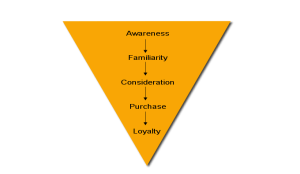
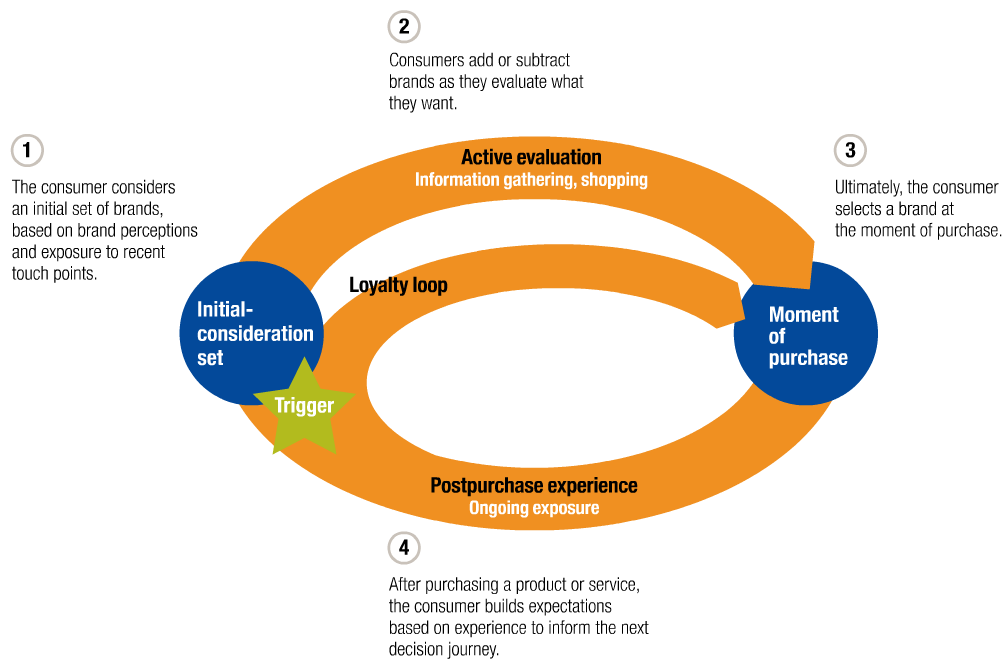
If this funnel were ever really true, it is not true now. Studies from Y&R, McKinsey Consulting and others show that the brand selection process does not involve a broad embrace of brands at the start, followed by a rational and linear winnowing down to a preferred brand. The McKinsey model suggests a path that looks more like this:
There are several significant differences between this model and the traditional funnel. Most notable are:

  • When something triggers our desire to make a purchase, we start with a narrow preconceived set of brands, not a wide view of the category
  • That initial set of brands may actually grow instead of narrow as we evaluate our choices.
  • The move from the initial trigger to the final purchase may skip a step at any point.

This revised view has important implications. For one, it emphasizes how critical it is to understand your brand’s place with a potential customer at each stage of the process. Contrary to traditional funnel thinking, a new challenger brand may have a better chance getting attention in the Active Evaluation stage than the Initial Consideration stage. For another, it encourages forging multiple paths to purchase. Each person goes through their own purchase journey, skipping over one stage to the next.  If that person is forced to confined to a predetermined path, you risk losing their interest and their business. Taken together, it requires a system that can spot when a personal trigger event happens  (e.g., visit to a car dealer, browsing an online catalog, moving to a new town) and act on it immediately. Consider that the average time from a trigger event to a purchase decision is 10-12  days for someone going on a vacation.  The time from trigger to purchase for a mobile phone is about 7 days. Always On marketers who can spot the trigger and market accordingly in that short span of time gain a huge advantage.

2. Great Expectations

Consumer expectations have changed significantly. If you can think back as long as five years ago, the idea that you would shout out a company’s name on the street and expect a personal reply would be grounds for psychiatric evaluation. But Twitter has created an expectation fairly close to that. People register complaints with no more than a company hashtag and are miffed if there is not a response.

This represents a ratcheting up in consumer expectations. People increasingly expect real-time interactions from the brands they care about.

3. Big Data

The burgeoning availability of actionable real-time data provides new opportunities to truly deliver on one-to-one marketing. The “one-to-one marketing “ label has been around for decades, but it was a way of thinking rather than an actual way of working. Traditional database marketing relies on segmentation schema that group people by common characteristics.  Segmentation is a way to break a mass group up into smaller groups, but is not truly individualized.  It creates proxies for real knowledge of the person.  For example, a battery manufacturer would create a “gadget lovers” segment based on demographic and survey data, and design marketing programs targeted in various degrees of specificity to that group. That approach is several times more effective that simple mass marketing. Yet their effectiveness would be even several factors higher than that if they knew nothing about a person’s demographic and survey responses, but did know how many times an individual had purchased batteries in the past six months, what devices they owned, the last time they bought a batteries, and where they were shopping for electronics right now.  In that way, Big Data renders group segmentation obsolete. Always On marketing operates on a segment-of one-philosophy.

What Does Always it Require?

An Always On marketing platform require four major components.

1. A Powerful Marketing Engine

The most critical component of Always On marketing is the ability to gather, process, and act on large amounts of data. Big Data generates a continuous fire hose of data that cannot be meaningfully processed by traditional analytic methods. A Marketing Engine is a collection of tools, partners, and processes that enable a brand to:

  • Combine multiple data sources to construct an actionable profile of each individual they encounter.
  • Apply business rules that allow real-time matches between individuals and brand content
  • Track responses of individuals to brand contacts and pursue different paths with that individual based on the nature of that response
  • Monitor performance across channels in a way that allows for constant optimization

2. Deep Reservoir of Brand Content

Even with the most powerful Marketing Engine in place, it is not effective if the interactions with people aren’t compelling and relevant. That’s why brands need to build and update sources of content that can be at the ready. That content can be constructed dynamically (e.g. customized offers),  pre-produced (e.g. how-to videos), or human (e.g. a customer service representative).  As brands embrace an Always On approach, the content needs will become apparent as their interactions grow and patterns emerge.

3. A Clear Brand Story

One thing that hasn’t changed about effective marketing is the importance of having a compelling brand story.  This is what establishes the fundamental human attraction to brands. In fact, it is even more critical in an Always On environment. That’s because the brand story has to be told in so many more ways that it used to be. As a result, more people are involved in telling the brand story than ever before. Community managers, customer service agents, other employees and brand fans join brand managers as promoters of the brand. They need a clear story that can guide their efforts in concert without centralized control.  While it may seem put of place in a discussion about Marketing Engines and Big Data, the core truth is that storytelling is more essential than ever. Now,  it not only has to inspire the people who hear it, but also inspire the people who tell it.

4. A Different Mindset

All of the above components are critical to deliver Always On marketing. Yet, they won’t work without an accompanying shift in mindset. Many marketing organizations are built to deliver tightly structured campaigns that require extensive time for deliberation, review and testing behind the scenes before each launch. Always On requires a “constant beta” approach where the testing and enhancements are being made in market.  While it is no less rigorous strategically, it embraces a quicker and less predictable cadence. More effort has to be into crafting playbooks and operating principles, and less into approvals of individual executions. In this way, marketing organizations may come to look more like the best customer service organizations, both highly disciplined and highly flexible.

Leave a comment

Filed under 21st Century Marketing, Activation, Innovation

Facebook: Rebel Becomes the Empire

Facebook recently hosted a very well run Studio Live event in town. The goal was to provide marketers with new ways of using Facebook to benefit brands and their fans.  It achieved that goal, but inadvertently revealed the choppy waters that churn when the currents of innovation and self-interest conflict.

Here’s what happened. As part of the day, Facebook sponsored a “Hack Session.” The idea was to think innovatively and provocatively around a real case study. Prior to the case, we heard inspired talks about the hack culture that drives the Facebook development team. We were encouraged to adopt the pirate mentality, think outside the box, break the rules, and act boldly.  Different stories were shared reinforcing the moral that too many marketers were still stuck in the old way of doing things. We all urgently needed to embrace the hack culture to succeed in the modern marketplace.

We then broke out into small groups for the Hack Session. Our mission was to take the lessons they’d shared to build awareness and support for Feeding America. To take advantage of the competitive nature of the attendees, it was set up as a contest between the groups. The winning team would have their ideas implemented and other tokens of glory bestowed upon them. Inspired by the competition and such a worthy cause, our group eagerly jumped in. The overriding challenge was to get support for a cause amidst the clamor of many other worthy causes. We quickly came up with several ideas, but one big idea revved us up the most. It started by building a Hunger page with local stories about people we could all relate to who are facing the challenge of where their families’ next meal is coming from.  But why would anyone notice or care? Because we were going to tap into one of the hottest memes around Facebook. We were going to give their page the first Dislike button. People would be able to come in and “dislike” hunger, and by doing so, generate a contribution to Feeding America.

We were fired up and on fire, spinning out PR, social, and promotional ideas in a happy frenzy. The Facebook people assigned to our group joined in enthusiastically – for a while. Then we got word from their organizers. Our idea would not be seriously considered for the competition.

Us: Why?

Them:  Because the Dislike button isn’t “feasible.”

Us: You mean it isn’t technically feasible?

Them: No, it just isn’t feasible that Facebook would allow it.

It wasn’t feasible even temporarily, even for a single page, even for a great cause.  It was clear that even the self-declared disciples of the hack culture have their limits. It is a persistent lesson in human nature, even amidst the ceaseless revolution that has defined the digital era.  It’s always easier to break the rules when they’re someone else’s.

1 Comment

Filed under 21st Century Marketing, Innovation

What Comes After Facebook?

The ancient Roman Cicero said that “to be ignorant of the past is to forever be a child.” This seems an apt reminder for times when even recent history is ignored. As the Facebook retreat on Places and Daily Deals shows, it’s not the unstoppable juggernaut many believe it is. It is true that Facebook reaches more people than almost any other vehicle in the world. As such, marketers would be foolish to ignore it. At the same time, those with a long-term view would be foolish to assume it will continue to dominate the digital landscape.

The certainty of that statement doesn’t come from any brilliant strategic analysis, but only from history. In the past 15 years, there has been a steady historical record of supposedly dominant players overcome by the unceasing pace of change. Starting with Netscape, and continuing through Yahoo, AOL, and MySpace, the pattern repeats itself.  A new player establishes itself as the hot thing, rises to take over the dominant position in its category, and investors and pundits alike point to its widespread adoption as an insurmountable barrier to competition. Until it isn’t.

So what will replace Facebook and when? No one can know. But given the trends, you can make a good guess about where it might come from. The rise of the web has been an exercise in disintermediation, or in non B-school terms, the elimination of the middle man. Google has done that with content. It used to be that content and distribution were linked. If you wanted to find content (TV show, magazine article, etc), you had to go the content provider (CBS, Esquire, etc). Google let you find the content without going through the provider. They effectively decoupled content and distribution. YouTube, Hulu, and others have extended that separation. I can consume content without ever visiting the its source.

Right now Facebook links three things: distribution network, content creation and content consumption.  In other words, I have to use Facebook if I want to manage my list of friends, if I want to share something with them, or if I want them to share something with me. This combination makes it the hub of social activity. It makes it the second most visited site in the world.  That traffic provides its cultural currency and its commercial reason for being. Yet you can already see the potential for disintermediation. Social network consoles show a future where content creation and consumption are separated from the distribution network. Yonoo, Digsby and others let users bring content from several source into a single dashboard. It points to a future where I never have to be on Facebook in order to use Facebook’s distribution infrastructure. The same way that content sites get demoted to just something Google can scrape, social networking sites could become just feeds for the consoles. And if it does not already exist, it is not hard to imagine an app that manages your LinkedIn connections, Facebook friends, and Twitter followers in a single database that doesn’t require you to directly use their respective tools. If I can manage my content and manage my network without ever visiting Facebook, it becomes a conduit instead of a destination.

That may not be the way it plays out. But history says the digital barbarians are due to bring down the Facebook empire.

Leave a comment

Filed under 21st Century Marketing, Innovation

Paid-Owned-Earned is Not-Quite-Right

Like straw fedora hats, there are some trends you like that you know won’t last. Paid Owned and Earned is the fedora hat of marketing and media circles right now. It is stylish and current, and probably destined to last only a few seasons. It’s served a useful purpose in getting people beyond the old media labels that defined channels by their mode of delivery — television, print, online, OOH, etc. But it falls short of its own intent, which is to define media by how it connects with people rather than by what it looks like.

Paid Owned and Earned uses a financial nomenclature to separate media. As such, it represents the view of the producer not the consumer. Paid Owned and Earned may mean something to the company paying the bill. But does a person really care how a message was funded? Do people react differently to a message knowing that it is “owned” rather than “paid?” Of course not. These terms also lead to odd categorizations. Is a Facebook page owned or paid? A company doesn’t have to pay for a Facebook page, and they control the content, but they don’t own it either.

When I hear the savviest media people I know talk about Paid Owned and Earned, they are really using those words to mean something else. They are trying to describe the nature of how the marketing meets the consumer.

Here’s a more useful way to think about Paid Owned and Earned. First of all, we should start with idea that all marketing is some form of content. The content can be an app, a webpage, a 30-second TV spot, or a shelf talker.  If you think about all marketing as content, then you can think of media as the way that the content connects to the right person. In this model, there are three types of media:

1) Brand-t0-Person

The brand seeks out a person (or type of person) and puts the content in front of them. Ideally, it is content that the person welcomes, but they weren’t intending to find it. They went to ESPN, Huffington Post, or drove down the highway and the content came to them.

2) Person-to-Brand

The person seeks out the brand for the content they provide. They intentionally went to find it. They visited a website, downloaded an app, or searched for it. They found the  content instead of the content finding them.

3) Person-to-Person

 A person shares the content with another person. The brand is not directly involved in the exchange of content.

These categories are a more consumer-centered way of connecting with media. They are also more useful in understanding the role your media is playing in the marketplace.  It helps you think more clearly about how to allocate your media, construct a media plan, and measure its effectiveness. The only problem is that the labels aren’t as pithy as Paid Owned and Earned. How about some suggestions?

4 Comments

Filed under 21st Century Marketing, Activation, Innovation

Digital Marketing is Dead – Long Live Digital Marketing

The marketing services community is undergoing yet another spin as the world’s cultural and functional landscape grows ever more digital.  On one side, so-called traditional agencies continue striving to prove that they get digital with all the subtlety of an American Idol audition. On the other side, digital agencies are equally eager to show they can take center stage after years of playing support roles. Both sides fear irrelevance as the “digital” label becomes as redundant to marketing as the word “hard” is to “rock.” When almost every communication medium is technically being created or transmitted digitally, what does it mean to be digital?

You can see the challenge of this realization in how larger agencies are repositioning themselves and their digital arms. Large legacy agencies that excitedly established separate digital arms 8-10 years ago, like Tribal DDB or G2, are now figuring out how to reel them back in. What was seen as innovative then is now seen as damning evidence that your mother company doesn’t understand the digital space. Digital agencies are dealing with different ramifications of the same issue. If all marketing is becoming digital, and some agencies like Weiden and Goodby show themselves to be as creative in the digital arena as they were in  broadcast, are digital agencies starting to look too specialized to drive big brand ideas?

For marketers trying to sort this all out, it’s best to avoid the labels of traditional and digital. They may have been helpful for understanding what these places did in the past, but they are not helpful for what they can do for a brand now. The world may be going digital, but that does not mean that digital agencies are the best choice for marketers going forward. Too many digital agencies got that title because of their expertise with a particular toolset – websites, mobile apps or social community management. The current rise of digital goes beyond the toolset. It is the influence on our culture and expectations where digital is now having the most impact. People who’ve never redeemed a GroupOn or tweeted a word are thinking and behaving differently because of the impact the digital world is having on everything we do. In that sense, being digital is no longer about a toolset, it is about a mindset.

Marketers looking for a partner who can help then succeed in the modern marketplace want an agency with a digital mindset regardless of their historical toolset. In a marketing sense, a digital mindset means:

Invitations vs. Performances

When you think of your potential customers in terms of an audience, you think in terms of performing for them. It’s your show, and they are there to enjoy it.  You’re looking for feedback, but only of a limited kind — applause, cheers, laughter, boos.  If you think of  your customers as participants in your brand, you think in terms of inviting them to join with what you’re doing. Sometimes you’ll both be in the audience together, sharing common interests. Sometimes you’ll both be on stage, sharing new product ideas. In these and every situation in between, an invitation-mentality reflects the digital sensibility of marketing with people instead of to them.

2.1 vs. Ta Da

A traditional mindset sees success as an event, whereas a digital mindset sees it more as a process. The traditional campaign mentality treats each new effort as one-time attempt to get it right. You work on pulling work together for six months or so, then unveil it to the world like a movie or a book launch. The digital mentality sees a world that is more iterative. In the digital experience, you don’t expect to get everything right in your first version. You build it as best you can, and you expect to have to issue new versions to address issues or opportunities you did not foresee, or that may not have been there when you started.  No success is expected to continue without continual refinement and improvement. A traditional mindset tends to see the world in discrete episodes. A digital mindset sees the world more as real-time stream.

Speed Skating vs Figure Skating

Figure skating and speed skating both involve competitions on ice, but success takes different paths. In figure skating, you are the best in the world to the extent that you can convince an influential panel of judges that you are the best. In many ways, it is equivalent to how agencies used to get ranked. If you won a lot of awards from judges who thought you were good, that meant you were good. In speed skating, you are the best if you go faster than anybody else. Digital agencies love measuring. They’re hungry to prove what’s working. They don’t only use data at the end to build the case study, they use it in the beginning to shape the work. Marketing will always constitute some measure of both art and science, but digital agencies look for inspiration from them both.

Architects vs. Authors

If  I ask  who wrote “The Great Gatsby,” many could tell me it was F. Scott Fitzgerald. If I ask  who built the Empire State Building, the answer is both less well-known and less clear. An author takes satisfaction in literally crafting every word of their work. Owning the idea in the literary world means owning both the overarching concept and each detail of its execution. You rarely see books credited to more than one author. The traditional mindset has a similar instinct around enshrining the auteur. Architects, on the other hand,  know that their craft requires collaboration across many fields. They put forward the vision, but recognize the critical need for fellow engineers, builders, interior designers, and a host of others to make the idea come to life. The architect parallels the digital mindset that naturally looks to partnership as the operative model.

Digital marketing is entering a new phase where is less about mastering the technology and more about mastering the cultural dynamic. The tools will constantly be changing, so the toolset becomes less relevant. The digital mindset is what will drive marketing into the next phase.

Leave a comment

Filed under 21st Century Marketing, Innovation, Uncategorized

The Blessing of an Elusive Attention Span

Virginia Heffernan wrote a terrific piece in the NYT Sunday Magazine in late November 2010. Entitled “The Attention Span Myth,” she questioned the idea that the human attention span is in danger of eroding against the onslaught of technology and media. She spent a good part of the article arguing against enshrining  a long attention span as a morally and intellectually superior quality. But I found this particular paragraph the most powerful:

Whether the Web is making us smarter or dumber, isn’t there something just unconvincing about the idea that an occult “span” in the brain makes certain cultural objects more compelling than others? So a kid loves the drums but can hardly get through a chapter of the “The Sun Also Rises”; and another aces algebra but can’t even understand how Call of Duty is played. The actions of these children may dismay or please adults, but anyone who has ever been bored by one practice and absorbed by another can explain the kids’ choices more persuasively than does the dominant model, which ignores the content of activities in favor of a wonky span thought vaguely to be in the brain.

This insightful point puts the constant barrage of statistics on texting, video, and cross-media consumption into a very different light.  The point is that the cause and effect are essentially backwards. The always-on twitter-sized mediaverse is not creating our restless attention spans. Rather, our restless attention spans are creating the mediaverse. The reason that kids are texting their friends in history class isn’t because they are so different from the kids of 50 years ago, it is because they can. Quite simply, there were fewer options to being bored a generation ago. Back then, you could doodle, pass notes, or daydream. But if The Beaver and Cindy Brady could have gossiped with their friends instead of listening to a lecture on the Magna Carta, you can bet they would’ve done it. If good ol’ Dad in the worn leather chair could have checked out the sports scores when Ed Sullivan rolled out the trained dog act, you can bet he would’ve done it too.

In marketing circles, there are many who decry the media clutter as the enemy of effective communications. They protest that those fragile attention spans are making their jobs harder. With a bewildering number of choices at people’s disposal involving not only what types of media they consume, but when and how they consume it, it’s harder than ever to put across a marketing message. It was so much easier when people just stayed glued to their television sets. For this very reason, good marketers ought to be rejoicing. You used to be able to get away with being boring and expected as long as you had a big media budget. Now, the game is changing from who can command the airwaves to who can command attention. The winners will be those who can be the most interesting, entertaining, and engaging. That is a great thing for marketers. The harder it is for a company to connect with its current and potential customers, the more valuable those who can do it well become. Advertising people who used to complain about having to crank out formulaic commercials can revel in the challenge of making something that people will actually enjoy. I can’t speak for all my colleagues, but if smarts and creativity are increasingly the best ways to win, I can’t wait to play.

1 Comment

Filed under 21st Century Marketing, Activation, Innovation