Category Archives: Activation

The Growing Reality of Always On Marketing

It’s said that the future lies clearly in the present, as long as you know where to look. If you look at the underpinnings of today’s rising brands, a pattern emerges. There is, of course, the by-now standard dictum of a shared brand experience.  The idea of talking with people instead of at them is no less true for now being common wisdom. What’s less common are brands who have taken it to the next step.  It is one thing to have a Twitter manager lobbing out pseudo-conversational tidbits such as “what’s your favorite Super Bowl snack?” It is another thing entirely to know to whom you’re talking to and being able to share something with them of real interest based on the context of that particular moment. This is at the heart of Always On marketing.  Like most marketing innovations, Always On marketing started with small niche brands finding new ways to build buzz outside traditional approaches. Now you see established brands like AMEX, JetBlue and Gatorade adopting Always On principles.

What is Always On?

At its heart, it’s a simple premise. Always On marketing is the ability to respond in real-time to an individual customer with the most relevant brand content.  If I’m in the market for a new smartphone, and I don’t know whether I want an iPhone or Android model, a carrier who serves up reviews of the two types of phone would have an advantage winning me over as a customer. If I’m away from home at my kid’s basketball tournament, and a quick-service restaurant sends me a coupon and directions to their place around the corner, they’re likely to get a sale.  While a simple idea in theory, in practice it requires a new set of capabilities.

What’s Driving It?

The drive for Always On marketing side is a combination of developments on both the producer and consumer side of the equation. In total, there are three overall developments driving the moves to Always On marketing.

1. The Death of the Funnel

The traditional sales funnel looked something like this:

If this funnel were ever really true, it is not true now. Studies from Y&R, McKinsey Consulting and others show that the brand selection process does not involve a broad embrace of brands at the start, followed by a rational and linear winnowing down to a preferred brand. The McKinsey model suggests a path that looks more like this:
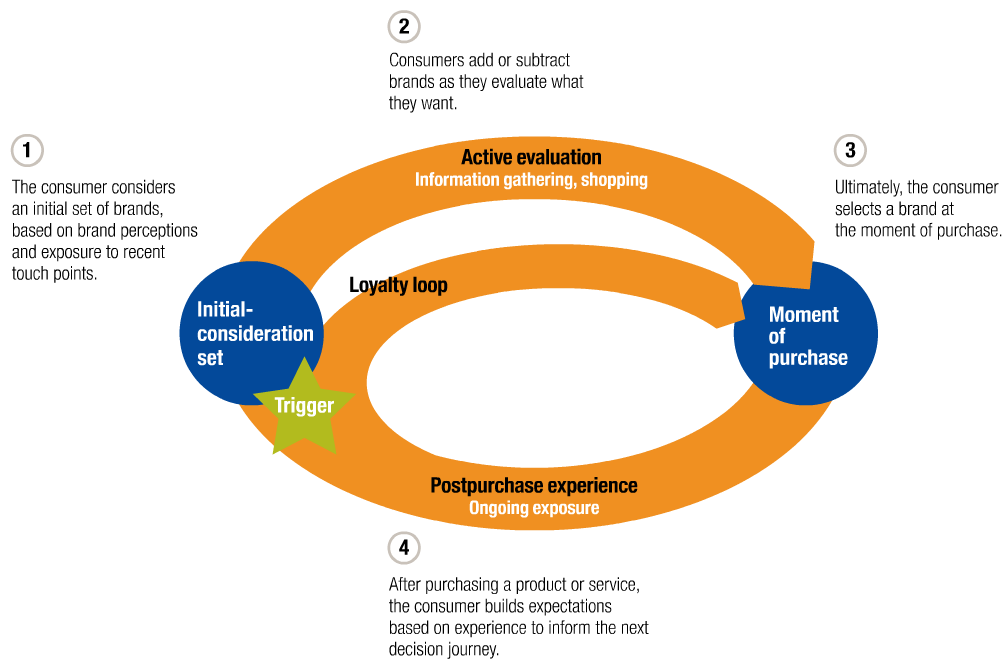
There are several significant differences between this model and the traditional funnel. Most notable are:

  • When something triggers our desire to make a purchase, we start with a narrow preconceived set of brands, not a wide view of the category
  • That initial set of brands may actually grow instead of narrow as we evaluate our choices.
  • The move from the initial trigger to the final purchase may skip a step at any point.

This revised view has important implications. For one, it emphasizes how critical it is to understand your brand’s place with a potential customer at each stage of the process. Contrary to traditional funnel thinking, a new challenger brand may have a better chance getting attention in the Active Evaluation stage than the Initial Consideration stage. For another, it encourages forging multiple paths to purchase. Each person goes through their own purchase journey, skipping over one stage to the next.  If that person is forced to confined to a predetermined path, you risk losing their interest and their business. Taken together, it requires a system that can spot when a personal trigger event happens  (e.g., visit to a car dealer, browsing an online catalog, moving to a new town) and act on it immediately. Consider that the average time from a trigger event to a purchase decision is 10-12  days for someone going on a vacation.  The time from trigger to purchase for a mobile phone is about 7 days. Always On marketers who can spot the trigger and market accordingly in that short span of time gain a huge advantage.

2. Great Expectations

Consumer expectations have changed significantly. If you can think back as long as five years ago, the idea that you would shout out a company’s name on the street and expect a personal reply would be grounds for psychiatric evaluation. But Twitter has created an expectation fairly close to that. People register complaints with no more than a company hashtag and are miffed if there is not a response.

This represents a ratcheting up in consumer expectations. People increasingly expect real-time interactions from the brands they care about.

3. Big Data

The burgeoning availability of actionable real-time data provides new opportunities to truly deliver on one-to-one marketing. The “one-to-one marketing “ label has been around for decades, but it was a way of thinking rather than an actual way of working. Traditional database marketing relies on segmentation schema that group people by common characteristics.  Segmentation is a way to break a mass group up into smaller groups, but is not truly individualized.  It creates proxies for real knowledge of the person.  For example, a battery manufacturer would create a “gadget lovers” segment based on demographic and survey data, and design marketing programs targeted in various degrees of specificity to that group. That approach is several times more effective that simple mass marketing. Yet their effectiveness would be even several factors higher than that if they knew nothing about a person’s demographic and survey responses, but did know how many times an individual had purchased batteries in the past six months, what devices they owned, the last time they bought a batteries, and where they were shopping for electronics right now.  In that way, Big Data renders group segmentation obsolete. Always On marketing operates on a segment-of one-philosophy.

What Does Always it Require?

An Always On marketing platform require four major components.

1. A Powerful Marketing Engine

The most critical component of Always On marketing is the ability to gather, process, and act on large amounts of data. Big Data generates a continuous fire hose of data that cannot be meaningfully processed by traditional analytic methods. A Marketing Engine is a collection of tools, partners, and processes that enable a brand to:

  • Combine multiple data sources to construct an actionable profile of each individual they encounter.
  • Apply business rules that allow real-time matches between individuals and brand content
  • Track responses of individuals to brand contacts and pursue different paths with that individual based on the nature of that response
  • Monitor performance across channels in a way that allows for constant optimization

2. Deep Reservoir of Brand Content

Even with the most powerful Marketing Engine in place, it is not effective if the interactions with people aren’t compelling and relevant. That’s why brands need to build and update sources of content that can be at the ready. That content can be constructed dynamically (e.g. customized offers),  pre-produced (e.g. how-to videos), or human (e.g. a customer service representative).  As brands embrace an Always On approach, the content needs will become apparent as their interactions grow and patterns emerge.

3. A Clear Brand Story

One thing that hasn’t changed about effective marketing is the importance of having a compelling brand story.  This is what establishes the fundamental human attraction to brands. In fact, it is even more critical in an Always On environment. That’s because the brand story has to be told in so many more ways that it used to be. As a result, more people are involved in telling the brand story than ever before. Community managers, customer service agents, other employees and brand fans join brand managers as promoters of the brand. They need a clear story that can guide their efforts in concert without centralized control.  While it may seem put of place in a discussion about Marketing Engines and Big Data, the core truth is that storytelling is more essential than ever. Now,  it not only has to inspire the people who hear it, but also inspire the people who tell it.

4. A Different Mindset

All of the above components are critical to deliver Always On marketing. Yet, they won’t work without an accompanying shift in mindset. Many marketing organizations are built to deliver tightly structured campaigns that require extensive time for deliberation, review and testing behind the scenes before each launch. Always On requires a “constant beta” approach where the testing and enhancements are being made in market.  While it is no less rigorous strategically, it embraces a quicker and less predictable cadence. More effort has to be into crafting playbooks and operating principles, and less into approvals of individual executions. In this way, marketing organizations may come to look more like the best customer service organizations, both highly disciplined and highly flexible.


Leave a comment

Filed under 21st Century Marketing, Activation, Innovation

Paid-Owned-Earned is Not-Quite-Right

Like straw fedora hats, there are some trends you like that you know won’t last. Paid Owned and Earned is the fedora hat of marketing and media circles right now. It is stylish and current, and probably destined to last only a few seasons. It’s served a useful purpose in getting people beyond the old media labels that defined channels by their mode of delivery — television, print, online, OOH, etc. But it falls short of its own intent, which is to define media by how it connects with people rather than by what it looks like.

Paid Owned and Earned uses a financial nomenclature to separate media. As such, it represents the view of the producer not the consumer. Paid Owned and Earned may mean something to the company paying the bill. But does a person really care how a message was funded? Do people react differently to a message knowing that it is “owned” rather than “paid?” Of course not. These terms also lead to odd categorizations. Is a Facebook page owned or paid? A company doesn’t have to pay for a Facebook page, and they control the content, but they don’t own it either.

When I hear the savviest media people I know talk about Paid Owned and Earned, they are really using those words to mean something else. They are trying to describe the nature of how the marketing meets the consumer.

Here’s a more useful way to think about Paid Owned and Earned. First of all, we should start with idea that all marketing is some form of content. The content can be an app, a webpage, a 30-second TV spot, or a shelf talker.  If you think about all marketing as content, then you can think of media as the way that the content connects to the right person. In this model, there are three types of media:

1) Brand-t0-Person

The brand seeks out a person (or type of person) and puts the content in front of them. Ideally, it is content that the person welcomes, but they weren’t intending to find it. They went to ESPN, Huffington Post, or drove down the highway and the content came to them.

2) Person-to-Brand

The person seeks out the brand for the content they provide. They intentionally went to find it. They visited a website, downloaded an app, or searched for it. They found the  content instead of the content finding them.

3) Person-to-Person

 A person shares the content with another person. The brand is not directly involved in the exchange of content.

These categories are a more consumer-centered way of connecting with media. They are also more useful in understanding the role your media is playing in the marketplace.  It helps you think more clearly about how to allocate your media, construct a media plan, and measure its effectiveness. The only problem is that the labels aren’t as pithy as Paid Owned and Earned. How about some suggestions?

4 Comments

Filed under 21st Century Marketing, Activation, Innovation

The Blessing of an Elusive Attention Span

Virginia Heffernan wrote a terrific piece in the NYT Sunday Magazine in late November 2010. Entitled “The Attention Span Myth,” she questioned the idea that the human attention span is in danger of eroding against the onslaught of technology and media. She spent a good part of the article arguing against enshrining  a long attention span as a morally and intellectually superior quality. But I found this particular paragraph the most powerful:

Whether the Web is making us smarter or dumber, isn’t there something just unconvincing about the idea that an occult “span” in the brain makes certain cultural objects more compelling than others? So a kid loves the drums but can hardly get through a chapter of the “The Sun Also Rises”; and another aces algebra but can’t even understand how Call of Duty is played. The actions of these children may dismay or please adults, but anyone who has ever been bored by one practice and absorbed by another can explain the kids’ choices more persuasively than does the dominant model, which ignores the content of activities in favor of a wonky span thought vaguely to be in the brain.

This insightful point puts the constant barrage of statistics on texting, video, and cross-media consumption into a very different light.  The point is that the cause and effect are essentially backwards. The always-on twitter-sized mediaverse is not creating our restless attention spans. Rather, our restless attention spans are creating the mediaverse. The reason that kids are texting their friends in history class isn’t because they are so different from the kids of 50 years ago, it is because they can. Quite simply, there were fewer options to being bored a generation ago. Back then, you could doodle, pass notes, or daydream. But if The Beaver and Cindy Brady could have gossiped with their friends instead of listening to a lecture on the Magna Carta, you can bet they would’ve done it. If good ol’ Dad in the worn leather chair could have checked out the sports scores when Ed Sullivan rolled out the trained dog act, you can bet he would’ve done it too.

In marketing circles, there are many who decry the media clutter as the enemy of effective communications. They protest that those fragile attention spans are making their jobs harder. With a bewildering number of choices at people’s disposal involving not only what types of media they consume, but when and how they consume it, it’s harder than ever to put across a marketing message. It was so much easier when people just stayed glued to their television sets. For this very reason, good marketers ought to be rejoicing. You used to be able to get away with being boring and expected as long as you had a big media budget. Now, the game is changing from who can command the airwaves to who can command attention. The winners will be those who can be the most interesting, entertaining, and engaging. That is a great thing for marketers. The harder it is for a company to connect with its current and potential customers, the more valuable those who can do it well become. Advertising people who used to complain about having to crank out formulaic commercials can revel in the challenge of making something that people will actually enjoy. I can’t speak for all my colleagues, but if smarts and creativity are increasingly the best ways to win, I can’t wait to play.

1 Comment

Filed under 21st Century Marketing, Activation, Innovation

Planning is Everything. Plans are Nothing.

The title above is from a quote usually ascribed to Dwight Eisenhower.  Though he was referring to battle plans, it is an apt lesson for business plans as well. His point was that the battle never goes as planned. Weather conditions, enemy reactions and human mistakes conspire to ensure that every military action usually goes off plan before the first shot is fired.  But if the planning process is done with the proper rigor, leaders can react more effectively to unexpected developments. They can assess how changes impact their overall strategy, and better judge the consequences of their subsequent decisions.

I recalled this quote after seeing an interesting discussion on LinkedIn debating the value of business plans for new companies.  Some potential entrepreneurs were dismissing the value of business plans for start-ups because they rarely had any relevance to the business once they hit the  realities of actually going to market. General Eisenhower reminds us how this argument misses the point. The value of a business or marketing plan is not in the plan itself, but in forcing you to think in a rigorous way about how best to deploy your resources. Who is your target? What’s your value to them? Who’s your competition? What kind of human and financial resources will you need to make a go of it? Of course, unless you are the first true psychic, most of what you come up with will be wrong.  The details of the plan may be mere historical artifacts within months of launch. But if you planned well, you are better able to identify and react to what you were wrong about.

The same lesson was delivered in another context by an accomplished climber I once heard speak. He described the meticulous planning process that his team followed before a major climb. They literally mapped out every step. He went on to say that they almost never followed the predetermined path once the actual climbing began, but it was the planning that allowed them to make intelligent choices under stress about what they could afford to change.

Whether you are crafting a business plan for a new company or a marketing plan for an established brand, there are three important lessons in this.  One is that a plan is worth what you put into it.  If you just go through the motions in order to be able to point to an official-looking plan, it will be of no value. Second, you shouldn’t dismiss the planning process just because the plans themselves are rarely executed.  A well-constructed plan will make you a smarter leader and manager for the unexpected turns that inevitably come your way. The final related lesson is that you should not treat the plan as anything but your best current guess. If the plan isn’t working, don’t be afraid to change it. Too many marketing managers disregard new information and new opportunities because it’s “not in the plan.” A plan is not a substitute for thinking. Plans should be treated more like boyfriends than husbands. You should always be open to a better one.

Leave a comment

Filed under Activation, Business Management, Market Strategy

I Hate Focus Groups and You Should Too

Focus groups are the most  abused form of research in marketing.

I would go so far as to say that more harm than good has been done with focus groups. Because they are relatively easy to set-up and conduct, people overlook their inherent limitations in order to get comfort from having done some form of research before making a risky decision. It allows people to check the box next to research. But in many cases, it would have been better to do no research at all than to have only done focus groups. Here are several of the factors that make focus groups a less than ideal research tool:

Selection Bias: Most research is built on the assumption that you are tapping into a random sample of your desired target market.  Focus groups tend to have a persistent selection bias that negates that assumption.  In our time-starved society, few people are willing to go out of their way and give 2-3 hours of their time to discuss something they don’t care that much about for $50. Those that do tend to either have time on their hands, are eager to share an opinion, or really want the money. In some cases, that may be fine. In most cases, it introduces a type of person whose motivations are different from the target audience you want to understand.

Sample Size: The biggest abuse of focus groups is treating them like a quantitative study. Too often, someone will  conduct a series of focus groups, and form a conclusion about an idea based on the percentage of people who liked it. From a statistical perspective, this is unfounded. Five rounds of focus groups will involve about 20-25 people. Even if you assume a random sample of people, at this number the relative reliability of the results could be in the area of +/- 30%. So if 2/3rds of the people you talk to in focus groups give it a positive rating, it is equally likely that 2/3rds of your overall target actually dislikes the idea.

Rational Bias: Another well-known bias with focus groups is our desire to look smart.  Said another way, we tend to make up rational reasons for why we like or don’t like things, even when we don’t have any.  So when you sit people down in a room, walk them through an idea, and then ask them to comment, you are likely to get an artificial response. People don’t like to admit that they like or dislike things based on what may seem frivolous reasons to others. They won’t admit to wanting to look cool or be popular, even though we know that drives a lot of human behavior. So the answers you tend to get in focus groups downplay the emotional human elements that are central to our motivations.

Environmental Factors: There are a host of environmental factors around focus groups that color what you get out of them.  For one, you are often exposing them to an idea outside of its context or in a less tangible form.  For example, asking people if they think they’d notice a new package design after you’ve forced them to look at a picture of a package is not likely to get you a reaction anything close to glancing past a three-dimensional package in the middle of a supermarket aisle.

Group Dynamics:   Most of us like to get along with others, so there is a hesitancy to disagree openly with another person in the group. Some people tend to be more comfortable talking than others. When you combine those factors together, you tend to get people who unintentionally dominate a group. More extroverted people comment first, and that sets a bench line for other people’s response. Good moderators can help draw out people, but they are fighting a basic human characteristic. So group reactions tend to move toward consensus rather than diversity.

Lack of a Hypothesis: Good research should have some ingoing hypothesis that you are trying to prove or disprove.  For example, the hypothesis may be as simple as “current users prefer this new package design to the old one.” The format and questions in the research are then built around getting a solid read on that hypothesis.  All too often in focus groups, this discipline falls by the wayside. People will just want to do some focus groups to get a general reaction to an idea. Without a hypothesis, people just look at the collection of comments and try to discern possible patterns in them after that fact. The problem with this is that focus groups always generate a number of positive and negative comments. So you can construct any number of theories to explain what may be a random pattern of responses.

So when is it a good idea to use focus groups? For the reasons cited above, they are not good at projecting how meaningful or universal a particular reaction might be.  There are two situations when they are useful.  One is as a starting point. If you are early in your learning process,  and don’t even know what issues may be relevant, focus groups can help you get an initial lay of the land.  The other situation is when you want to better understand the reasons behind a specific reaction.  Suppose your team is working on a new interface design for a website. It’s a radical new design that you’re concerned might confuse novice users. A focus group would not necessarily give you an accurate sense of how many people found your interface confusing. But it could help you better understand what was causing the confusion for those users who were confused by it. In other words, if focus groups are not a reliable tool for finding the answer, they can be useful for understanding the reasons behind it.

Leave a comment

Filed under Activation, Innovation

Ten Things Your Agency Doesn’t Want You to Know: #4

You have the wrong people in your agency meetings.

It is a truth of life that people often make the mistake of assuming that just because they consume a lot of something, they are expert at how to make it. People who drink a lot of fine wine will talk about terroir and tasting notes even if their palettes couldn’t distinguish between Merlot and pine tar. The same can be said about movies, driving and advertising. People have been surrounded by advertising all their lives, so they naturally and erroneously assume they know a lot about it. The result is that there’s an implicit and harmful assumption that everyone’s opinion is valid. The CFO weighs in, the summer intern gets a vote, and various other unqualified personnel are encouraged to participate in the evaluation of the work “as part of their development.” It’s hard to believe that a company would let a first-year finance associate tweak the firm’s capital structure, or the HR director play with the supply chain, yet often have no qualms doing the equivalent thing to their marketing. If you want your marketing programs to be better, than have your most qualified marketers work on them. You should demand the same level of expertise and experience in your marketing decisions as you do in your other business decisions.

Leave a comment

Filed under Activation, Business Management, Innovation

Getting It: Charmin vs. Cottonelle

One of the biggest mistakes that marketers make when attempting to use social media is focusing on the channel first. Many of them have been trained that success comes from tapping into what’s hot whether that be celebrities, television shows,  or urban slang.  So they go into social media by trying to figure out  the hot place to be.  First they went rushing into Second Life, then MySpace, then Facebook, and now iPhone apps.

That mentality misses the point of social media: it is not to intercept people on their way to what interests them,  it is to engage people so you are what interests them.  The first task is not to assess the popularity of something unrelated to who you are, it’s about finding something rooted in who you are as a brand that other people find interesting. And that’s where the real challenge lies.  Before you pick any social media channel, you need to figure out what makes you interesting to somebody. Sure, it’s easy to figure out why people would want to talk to you if you’re Nike, BMW, or Maxim. Who doesn’t want to talk about sports, cars or sex?

It’s a little harder when you’re a less naturally conversational product.  Even if it’s something people use a lot of, it doesn’t mean they want to have a conversation about it.  If you make socks, table salt or toilet paper, is there anything that could make a normal person seek you out?

It turns out there is, if you are smart about it. For proof, consider what Procter & Gamble has done with their Charmin toilet paper. By owning public restrooms, they found a reason for people to talk about them and with them.  In 2002, the brand team started Potty Palooza, a portable set-up of high-end public toilets that traveled around the country to concerts, festivals, and other events.  It became an attraction in its own right, and the subject of considerable buzz. They built on that momentum with the installation of luxurious public restrooms in key venues like Times Square. Most recently  they extended their idea into the sponsorship of a mobile app, SitorSquat, that maps out public washrooms around the world.  These efforts have helped strengthen Charmin’s place as the most popular toilet paper brand, and even to have its premium line cited as a leading economic indicator. They found a way to make  people want to talk about a toilet paper brand. They started by finding something inherently interesting about the brand, and then played it out in various channels where it fit.

They did not pick a channel and then shoehorn something into it. For an example of that, you can look at Cottonelle’s Facebook page. Here’s the mission of their page in their own words:

“The Cottonelle® Brand Facebook page is intended to provide a place for fans to discuss Cottonelle® products and promotions.”

There’s  no reason to go there unless you have some pre-existing connection to the brand. I can’t say what motivated this effort, but it seems like someone simply decided Cottenelle needed to be on Facebook.  They do a nice enough job trying to keep some kind of conversation going, but you can feel the strain like small talk between people who arrived too early for an office party.  It’s hard to have a meaningful conversation without something interesting to talk about.

(credit to Bill Hague of Magid Research for related insights)

2 Comments

Filed under 21st Century Marketing, Activation, Branding, Innovation

The Purchase Funnel Fallacy

FunnelThe Purchase Funnel is more than a metaphor. Many companies actually use it as a tool to shape their sales and marketing programs. It is simple, intuitive, and wrong.  At least it is wrong for most products in developed economies of the Western world.

It is like physics , in that Newtonian physics is accurate for objects much larger than atoms and much slower than light. But it falls apart for describing subatomic particles moving at great speed. Similarly, the Purchase Funnel is accurate for markets with a limited set of products and information sources. But it falls apart  in a world of overwhelming product choice and a constant bombardment of brand messaging.

Think about the last time you decided to try something new. Did you survey all the product choices of which you were aware? Did you narrow that list to a subset of products you would consider? Did you sample the products within that set, and then determine which one to adopt? You may have done something close to that for a new house or a car, but most people would not describe that process for how they purchased a new shampoo, soft drink, or candy bar.

If your own behavior doesn’t convince you, take a look at Y&R’s Brand Asset Valuator. Y&R has been a marketing laggard for the last decade, but their brand tool is the most comprehensive brand database in the world in terms of both the number of brands it tracks, how many countries it tracks them in,  and how long it has been tracking them (full disclosure: I used to work for Y&R). While they are hesitant to say it, it provides empirical proof that the sales funnel is flawed. Time and time again, it tracks the rise and fall of brands.  It shows a consistent pattern.  They track four main characteristics of a brand:

  1. Knowledge – How well you feel you know the brand
  2. Relevance – How relevant you think the brand is to you
  3. Esteem – How well you think of the brand
  4. Differentiation – How unique you think the brand is

If the Purchase Funnel were an accurate model, you would expect to see a brand’s profile to develop in the order they are listed above. First, you’d get to know something about the brand, then you would determine its relevance to you, and so on. But it turns out that is not the case. In almost every case, the first element that people register about the brand is Differentiation. That may seem counter-intuitive at first, but not after you consider our environment. We are overwhelmed by brand choices and messages. We don’t seek them out, we avoid them. We have to filter things out in order to stay sane.  So what gets through our filters? Something that is different, unique. That’s what we notice first. Only after we notice something different do we evaluate whether it is for us or not.

Forrester recently took on the Purchase Funnel as well, but they ascribed its demise to the internet (good discussion of this and McKinsey’s alternative model from Robin Grant at We Are Social) . That is true to the extent that social media helps us manage our filtering process even more efficiently. But the underlying cause is something deeper. In our world, interest comes before awareness.

1 Comment

Filed under Activation, Branding