Category Archives: Branding

How Brand Purpose Lost its Way

[as appeared in Advertising Age]

Image result for guruThere’s a rampant belief among today’s marketers that a successful brand requires an overarching brand purpose. But there’s scant evidence to support that belief. What exactly is brand purpose? By aligning a company with a role in contributing to a better world, it allows a company to aspire to a higher standard than a brand mission or brand positioning. Among the most cited examples are:

Dove: Achieving real beauty, building self-esteem

Coca-Cola: To inspire moments of optimism and happiness

Apple: To empower creative exploration and self-expression

Proponents of brand purpose often illustrate their point with a Ted Talk by Simon Sinek about starting with the “why” behind the brand. That talk opens by comparing the Wright brothers to Samuel Langley. As presented, Langley had all the financing, credentials and official support while the Wright brothers had only their inspiring vision. Langley wanted to build an airplane, while the Wright brothers wanted to change the world through flight. Their deeper “why” won out over Langley’s shallow “what.”

It’s a stirring presentation with a significant flaw: Sinek obviously couldn’t speak with the parties involved, and the documentary evidence of a higher calling is thin. The correspondence the Wrights left behind offers the same generalities about human flight that many people of the time used, and dealt mostly with engineering issues. There is as little evidence to support that the passionate “why” fueled the Wright brothers’ success, as there is to support that purpose-driven brands outperform peers. There are at least three flaws to the most common claims.

First, they speak to correlation not cause. As Nate Silver notes, ice cream sales are positively correlated with—but don’t cause—forest fires.

Second, determining which brands have a purpose and which don’t is subjective. So it’s easy to skew the data intentionally or unintentionally.

Third, because brand purpose is a relatively new trend, it’s statistically more likely that younger, higher-growth companies have them.

This doesn’t mean brands shouldn’t have a higher-order, strategic objective or that companies don’t have an obligation to be good corporate citizens. Brand purpose adherents go beyond this, insisting that every brand must have a social goal in order to grow. But a quick examination of the core tenets behind this assertion don’t stand up to scrutiny.

As strategic guide

In a Harvard Business Review article, one CMO said that “purpose streamlines decision-making.” But most brand purpose statements are so lofty they lack any useful applicability. Coca-Cola’s purpose is to inspire moments of optimism and happiness. How would that guide new product development? Anything that tastes good, feels good or looks good would qualify. It allows for comfy sweaters, pets and movies with happy endings. Generalities are poor tools for strategic direction.

As core values

Brand purpose is meant to serve as an internal driver of company values. Facebook’s purpose is to “give people the power to build community and bring the world closer together.” However, Facebook and other forms of social media are more often cited as a source of cultural and political divisiveness. Many would argue that Facebook has prospered by defying the values inherent in its purpose rather than fulfilling them.

As brand story

We all like brand stories, be it Levi’s jeans born in the Old West or a French widow creating Veuve Clicquot champagnes. That a product or service came to be just because people were willing to pay for it is dismissed as uninteresting. Crafting a brand purpose statement onto an existing brand undercuts the authenticity marketers are trying to obtain.

Marketers need to embrace the less sexy but more proven path to brand success by developing the three constants that drive successful brands: relevance, value and differentiation. Brand purpose is one way to bring differentiation to a brand, but it is not the only way.

Leave a comment

Filed under Brand Purpose, Branding

Good vs. Great Brands = To vs. Through

HD TattooWe in the marketing game are constantly looking for ways to attract people to brands. Yet when you look at the brands that are the most successful and most enduring, a subtle truth emerges. People connect to good brands, but they connect through great brands.

Many marketers fantasize about having an asset that’s as iconic as the Harley Davidson brand. The ultimate success, many say, is when your customers are willing to tattoo your logo onto their bodies.  It’s worth thinking for a moment about why they are doing that. Is it to commemorate the great relationship they’ve developed with the brand? Are they doing it as a tribute to the Harley worker or dealer who made their great ride possible? Of course not. They do it to signal to other people.  The brand becomes a way for them to define themselves to others. They are going through the brand to connect with other people about what matters to them.

The Apple logo on the Powerbook computer is an apt metaphor. There was an extensive debate among Apple designers as to the best orientation for the logo on the computer.  Because of Apple’s emphasis on the user experience, the logo was originally placed on the computer so that it was right side up to the user as the computer was opened. But after a few years, the logo was flipped. They decided it was more important for others to see the logo right side up when the computer was opened. Apple recognized that the relationship between the user and the product was less important than the relationship between the user and other people.

This truth is especially applicable as brands continue to adapt to the world of social media. Ambitious marketers should look beyond metrics that measure direct interactions with the brand and strive to enable interactions people can have with others through their brand.  For example, in this framework, Pinterest repins are far more valuable than visits and even more than clickthroughs. In this context, the most important role of the brand is not the direct relationship it develops with the customer, but the relationships it helps that person define with others.

2 Comments

Filed under 21st Century Marketing, Branding, Innovation

Is this the New Apple?

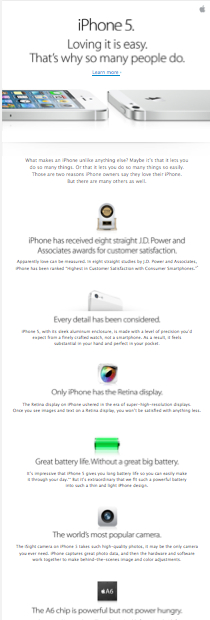
Apple eMailI recently received this promotional email from Apple for the iPhone 5. It brought to mind some of the recent chatter about Apple’s legacy and future. I’ve tended to dismiss the talk from naysayers who’ve said the Apple reign appears over. This pronouncement has been made many times over many years, and their culture, values, and willingness to take risks has consistently brought them back from the inevitable setbacks.

But this email gave me pause. Its content and tone made me think there may be a turning point afoot after all. I couldn’t recall seeing something from Apple that was working so hard to sell. Obviously, few companies have mastered the art of selling better than Apple, but the best of their work did it in a way that was less about selling and more about enticing you to buy. It wasn’t going after you as much as it was inviting you to come to them. This email has none of that flirtatious quality. It is selling and selling hard.

It lists multiple features, and the word “lists” is intentional. Feature after feature scrolls by like a spec sheet. The Apple way had been to romance a particular feature to give you a sense of what wonder lay in store for the lucky user. No such alluring Fan Dance here. Every distinguishing feature is laid out with nothing left to the imagination. Yet the most telling indicator to me is the headline – “Loving it is easy. That’s why so many people do.” I’ve never seen Apple proclaim it’s popularity. Even as it came to dominate the smartphone market, it always carried the sense of being a club for the discerning person who appreciated design and creativity. This line brings them a step closer to the car companies and other  product makers who revel in claims about “best-selling” and “most popular.” Forget the club, bring on the bandwagon. I tempered my initial reaction to this shift in tone by arguing that it may be a by-product of the email channel. Maybe they gave themselves permission to go a little bit more hardsell in a direct response oriented channel. But the iPhone website has the same line so it seems it’s the basis of a broader campaign, not just email copy. If so, this signifies a different approach than we are used to experiencing from Apple, and makes the talk of a turning point for Apple a lot more credible.

1 Comment

Filed under 21st Century Marketing, Branding, Mobile

The Missing Measure of Business Strength

There are three areas that determine the strength of a business. Yet widely accepted measures have only been developed for two of them.

The overall health of a business depends on three factors:

  1. The quality of its products and services
  2. The cost/price structure
  3. The strength of customer relationships

The third area is often overlooked, but shouldn’t be. Peter Drucker distilled the issue into a fundamental truth when he said that “the purpose of business is to create and keep a customer.” It’s the strength of the customer relationship that makes people automatically ascribe higher levels of design and performance to Apple products.  It’s the lack of a customer relationship that feeds the high churn rates in wireless carriers. This is what CEO’s mean when they use the word “brand,” as opposed to what CMO’s often mean when they use the word brand. The CEO describes it in terms of a competitive advantage, and the CMO too often in terms of imagery and recall.

As vital as this relationship is to both the short and long-term health of the business, the measurements around it are not well-developed. There are rigorous measures and standards around quality, as evidenced by approaches like Six Sigma and third-party evaluators like J.D. Power. There are even more rigorous measures in place over the financial health of the firm, enough to employ an army of accountants at any large firm.  But measures of the customer relationship are underdeveloped. The net promoter score attempts to measure the customer relationship by likelihood to recommend to  friend. It is the closest thing we have to a standard measure of customer relationships.  As such, it has been a useful tool for many companies looking to develop a stronger customer-centered culture. Still, its critics are as numerous as its supporters because it lacks the objectivity that is standard in measurements of quality and financial performance. For example, people may be less likely to recommend something they perceive as a vice, even if they are very satisfied (e.g. high fat ice cream). Many companies have their own loyalty measures that are more sophisticated than the net promoter score. But the fact that they are proprietary means that it’s difficult to compare their measures to other competitive companies.

The day will come when savvy investors will analyze customer relationships as closely as they analyze EBITDA. That will be a good day for enlightened marketers because it will establish the best of them as mission-critical drivers of business growth.

Leave a comment

Filed under 21st Century Marketing, Branding, Business Management

Getting It: Charmin vs. Cottonelle

One of the biggest mistakes that marketers make when attempting to use social media is focusing on the channel first. Many of them have been trained that success comes from tapping into what’s hot whether that be celebrities, television shows,  or urban slang.  So they go into social media by trying to figure out  the hot place to be.  First they went rushing into Second Life, then MySpace, then Facebook, and now iPhone apps.

That mentality misses the point of social media: it is not to intercept people on their way to what interests them,  it is to engage people so you are what interests them.  The first task is not to assess the popularity of something unrelated to who you are, it’s about finding something rooted in who you are as a brand that other people find interesting. And that’s where the real challenge lies.  Before you pick any social media channel, you need to figure out what makes you interesting to somebody. Sure, it’s easy to figure out why people would want to talk to you if you’re Nike, BMW, or Maxim. Who doesn’t want to talk about sports, cars or sex?

It’s a little harder when you’re a less naturally conversational product.  Even if it’s something people use a lot of, it doesn’t mean they want to have a conversation about it.  If you make socks, table salt or toilet paper, is there anything that could make a normal person seek you out?

It turns out there is, if you are smart about it. For proof, consider what Procter & Gamble has done with their Charmin toilet paper. By owning public restrooms, they found a reason for people to talk about them and with them.  In 2002, the brand team started Potty Palooza, a portable set-up of high-end public toilets that traveled around the country to concerts, festivals, and other events.  It became an attraction in its own right, and the subject of considerable buzz. They built on that momentum with the installation of luxurious public restrooms in key venues like Times Square. Most recently  they extended their idea into the sponsorship of a mobile app, SitorSquat, that maps out public washrooms around the world.  These efforts have helped strengthen Charmin’s place as the most popular toilet paper brand, and even to have its premium line cited as a leading economic indicator. They found a way to make  people want to talk about a toilet paper brand. They started by finding something inherently interesting about the brand, and then played it out in various channels where it fit.

They did not pick a channel and then shoehorn something into it. For an example of that, you can look at Cottonelle’s Facebook page. Here’s the mission of their page in their own words:

“The Cottonelle® Brand Facebook page is intended to provide a place for fans to discuss Cottonelle® products and promotions.”

There’s  no reason to go there unless you have some pre-existing connection to the brand. I can’t say what motivated this effort, but it seems like someone simply decided Cottenelle needed to be on Facebook.  They do a nice enough job trying to keep some kind of conversation going, but you can feel the strain like small talk between people who arrived too early for an office party.  It’s hard to have a meaningful conversation without something interesting to talk about.

(credit to Bill Hague of Magid Research for related insights)

2 Comments

Filed under 21st Century Marketing, Activation, Branding, Innovation

Getting It: Chevrolet and Volkswagen

The contrast in behavior between two car companies over the past several  months could hardly be more illuminating.  As reported by DetroitNews.com, the marketing heads of GM directed their internal staff to stop referring to cars using the Chevy nickname and instead use the more proper Chevrolet label.   It smacks of  a guy I knew named “Ox” who tried to convert everyone to calling him Alex after he graduated college and got his first job in banking.  He thought it was more fitting to help him climb the corporate ladder.  It distanced him from his old friends and made him less interesting to his new ones. After all, who would you rather have watching over your money, Alex or the Ox?  GM’s attempt to backtrack a couple days later was only slightly less baffling.  They explained that because they sell more cars internationally now than domestically, they thought it better for consumers outside the U.S. to learn their proper name first before learning the nickname.  That defies the way nicknames really work with both people and products,  if Paul David Hewson (Bono)  and Coca-Cola (Coke) are any indication.

Compare that approach to Volkswagen.  They’ve embraced the Punch Dub game that kids started around spotting a Volkswagen.  When I saw their ads shortly after my kids starting punching each other in the arm every time they saw a VW drive by, it was both endearing and smart.  It made those familiar with the game feel like insiders, and those unfamiliar with it curious. Every marketer strives to integrate their brands into the popular culture, and they handled the opportunity deftly.

The contrast comes down to a simple definition of a brand. While marketers work hard to foster brands, a true brand is ultimately owned by the consumers. It is people’s perceptions and feelings that define a brand. VW took what people were doing around the brand and embraced it, GM pushed it away. Maybe GM took their part in popular culture for granted because Chevy has been around so long.  It might have been easier for VW to see the relatively new phenomenon as a gift in a way that GM could not. Still, the fundamental mistake was in a mindset that misunderstood the fundamental nature of brands.

Leave a comment

Filed under 21st Century Marketing, Branding, Cases, Market Strategy

How Markets Create the Need for Tea Parties

As the anti-incumbent story rumbles  across the mediascape, there is a familiar theme — call it the “I’m mad as hell and I’m not going to take it anymore” movement. Congress is at its lowest approval ratings of all time, political distrust is at an all-time high, and new activist fervor is sweeping the land. Politics as we know it is about to change.

Don’t believe the hype.  Whether it’s the Know Nothings of the 1840’s, the Term Limit supporters of the 1990’s,  or today’s Tea Party, they are all a response to the fundamental structure of the American political market.

I worked on political campaigns, and it is important to learn that there is a fundamental difference between the political marketplace and the consumer marketplace.  Both are ruthlessly competitive, so it is not a difference in ethics or morality. It has to do with what I call “category effects.”  Consumer markets have them, and political markets don’t.  Here’s why.

In simple game theory terms, there are four general outcomes between two competitors in the consumer marketplace:

  • Both gain
  • Both lose
  • Competitor 1 gains, Competitor 2 loses
  • Competitor 1 loses, Competitor 2 gains

For an example where both gain, look at Adidas and Nike. Both doing well financially, both well-regarded major brands, and benefiting to a large extent from the fact that they have a major competitor helping them drive the market and mythology of athletes and athletic gear.

For an example where both lose, look at United and American Airlines. Even before the recession, the two largest US carriers were losing share to Southwest-like competitors on the discount end and Virgin on the high-end. Neither gained from the struggles of the other, and both added to each other’s  problems by pricing and service policies that soured people on the airline travel experience.

In both situations, individual players face consequences for how the whole category performs.  If companies compete in such a way that the category grows, they may both win.  If they compete in a way that the category suffers, they may both lose. It is in their self-interest to have people think well of the category.

By contrast, political competition has only two outcomes:

  • Competitor 1 gains, Competitor 2 loses
  • Competitor 1 loses, Competitor 2 gains

In a campaign, it does not matter if you have two great candidates or two terrible candidates, one person gets elected.  There is no outcome where both gain or both lose.  There are 100 Senators in the US Congress, and short of a change to the Constitution or an overthrow of the US government, that number is not going to change based on people’s approval ratings.   In other words, there are no category effects for politicians. If doesn’t matter if people love or hate the category, 50 people still win the same prize either way. There is no self-interest for politicians to make people feel better about the category.

That is why negative advertising is frowned upon in the consumer marketplace, and embraced in the political marketplace.  In politics, if people hate the category I’m in, I can still win as long as they dislike my opponent more than me.  It doesn’t matter if the population is so put off that only 3 people even bother to vote. If two of them vote for me, I win.   In the supermarket, if people hate the my category, it does not help if they hate me less.  I still lose. If two people buy my product  and only one buys my competitor’s, we both go out of business.

As long as there are no category effects in politics, there is no incentive within the system for the candidates to improve the institution.  Efforts like the Tea Party represent an external effort from outside the system,  attempting to impose category effects on a market that inherently lacks them.  If patterns are true to form, one of the political parties will absorb their key tenets into their platforms, and the system will continue to chug along as it always has.

1 Comment

Filed under 21st Century Marketing, Branding, Market Strategy, Uncategorized

The Brand – Marketing Paradox

Over the past few years, there has been two converse trends that speak to an interesting shift in the marketing landscape. On the one hand, the benefits of a strong brand have become more discussed and desired than ever before. CEOs, politicians, athletes, and entertainers are obsessed with developing and shaping their respective brand.  Numerous self-help columns promise to help people develop their individual brands. Never before has branding been perceived as such a critical success factor by so many people in so many fields.

So these should be heady days for established branding experts. Marketers from brand managers to agency directors should be enjoying unprecedented status and influence. Yet the opposite situation seems to be the case. White papers for CMOs circulate around the struggle to get a seat at the decision-making table.  Agencies are increasingly treated as commodities, set out for bid in much the same way as office supply contracts.  Major consumer marketing companies have bypassed the professionals to embrace “user-generated content” and crowdsourcing to fuel their marketing campaigns.

One explanation for these contrasting trends is that branding has become too important to be left to the marketers. Supporters of this view argue that the limited toolset and mindset of traditional marketers has made them ill-equipped to deal with the challenges of the modern marketplace.  There is some isolated truth in this, but anyone who has dealt with a large sample of CMOs can attest that as whole they are as engaged, intelligent, and creative as anyone you could hope to meet.

The more credible explanation is that branding has become bigger than marketing.  The digital era has brought an unprecendented amount of information and transparency to products and the companies who make them. As a result, people are forming brand impressions from a far greater number of inputs than ever before.  A frustrating customer service experience becomes a viral video hit, a golf outing with clients sparks national outrage,  financing from an overseas bank results in a store boycott. So brand impressions are being formed less by the things marketers control and more by the corporate culture and its day-to-day operations. 

Branding used to cover a company like frosting on a cake. It was something you added at the end to make it look good. Now the branding is baked in. For branding experts to contribute, they have to make a positive impact on what goes into the cake, not on what comes out of the oven.

Leave a comment

Filed under 21st Century Marketing, Branding

The Naming Game

RoseAt some point in every new product introduction, you have to come up with a name. Based on my experiences naming both products and companies, the naming process can be one of the biggest tail-chasing exercises a company can do. There is an unreasonable expectation that a 2-4 syllable combination can communicate on its face a list of a dozen qualities that various stakeholders think it is critical to convey. Brand identity firms create million-dollar projects out of this fallacy.
 The fallacy is quick to see if you spend a moment considering the brand names that are most familair to you.  Consider what the biggest brand names today would communicate if you knew nothing else about the company:

  • Amazon: Online store or adventure travel company
  • Microsoft: Software company or synthetic fabric manufacturer
  • Nike: Shoe company or defense contractor (and you’re supposed to pronounce the “e”?)

The truth is that a name is what you make it stand for.  The power of the biggest brand names, including those listed above, came from the work that went into them.  Names do not make the brand, brands make the name. The most you can hope for is that:

  1. You can own the name as a legal trademark as you expand and grow
  2. You will not be confused with another well-known brand, especially a competitor
  3. You don’t start by having to overcome an linguistic negative like being hard to pronounce or meaning something obscene in the languages of regions where you intend to do business
  4. You can tell some story about the name for those who are curious in order to help build some of your brand lore

The only other rule is that nobody really likes a name that they didn’t come
up with. So be prepared for second-guessing no matter what name you choose.

Leave a comment

Filed under Branding

Earning Interest

There is a simple way to sum up all the trends around social media, viral marketing, mobile apps and other developments in marketing — we are shifting from a world in which attention is bought to one in which attention must be earned.

I recall attending an AOL conference back in the day when AOL was bigger than the Web. One panelist whose name sadly escapes me, shared some amazingly prescient wisdom over a technical discussion of how to deal with the limits of dial-up internet access. He said “I think our biggest bandwidth problem is going to be people’s attention span.” That sums up the marketer’s challenge better than anything else I can think of.

The number one question all marketers should ask themselves before launching any program is “why would this be of interest to anyone in my target?” Interest can take many forms, so not everything has to work in the same way.  A great Superbowl ad and a great customer service experience can both engage people. Our basic human motivations provide multiple ways to attract our attention. Here are five broad categories that we look at to help design marketing programs that earn interest:

  • Passion – We all have passions that bring pleasure to our lives. It may be for fashion, the Green Bay Packers,  or Broadway musicals. Whether carnal or intellectual, we seek out avenues that allow us to feed and  indulge our passions.
  • Curiosity – We are naturally attracted to mysteries and riddles. There are few things in this world more seductive than an unopened package. Once something piques our curiosity, it’s like an itch we have to scratch.
  • Entertainment – As YouTube empirically proves every day, we seem to have a bottomless desire to be entertained. Whether it’s through humor, drama or pure spectacle, there are few better ways to endear yourself to someone than to entertain them.
  • Interaction – It is deep within our species to want to connect with others of our kind. Shared experiences give us more satisfaction than solitary endeavors. Bars and online forums both owe their existence to our inherent desire to interact with others.
  • Utility – We all feel like our lives should be easier. So we embrace tools that fulfill the promise of saving time, money, or effort. 

Successful marketers are those who can earn the interest of their target. Marketing plans sometimes still refer to “paid media” (advertising) and “earned media” (PR). It’s all earned media now.

1 Comment

Filed under 21st Century Marketing, Branding, Innovation