Category Archives: Innovation

Mobile Gaming Crossing the Line

Online-OfflineOne of the benefits of the holidays is having time to observe the full force of the marketing onslaught. While gauging the pulse of retailers pre-Christmas and post-Christmas marketing plans, I was struck by two television ads that I saw aired repeatedly. One was for Supercell’s Clash of Clans and the other for King’s Candy Crush Saga.

These two games represent the hottest properties in mobile gaming, as most any peek over the shoulder of fellow airline passengers could tell you. Candy Crush alone hit over half a billion downloads before the end of 2013. They follow in the line of crazes that extend back to the historical days of Words with Friends and Angry Birds. Yet, I don’t recall seeing any of those franchises using broadcast TV to feed their respective runs. Unlike console games, the rise and fall of previous mobile gaming hits took place almost entirely in the digital/social realms it was designed for.

The use of TV to drive online downloads is consistent with a trend that is increasingly erasing the divide between offline and online marketing approaches. You can also see this in the refined sales pitches coming from Facebook and Twitter. They are increasingly touting the synergistic effects of their platforms. Pitches that used to be be about the unique effectiveness of online marketing now emphasize the ways that online advertising enhances the effectiveness of offline marketing.  Like most marketing trends, it’s a move that shows marketers catching up with human behaviors. As we increasingly jump the line in our real lives, it’s natural that our consumer lives would follow.

Leave a comment

Filed under Digital Marketing, Innovation, Mobile

Good vs. Great Brands = To vs. Through

HD TattooWe in the marketing game are constantly looking for ways to attract people to brands. Yet when you look at the brands that are the most successful and most enduring, a subtle truth emerges. People connect to good brands, but they connect through great brands.

Many marketers fantasize about having an asset that’s as iconic as the Harley Davidson brand. The ultimate success, many say, is when your customers are willing to tattoo your logo onto their bodies.  It’s worth thinking for a moment about why they are doing that. Is it to commemorate the great relationship they’ve developed with the brand? Are they doing it as a tribute to the Harley worker or dealer who made their great ride possible? Of course not. They do it to signal to other people.  The brand becomes a way for them to define themselves to others. They are going through the brand to connect with other people about what matters to them.

The Apple logo on the Powerbook computer is an apt metaphor. There was an extensive debate among Apple designers as to the best orientation for the logo on the computer.  Because of Apple’s emphasis on the user experience, the logo was originally placed on the computer so that it was right side up to the user as the computer was opened. But after a few years, the logo was flipped. They decided it was more important for others to see the logo right side up when the computer was opened. Apple recognized that the relationship between the user and the product was less important than the relationship between the user and other people.

This truth is especially applicable as brands continue to adapt to the world of social media. Ambitious marketers should look beyond metrics that measure direct interactions with the brand and strive to enable interactions people can have with others through their brand.  For example, in this framework, Pinterest repins are far more valuable than visits and even more than clickthroughs. In this context, the most important role of the brand is not the direct relationship it develops with the customer, but the relationships it helps that person define with others.

2 Comments

Filed under 21st Century Marketing, Branding, Innovation

Real-Time Marketing Takes Real Character

Open 24 HoursReal-time Marketing is a catch phrase of the moment. There are arguments as to what it means and how far it will go, but no one can argue with these basic premises:

  • Response times are shrinking for marketers who want to play in the currents of popular culture. The velocity of change in everything from bestseller lists to tourist destinations has accelerated the cycle from up-and-comer to has-been. Marketers have to act more quickly, frequently, and astutely to earn cultural relevance.
  • People expect brands to respond to them in multiple forums of their choosing. Today’s marketers can look with jealously at the ancient world where customer interactions were handled primarily in-store or through 800 numbers. People now assume that companies will respond to them wherever they happen to be – In-store, Facebook, Twitter, website, etc
  • People tap into a wider spectrum of company behaviors in forming their brand perceptions. While advertising still commands considerable power, people are increasingly influenced by a broader range of company activities. Apple suppliers’ working conditions, Chick-A-Fils political views, and Zappo’s sales agents have exhibited powerful affects on their brands.

These trends affect the most primary foundations of successful brand building. More specifically, they shed a new perspective on the concept of brand storytelling.  Any student of marketing knows that great brands are built on great stories. Stories are the means by which we understand, remember, and connect with things that are important to us. When we recall great people or great events, we do so with stories. It’s why American Idol and its variants don’t use their airtime to merely judge the talent. What draws viewers in are the stories they construct about what got them there (the obstacles they overcame, the people who inspired them, the dreams they’re chasing) and the stories that unfold as they progress through the natural drama provided by the multiple rounds of competition.

Traditional advertising rightly celebrates well-crafted stories. From Mean Joe Green and the kid with a Coke to Nike’s Jogger.  successful brands have harnessed stories to conjure the highest level of connection with their audience. Yet these tight, well-contained, highly produced stories don’t mesh easily with the trends we just described. How do you craft stories in the world of tweets, snapchats and user-generated content?

The answer is that today’s brand stories must rely more on characters than on plot. Stories that rely on plots don’t have the malleability to meet the emerging forms of marketing.  One can think of a movie like The Sixth Sense, composed with precision to deliver a steady dose of suspense that ends in a wonderful collision of surprise and inevitability. Compare that to a James Bond movie. Outside of a few twists, we already know how it is going to turn out in the end. Yet we embrace the ride in order to revel in experiencing the character we love. That is the advantage of character-based stories. They lend themselves to endless sequels.  No one is pressing for Sixth Sense II but the James Bond franchise keeps churning on.  Characters allow the stories to pour out in endless variation. They inspire Fan Fiction and fierce loyalties.  The common quality in people’s passionate embrace of Star Trek, Sex in the City, House of Cards, and similar properties is not in the plots, but in the characters.

This is not the “brand character” often listed on a standard marketing brief. Those usually list a short collection of well-worn adjectives. Character needs to be richer than that. We feel genuine attachment for entirely opposite types:  because they are the same as us, because they are different from us, because of their glamour, because of their humanity, because of their goodness, because of their badness.  We are drawn less by type than by depth. A real character is the fuller expression of the drives, instincts and world view that shape how you act in the world.  We want to be in the company of that kind of character, to interact with it, even to add to it. With this character firmly in place, a brand can more easily weave stories across channels, and let people tell stories on its behalf. This is the character that brands require to prosper in today’s real-time marketing environment.

(This topic was inspired by a discussion with Mark Figliulo on the nature of character in stories).

Leave a comment

Filed under 21st Century Marketing, Digital Marketing, Innovation

From Mobile First to Moment First

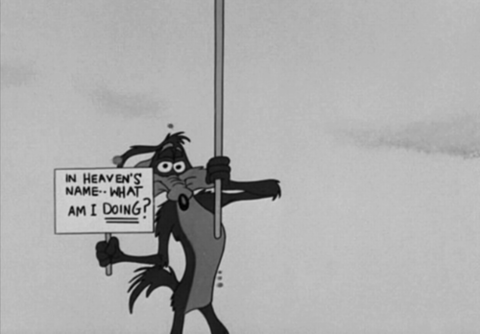
Wile E. Coyote in heaven's name what am I doingMobile First is the mantra currently dominating the design and development community, including mine. The truth is that the Mobile First is a much better guess about what I want, but it is still a guess. Assumptions about what Mobile means are increasingly cloudy. As smartphones and tablets come to dominate the device landscape, their usage is expanding beyond the simple “on the go” assumption typically associated with mobile.

People are increasingly using these devices as substitutes for the PC. Recent statistics suggest that over 80% of tablet usage occurs at home.  Another study estimates that 68% percent of smartphone usage is at home. Based on these figures, it is perhaps unsurprising that 1 out of 3 users prefer to use the full site on their mobile devices when given a choice. So it is increasingly hard to characterize mobile device usage as an “on the go” experience. To assume it is more time-constrained and transaction-oriented will become less true as these devices continue to replace PCs as the primary Internet device.

The real goal for developers should be to work towards Moment First design. The principles surrounding Adaptive Design and the Contextual Web point to the next challenge in experience design. Being in the moment requires making better use of the multiple hints we can gather about how people are engaged when they look for content. It will take into account more than the device, but also the location, time, behavior patterns and other situational clues that can gear the content to the best perceived need for that moment. Building a Moment First architecture will continue a pattern in which the technical development for content delivery becomes increasingly more complicated so that the experience itself can be simpler and more intuitive. This provides an opportunity for toolmakers and experience designers to find ways to harness that complexity in new development models.

Leave a comment

Filed under 21st Century Marketing, Innovation, Mobile

Mobile: Moments that Matter

The rise in mobile communications signals a change in marketing that is more significant than a shift in channels. It represents a profound reconsideration in how to think about effective targeting. The principles that drive the prevailing wisdom on targeting are based on the historical move from mass advertising to direct marketing. Mass advertising provided a low CPM, but for most marketers it involved a good deal of waste. With TV, radio and print, in order to capture the people you really wanted, you had to expose your message to a larger audience of people you didn’t want. You could reduce that somewhat by seeking out narrower audiences in niche programs or titles, but it was still casting a wide net.

The promise of direct marketing was that you could deliver your communications only to the people you really wanted to reach. If you wanted affluent Moms in households with kids under 12, that’s all you had to buy. The higher CPMs that came with this approach were justified by the efficiency and higher response rates. There was a shift from seeking out as many people as possible to seeking out only the people that mattered. It was a shift from focusing on “Places that Matter” to “People That Matter.”

The arrival of digital performance marketing took the principle of “People that Matter” to an even higher degree of precision. You could go beyond demographics and customer data in targeting, and include even finer distinctions revealed by online behavior. Now you could target Moms in affluent households with kids under 12, who seek out photography tips, love Gwen Stefani videos, and visited your website two days ago. At first, Mobile seemed like an opportunity to take that specificity even further. But as the nature of mobile usage evolved, it turns out a difference in degree became a difference in kind.

Mobile shifts targeting from a focus on “People that Matter” to a focus on “Moments that Matter.” Digital media maven Dave Marsey coined that phrase to signal the new challenges and opportunities Mobile provides beyond more precise targeting of individuals. Both the explicit and implicit data around Mobile allows marketers to market to the situation rather than just a person. For many brands, the moment is more important than the person. If you are in the QSR business, for example, would you rather connect with someone in the heart of your demographic target, or with someone stepping out of work for lunch at 11:50am within a walking distance of one of your restaurants? The first choice is a person that matters, the second is a moment that matters. Ideally, you’d want both, but the power of knowing the context of the moment has the potential to trump what you know about the person.

Yet the advantage of knowing the moment is only useful if you manage to it. People generally use mobile with more intent than traditional media, and marketers will be successful to the extent that they are seen as relevant to that intent. Relevance used to be defined in terms of what you said. In the mobile ecosystem, relevance is what you provide. In the QSR example, the lunch-seeking office worker is focused on what to eat. So she’s more interested in a new menu item and much less in a concert promotion. The situation would be reversed when that same worker is headed home chilling out with Pandora.  That’s why the argument about the screen size of mobile devices and such miss the point. Mobile marketing is not about how to stand out on a screen, but how to provide people with value in that moment. Value can take many forms:  education, entertainment, shopping, etc. Taking full advantage of Moments that Matters doesn’t require more pixels; it requires more thought.


Leave a comment

Filed under Digital Marketing, Innovation, Mobile, Uncategorized

Is Facebook the Nike of Social Media?

All the discussions about Facebook’s IPO center on how a company that already dominates the social mediasphere can continue to dramatically grow even more in the future.  The valuation it’s seeking is justified if you believe that what Facebook is now represents a fraction of what it will become.

There is an interesting parallel here to the US athletic shoe industry of a few decades ago. Historically, that industry had a rotating position at #1.  Leadership was determined by external trends largely outside of the control of the companies.  As changes in tastes, fashion, and fitness changed, so did companies’ fortunes.  When basketball shoes were only for basketball players, Converse dominated. When they became a fashion statement, Converse faded. When running was the fitness movement sweeping the nation, Nike came to the fore.  When running gave way to aerobics, Reebok was born. Because of that, up until the 1980’s, no company that lost the #1 position ever regained it. In this way, the industry was similar to the social media world. As Friendster gave way to MySpace, which gave way to Facebook, no company ever regained its position after the crowd had moved on to the next thing. They were each the beneficiary and the victim of changing tastes and trends.

In 1983, Nike slipped. They missed some trends, had overextended their product lines, and dropped from the leadership position. Phil Knight came back as CEO and pivoted the company. Over the course of a year and a half, they changed the leadership team, cut costs, streamlined existing products, established new ones, and changed their marketing strategy. Progress was erratic, but by the 1990’s, they had regained the lead spot. For the first time, a company had strategically engineered a return to leadership in that category.

So the question is whether Facebook is a Nike. Can they engineer success in a way that defies the way the industry has behaved until now?

Leave a comment

Filed under Innovation, Market Strategy

The Four Tenets of A Digital Mindset

The Digital New Fronts showed another maturing stage in the development of online content. It demonstrated the continued blurring of the offline and online worlds. Television series and web series are increasingly utilizing the same talent, pursuing the same audience, and selling to the same advertisers. This blurring will continue as advances in addressable television, tablets, and over-the-top video make the distinction between digital and broadcast content disappear.

This represents both a victory and a conundrum for proponents of digital marketing. The victory rests in the growing importance of social, mobile, and online marketing in the plans of even the most traditional marketers. Several global brands are being built almost entirely on digital marketing strategies.  So, as far as rising to the ranks of market importance, digital has “won.”  But the conundrum is rooted in this same success for digital practitioners of every stripe.  When everything and everyone is using digital, is there any meaningful distinction left in being a digital marketer?

Digital marketers used to distinguish themselves based on their mastery of channels that most other people didn’t understand. They knew how to design websites, build rich media banners, and bid on search terms. That knowledge is both more widespread and easier to tap into than ever before.  That said, there is still something quite valuable about true digital marketing. It’s not about the toolset; it’s about the mindset. What is still lacking for many marketers and agencies is the mindset that comes from a digital way of looking at that world.  There are four core tenets underlying the digital mindset:

Everything is Connected

The digital imperative is to constantly seek new points of connection. In marketing, digital brands find new ways to connect across multiple levels.  Those connections can be made across time, people, information, and interests.  In that way, it can connect brand building with sales, existing customers with potential customers, R&D with Customer Service, etc. Where traditional marketing tends to separate into channels, digital marketing is always finding new ways to link together.

Actions Trump Impressions

Traditional marketers often measure the effectiveness of their efforts by the impressions they generate. Even experiential efforts like live events are reported in terms of how many equivalent impressions they generated. The digital mindset sees value in actions. An action is a measure of commitment, while an impression is only a measure of exposure.  If you’re looking to make a friend, interacting with someone will get far better results than being seen by someone. Similarly, if you can get someone to post something, share something, or like something then you are far more likely to sell something, either to that person or someone they know.  In that view, getting a thousand people to do something is more valuable than getting a million people to see something.

Always Optimizing

The traditional marketing cycle is like a movie release. The marketers spend months developing a new story, work behind the scenes to perfect the details, and after several months, launch it to the world in a glorious finale. If it succeeds, you make a sequel; it if fails you start over with a new one. The digital mindset embraces the beta view of software development. The launch is seen as more a beginning than an end. By gathering feedback and measuring reactions, the first release gets tweaked and upgraded.  In the digital view, a release does not have the rigidity of a final cut, but the malleability of software code.

Data is Currency

All of these elements are driven by data. To be digital, you need to be know how to harvest, process, and analyze data.  And it’s not just for performance metrics. Performance measurement is vital, but data provides much more than that. Digital marketers are excited by data because it reveals new connections, shows what people are really doing, and points the way to building deeper relationships. The digital mindset not only recognizes the awesome business potential of data, but the amazing creative potential of data as well.

Having the latest digital tools doesn’t make you a digital marketer anymore than owning a chessboard makes you a chess player.  For both qualifications, the proof is in how you play the game.

Leave a comment

Filed under 21st Century Marketing, Digital Marketing, Innovation

The Growing Reality of Always On Marketing

It’s said that the future lies clearly in the present, as long as you know where to look. If you look at the underpinnings of today’s rising brands, a pattern emerges. There is, of course, the by-now standard dictum of a shared brand experience.  The idea of talking with people instead of at them is no less true for now being common wisdom. What’s less common are brands who have taken it to the next step.  It is one thing to have a Twitter manager lobbing out pseudo-conversational tidbits such as “what’s your favorite Super Bowl snack?” It is another thing entirely to know to whom you’re talking to and being able to share something with them of real interest based on the context of that particular moment. This is at the heart of Always On marketing.  Like most marketing innovations, Always On marketing started with small niche brands finding new ways to build buzz outside traditional approaches. Now you see established brands like AMEX, JetBlue and Gatorade adopting Always On principles.

What is Always On?

At its heart, it’s a simple premise. Always On marketing is the ability to respond in real-time to an individual customer with the most relevant brand content.  If I’m in the market for a new smartphone, and I don’t know whether I want an iPhone or Android model, a carrier who serves up reviews of the two types of phone would have an advantage winning me over as a customer. If I’m away from home at my kid’s basketball tournament, and a quick-service restaurant sends me a coupon and directions to their place around the corner, they’re likely to get a sale.  While a simple idea in theory, in practice it requires a new set of capabilities.

What’s Driving It?

The drive for Always On marketing side is a combination of developments on both the producer and consumer side of the equation. In total, there are three overall developments driving the moves to Always On marketing.

1. The Death of the Funnel

The traditional sales funnel looked something like this:
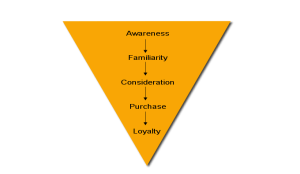
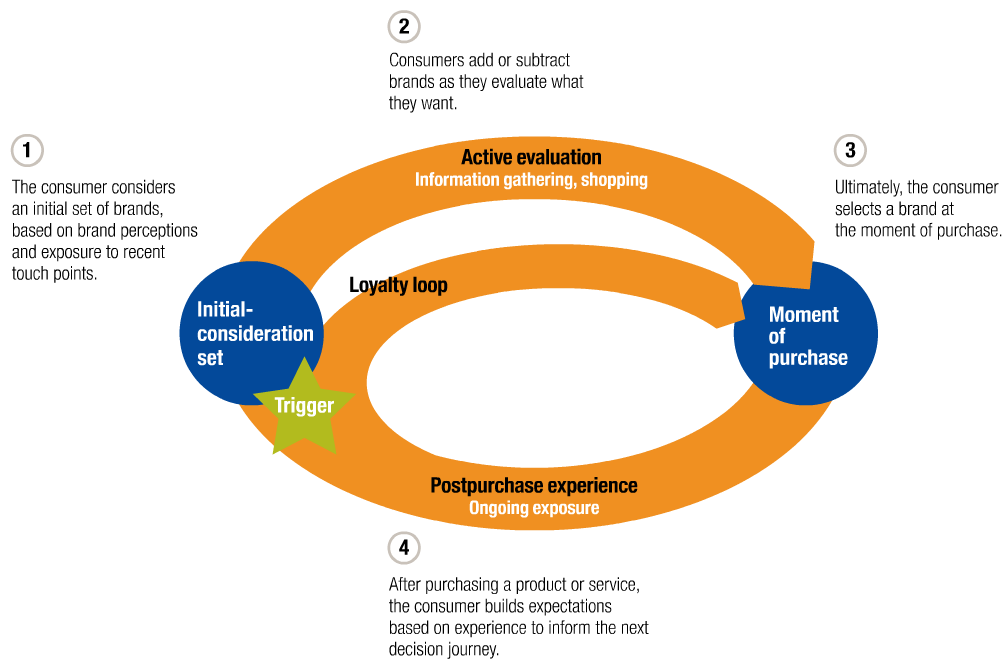
If this funnel were ever really true, it is not true now. Studies from Y&R, McKinsey Consulting and others show that the brand selection process does not involve a broad embrace of brands at the start, followed by a rational and linear winnowing down to a preferred brand. The McKinsey model suggests a path that looks more like this:
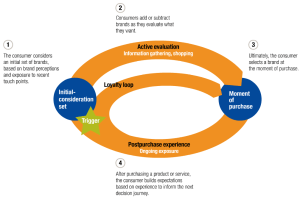
There are several significant differences between this model and the traditional funnel. Most notable are:

  • When something triggers our desire to make a purchase, we start with a narrow preconceived set of brands, not a wide view of the category
  • That initial set of brands may actually grow instead of narrow as we evaluate our choices.
  • The move from the initial trigger to the final purchase may skip a step at any point.

This revised view has important implications. For one, it emphasizes how critical it is to understand your brand’s place with a potential customer at each stage of the process. Contrary to traditional funnel thinking, a new challenger brand may have a better chance getting attention in the Active Evaluation stage than the Initial Consideration stage. For another, it encourages forging multiple paths to purchase. Each person goes through their own purchase journey, skipping over one stage to the next.  If that person is forced to confined to a predetermined path, you risk losing their interest and their business. Taken together, it requires a system that can spot when a personal trigger event happens  (e.g., visit to a car dealer, browsing an online catalog, moving to a new town) and act on it immediately. Consider that the average time from a trigger event to a purchase decision is 10-12  days for someone going on a vacation.  The time from trigger to purchase for a mobile phone is about 7 days. Always On marketers who can spot the trigger and market accordingly in that short span of time gain a huge advantage.

2. Great Expectations

Consumer expectations have changed significantly. If you can think back as long as five years ago, the idea that you would shout out a company’s name on the street and expect a personal reply would be grounds for psychiatric evaluation. But Twitter has created an expectation fairly close to that. People register complaints with no more than a company hashtag and are miffed if there is not a response.

This represents a ratcheting up in consumer expectations. People increasingly expect real-time interactions from the brands they care about.

3. Big Data

The burgeoning availability of actionable real-time data provides new opportunities to truly deliver on one-to-one marketing. The “one-to-one marketing “ label has been around for decades, but it was a way of thinking rather than an actual way of working. Traditional database marketing relies on segmentation schema that group people by common characteristics.  Segmentation is a way to break a mass group up into smaller groups, but is not truly individualized.  It creates proxies for real knowledge of the person.  For example, a battery manufacturer would create a “gadget lovers” segment based on demographic and survey data, and design marketing programs targeted in various degrees of specificity to that group. That approach is several times more effective that simple mass marketing. Yet their effectiveness would be even several factors higher than that if they knew nothing about a person’s demographic and survey responses, but did know how many times an individual had purchased batteries in the past six months, what devices they owned, the last time they bought a batteries, and where they were shopping for electronics right now.  In that way, Big Data renders group segmentation obsolete. Always On marketing operates on a segment-of one-philosophy.

What Does Always it Require?

An Always On marketing platform require four major components.

1. A Powerful Marketing Engine

The most critical component of Always On marketing is the ability to gather, process, and act on large amounts of data. Big Data generates a continuous fire hose of data that cannot be meaningfully processed by traditional analytic methods. A Marketing Engine is a collection of tools, partners, and processes that enable a brand to:

  • Combine multiple data sources to construct an actionable profile of each individual they encounter.
  • Apply business rules that allow real-time matches between individuals and brand content
  • Track responses of individuals to brand contacts and pursue different paths with that individual based on the nature of that response
  • Monitor performance across channels in a way that allows for constant optimization

2. Deep Reservoir of Brand Content

Even with the most powerful Marketing Engine in place, it is not effective if the interactions with people aren’t compelling and relevant. That’s why brands need to build and update sources of content that can be at the ready. That content can be constructed dynamically (e.g. customized offers),  pre-produced (e.g. how-to videos), or human (e.g. a customer service representative).  As brands embrace an Always On approach, the content needs will become apparent as their interactions grow and patterns emerge.

3. A Clear Brand Story

One thing that hasn’t changed about effective marketing is the importance of having a compelling brand story.  This is what establishes the fundamental human attraction to brands. In fact, it is even more critical in an Always On environment. That’s because the brand story has to be told in so many more ways that it used to be. As a result, more people are involved in telling the brand story than ever before. Community managers, customer service agents, other employees and brand fans join brand managers as promoters of the brand. They need a clear story that can guide their efforts in concert without centralized control.  While it may seem put of place in a discussion about Marketing Engines and Big Data, the core truth is that storytelling is more essential than ever. Now,  it not only has to inspire the people who hear it, but also inspire the people who tell it.

4. A Different Mindset

All of the above components are critical to deliver Always On marketing. Yet, they won’t work without an accompanying shift in mindset. Many marketing organizations are built to deliver tightly structured campaigns that require extensive time for deliberation, review and testing behind the scenes before each launch. Always On requires a “constant beta” approach where the testing and enhancements are being made in market.  While it is no less rigorous strategically, it embraces a quicker and less predictable cadence. More effort has to be into crafting playbooks and operating principles, and less into approvals of individual executions. In this way, marketing organizations may come to look more like the best customer service organizations, both highly disciplined and highly flexible.

Leave a comment

Filed under 21st Century Marketing, Activation, Innovation

Facebook: Rebel Becomes the Empire

Facebook recently hosted a very well run Studio Live event in town. The goal was to provide marketers with new ways of using Facebook to benefit brands and their fans.  It achieved that goal, but inadvertently revealed the choppy waters that churn when the currents of innovation and self-interest conflict.

Here’s what happened. As part of the day, Facebook sponsored a “Hack Session.” The idea was to think innovatively and provocatively around a real case study. Prior to the case, we heard inspired talks about the hack culture that drives the Facebook development team. We were encouraged to adopt the pirate mentality, think outside the box, break the rules, and act boldly.  Different stories were shared reinforcing the moral that too many marketers were still stuck in the old way of doing things. We all urgently needed to embrace the hack culture to succeed in the modern marketplace.

We then broke out into small groups for the Hack Session. Our mission was to take the lessons they’d shared to build awareness and support for Feeding America. To take advantage of the competitive nature of the attendees, it was set up as a contest between the groups. The winning team would have their ideas implemented and other tokens of glory bestowed upon them. Inspired by the competition and such a worthy cause, our group eagerly jumped in. The overriding challenge was to get support for a cause amidst the clamor of many other worthy causes. We quickly came up with several ideas, but one big idea revved us up the most. It started by building a Hunger page with local stories about people we could all relate to who are facing the challenge of where their families’ next meal is coming from.  But why would anyone notice or care? Because we were going to tap into one of the hottest memes around Facebook. We were going to give their page the first Dislike button. People would be able to come in and “dislike” hunger, and by doing so, generate a contribution to Feeding America.

We were fired up and on fire, spinning out PR, social, and promotional ideas in a happy frenzy. The Facebook people assigned to our group joined in enthusiastically – for a while. Then we got word from their organizers. Our idea would not be seriously considered for the competition.

Us: Why?

Them:  Because the Dislike button isn’t “feasible.”

Us: You mean it isn’t technically feasible?

Them: No, it just isn’t feasible that Facebook would allow it.

It wasn’t feasible even temporarily, even for a single page, even for a great cause.  It was clear that even the self-declared disciples of the hack culture have their limits. It is a persistent lesson in human nature, even amidst the ceaseless revolution that has defined the digital era.  It’s always easier to break the rules when they’re someone else’s.

1 Comment

Filed under 21st Century Marketing, Innovation

What Comes After Facebook?

The ancient Roman Cicero said that “to be ignorant of the past is to forever be a child.” This seems an apt reminder for times when even recent history is ignored. As the Facebook retreat on Places and Daily Deals shows, it’s not the unstoppable juggernaut many believe it is. It is true that Facebook reaches more people than almost any other vehicle in the world. As such, marketers would be foolish to ignore it. At the same time, those with a long-term view would be foolish to assume it will continue to dominate the digital landscape.

The certainty of that statement doesn’t come from any brilliant strategic analysis, but only from history. In the past 15 years, there has been a steady historical record of supposedly dominant players overcome by the unceasing pace of change. Starting with Netscape, and continuing through Yahoo, AOL, and MySpace, the pattern repeats itself.  A new player establishes itself as the hot thing, rises to take over the dominant position in its category, and investors and pundits alike point to its widespread adoption as an insurmountable barrier to competition. Until it isn’t.

So what will replace Facebook and when? No one can know. But given the trends, you can make a good guess about where it might come from. The rise of the web has been an exercise in disintermediation, or in non B-school terms, the elimination of the middle man. Google has done that with content. It used to be that content and distribution were linked. If you wanted to find content (TV show, magazine article, etc), you had to go the content provider (CBS, Esquire, etc). Google let you find the content without going through the provider. They effectively decoupled content and distribution. YouTube, Hulu, and others have extended that separation. I can consume content without ever visiting the its source.

Right now Facebook links three things: distribution network, content creation and content consumption.  In other words, I have to use Facebook if I want to manage my list of friends, if I want to share something with them, or if I want them to share something with me. This combination makes it the hub of social activity. It makes it the second most visited site in the world.  That traffic provides its cultural currency and its commercial reason for being. Yet you can already see the potential for disintermediation. Social network consoles show a future where content creation and consumption are separated from the distribution network. Yonoo, Digsby and others let users bring content from several source into a single dashboard. It points to a future where I never have to be on Facebook in order to use Facebook’s distribution infrastructure. The same way that content sites get demoted to just something Google can scrape, social networking sites could become just feeds for the consoles. And if it does not already exist, it is not hard to imagine an app that manages your LinkedIn connections, Facebook friends, and Twitter followers in a single database that doesn’t require you to directly use their respective tools. If I can manage my content and manage my network without ever visiting Facebook, it becomes a conduit instead of a destination.

That may not be the way it plays out. But history says the digital barbarians are due to bring down the Facebook empire.

Leave a comment

Filed under 21st Century Marketing, Innovation