Category Archives: Mobile

Has Marketing Truly Changed?

Retro-Telephone-And-Charger-For-Smartphone-Amazon-460x3842014 has brought the usual proclamations of  trends and predictions for marketers in the year ahead. Most of them take the tack of asserting how the world will be transformed and marketing forever changed.  There are, of course, the contrarians who dismiss everything as hype, asserting that the only thing that has changed is the buzzwords.

As always, there is truth in both views when viewed in the proper context. Here is a short list of what isn’t changing and what has changed for marketers across every industry.

WHAT ISN’T CHANGING

1. The Importance of Emotional Connections

The best brands foster an emotional connection with people that transcends product attributes. We are emotional animals in the end, and we want to feel an attachment with the things we use and own. It does not matter how quickly a brand adopts the latest social network if it doesn’t have a reason people want to connect.

2. The Discipline of Strategic Brand Behavior

People want their brands to stay in character. The tactics can be wide-ranging and innovative as long as they are rooted in what people come to the brand for in the first place. I don’t want my sportscar fantasy interrupted by a message of responsibility and I don’t want my warm family moment put off by a sexy flirtation. Regardless of the venue, a brand still needs to be rooted in a strategic reason for being.

3. The Quest for Differentiation

No matter what media we pursue, the marketing environment is characterized by clutter. The noise of life  creates the constant challenge to find ways to meaningfully stand out not just from competitors but from the hum we’ve taught ourselves to ignore.

WHAT HAS CHANGED

1. Consumer Expectations

We expect far more interaction with the companies we transact with. We expect them to respond in individualized ways . We expect to them to be where we are instead of searching out where they are. We bring an attitude to all our brand interactions that we used to only  bring  to our calls to customer service.

2. Performance Expectations

The rise of addressable media has increased the emphasis on measurement. Quarterly awareness tracking is increasingly inadequate for both marketers and the people they’re accountable too. Understanding and weighing the contribution of the marketing mix will continue to get more sophisticated and rigorous.

3. Expanding Toolsets

The explosion of channels has created a nearly infinite toolset for marketers. This will only continue. The idea of 360 marketing will be rendered increasingly irrelevant for its sheer impossibility. Marketers will need to strategically identify the tools and channels that make the most sense for them and their customers.

4. The Demands of Me.Here. Now

The world will keep speeding up on every level. On the cultural level, brands wanting to tap into social trends will require the means to respond in days not weeks. On the individual level, we’ll grow increasingly impatient with companies that don’t respond to us immediately. The continued rise of mobile technology will march hand-in-hand with a rising demand to engage when and where we want.

In short, the principles of brand marketing remain intact. The value of clear brand vision and a rich customer understanding is eternal. But the application of those principles demands a new mode of action that is rooted less in an architectural mindset (plan, design, build) and more in a software development mindset (build, learn, rebuild).


Leave a comment

Filed under 21st Century Marketing, Innovation, Market Strategy, Mobile, Uncategorized

Mobile Gaming Crossing the Line

Online-OfflineOne of the benefits of the holidays is having time to observe the full force of the marketing onslaught. While gauging the pulse of retailers pre-Christmas and post-Christmas marketing plans, I was struck by two television ads that I saw aired repeatedly. One was for Supercell’s Clash of Clans and the other for King’s Candy Crush Saga.

These two games represent the hottest properties in mobile gaming, as most any peek over the shoulder of fellow airline passengers could tell you. Candy Crush alone hit over half a billion downloads before the end of 2013. They follow in the line of crazes that extend back to the historical days of Words with Friends and Angry Birds. Yet, I don’t recall seeing any of those franchises using broadcast TV to feed their respective runs. Unlike console games, the rise and fall of previous mobile gaming hits took place almost entirely in the digital/social realms it was designed for.

The use of TV to drive online downloads is consistent with a trend that is increasingly erasing the divide between offline and online marketing approaches. You can also see this in the refined sales pitches coming from Facebook and Twitter. They are increasingly touting the synergistic effects of their platforms. Pitches that used to be be about the unique effectiveness of online marketing now emphasize the ways that online advertising enhances the effectiveness of offline marketing.  Like most marketing trends, it’s a move that shows marketers catching up with human behaviors. As we increasingly jump the line in our real lives, it’s natural that our consumer lives would follow.

Leave a comment

Filed under Digital Marketing, Innovation, Mobile

From Mobile First to Moment First

Wile E. Coyote in heaven's name what am I doingMobile First is the mantra currently dominating the design and development community, including mine. The truth is that the Mobile First is a much better guess about what I want, but it is still a guess. Assumptions about what Mobile means are increasingly cloudy. As smartphones and tablets come to dominate the device landscape, their usage is expanding beyond the simple “on the go” assumption typically associated with mobile.

People are increasingly using these devices as substitutes for the PC. Recent statistics suggest that over 80% of tablet usage occurs at home.  Another study estimates that 68% percent of smartphone usage is at home. Based on these figures, it is perhaps unsurprising that 1 out of 3 users prefer to use the full site on their mobile devices when given a choice. So it is increasingly hard to characterize mobile device usage as an “on the go” experience. To assume it is more time-constrained and transaction-oriented will become less true as these devices continue to replace PCs as the primary Internet device.

The real goal for developers should be to work towards Moment First design. The principles surrounding Adaptive Design and the Contextual Web point to the next challenge in experience design. Being in the moment requires making better use of the multiple hints we can gather about how people are engaged when they look for content. It will take into account more than the device, but also the location, time, behavior patterns and other situational clues that can gear the content to the best perceived need for that moment. Building a Moment First architecture will continue a pattern in which the technical development for content delivery becomes increasingly more complicated so that the experience itself can be simpler and more intuitive. This provides an opportunity for toolmakers and experience designers to find ways to harness that complexity in new development models.

Leave a comment

Filed under 21st Century Marketing, Innovation, Mobile

Is this the New Apple?

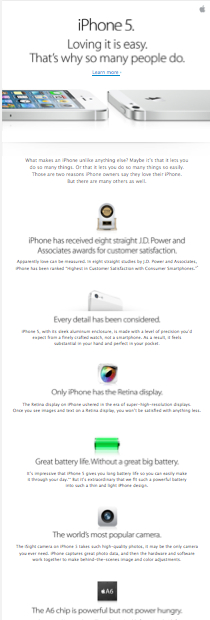
Apple eMailI recently received this promotional email from Apple for the iPhone 5. It brought to mind some of the recent chatter about Apple’s legacy and future. I’ve tended to dismiss the talk from naysayers who’ve said the Apple reign appears over. This pronouncement has been made many times over many years, and their culture, values, and willingness to take risks has consistently brought them back from the inevitable setbacks.

But this email gave me pause. Its content and tone made me think there may be a turning point afoot after all. I couldn’t recall seeing something from Apple that was working so hard to sell. Obviously, few companies have mastered the art of selling better than Apple, but the best of their work did it in a way that was less about selling and more about enticing you to buy. It wasn’t going after you as much as it was inviting you to come to them. This email has none of that flirtatious quality. It is selling and selling hard.

It lists multiple features, and the word “lists” is intentional. Feature after feature scrolls by like a spec sheet. The Apple way had been to romance a particular feature to give you a sense of what wonder lay in store for the lucky user. No such alluring Fan Dance here. Every distinguishing feature is laid out with nothing left to the imagination. Yet the most telling indicator to me is the headline – “Loving it is easy. That’s why so many people do.” I’ve never seen Apple proclaim it’s popularity. Even as it came to dominate the smartphone market, it always carried the sense of being a club for the discerning person who appreciated design and creativity. This line brings them a step closer to the car companies and other  product makers who revel in claims about “best-selling” and “most popular.” Forget the club, bring on the bandwagon. I tempered my initial reaction to this shift in tone by arguing that it may be a by-product of the email channel. Maybe they gave themselves permission to go a little bit more hardsell in a direct response oriented channel. But the iPhone website has the same line so it seems it’s the basis of a broader campaign, not just email copy. If so, this signifies a different approach than we are used to experiencing from Apple, and makes the talk of a turning point for Apple a lot more credible.

1 Comment

Filed under 21st Century Marketing, Branding, Mobile

Mobile: Moments that Matter

The rise in mobile communications signals a change in marketing that is more significant than a shift in channels. It represents a profound reconsideration in how to think about effective targeting. The principles that drive the prevailing wisdom on targeting are based on the historical move from mass advertising to direct marketing. Mass advertising provided a low CPM, but for most marketers it involved a good deal of waste. With TV, radio and print, in order to capture the people you really wanted, you had to expose your message to a larger audience of people you didn’t want. You could reduce that somewhat by seeking out narrower audiences in niche programs or titles, but it was still casting a wide net.

The promise of direct marketing was that you could deliver your communications only to the people you really wanted to reach. If you wanted affluent Moms in households with kids under 12, that’s all you had to buy. The higher CPMs that came with this approach were justified by the efficiency and higher response rates. There was a shift from seeking out as many people as possible to seeking out only the people that mattered. It was a shift from focusing on “Places that Matter” to “People That Matter.”

The arrival of digital performance marketing took the principle of “People that Matter” to an even higher degree of precision. You could go beyond demographics and customer data in targeting, and include even finer distinctions revealed by online behavior. Now you could target Moms in affluent households with kids under 12, who seek out photography tips, love Gwen Stefani videos, and visited your website two days ago. At first, Mobile seemed like an opportunity to take that specificity even further. But as the nature of mobile usage evolved, it turns out a difference in degree became a difference in kind.

Mobile shifts targeting from a focus on “People that Matter” to a focus on “Moments that Matter.” Digital media maven Dave Marsey coined that phrase to signal the new challenges and opportunities Mobile provides beyond more precise targeting of individuals. Both the explicit and implicit data around Mobile allows marketers to market to the situation rather than just a person. For many brands, the moment is more important than the person. If you are in the QSR business, for example, would you rather connect with someone in the heart of your demographic target, or with someone stepping out of work for lunch at 11:50am within a walking distance of one of your restaurants? The first choice is a person that matters, the second is a moment that matters. Ideally, you’d want both, but the power of knowing the context of the moment has the potential to trump what you know about the person.

Yet the advantage of knowing the moment is only useful if you manage to it. People generally use mobile with more intent than traditional media, and marketers will be successful to the extent that they are seen as relevant to that intent. Relevance used to be defined in terms of what you said. In the mobile ecosystem, relevance is what you provide. In the QSR example, the lunch-seeking office worker is focused on what to eat. So she’s more interested in a new menu item and much less in a concert promotion. The situation would be reversed when that same worker is headed home chilling out with Pandora.  That’s why the argument about the screen size of mobile devices and such miss the point. Mobile marketing is not about how to stand out on a screen, but how to provide people with value in that moment. Value can take many forms:  education, entertainment, shopping, etc. Taking full advantage of Moments that Matters doesn’t require more pixels; it requires more thought.


Leave a comment

Filed under Digital Marketing, Innovation, Mobile, Uncategorized