Category Archives: Uncategorized

Cannes: A Hater’s Guide

rose wine[A version of this article originally appeared in Advertising Age]

It’s easy to mock the Cannes Lions Festival of Creativity. The name alone does a lot of the work for you. Truth be told, I’m usually among those mockers. While there are many things to deeply love about our business, its need for self-congratulations is not among them. There’s no place where this need is expressed more strongly than at Cannes. My favorite complaints when joining the detractors include:

  1. You travel thousands of miles to meet with companies who would happily come to your home office tomorrow if you just asked nicely
  2. You stand a better chance of winning a Lion if you do a good job promoting a noble cause people naturally care deeply about than if you do a good job prompting a common product people naturally care little about. The latter requires 1000 times more creative juice and is the core task of our business, yet it’s scarcely represented among the “the best work.”
  3. As we face ever greater obligations for being responsible stewards of our clients’ marketing investments, we revel in rosé-soaked meetings on yachts in the South of France.

Yet before joining me in a collective eye roll, remember Oscar Wilde’s remark about cynics: they know the price of everything and the value of nothing. So while it’s easy to poke fun at the false glamor of the posers who cavort along the Croisette, it risks overlooking its fundamental substance. Here are the suggested strategies for finding the substance of Cannes:

Cross Some Borders – Because it’s roughly equidistant between Asia and the Americas, Cannes is one of the few places where the industry comes together on a global level. Despite the efforts of Brexit and Trump to stem the tides, our economic and cultural waves increasingly splash across borders. That makes Cannes a critical place for assessing the cross currents of ideas.  It’s a shame how many people run about without studying the work on display in the Palais. Don’t be one of those people. Take time to see the work on display. Even better, use one of the kiosks that allow for more efficient searching. I particularly recommend exploring work from the Nordics, Singapore, and India for ideas, as their audiences and markets tend to inspire fresh perspectives.

Stretch Out – While Cannes has been an industry mainstay for several decades, it has changed considerably in the last few years. The Festival has pushed the industry to move beyond “the ad” as the pre-eminent expression of our craft. They deserve credit for expanding the awards into interesting new categories. Its influence is in the right direction even if sometimes done in a faddish way. The specific categories to watch either in person or online are:

Creative Data

Cyber

Innovation

Product Design

Audition Your Next Partner – Much has been made in previous years of Ad Tech’s rise in the Cannes hierarchy. The names on the beachfront properties have changed, but it’s less about figuring out who’s on top than understanding how all the pieces fit together. Because marketing is becoming less about pure communications and more about the full customer experience, it requires a richer partner network to pull it all off.  The Cannes community embraces a broad diversity of players across content, media, data, and technology. To be clear, it’s nowhere near as broad as the CES start-up roster, but that’s the point. These are companies squarely focused on marketers. To get a sense of the type of partners you should start thinking about, visit the Discovery Zone in Lion Innovations.

The common theme through all these suggestions is to use Cannes to plug yourself into a broader network than you encounter in your day-to-day world. At least this cynic would have to admit that it’s impossible to leave the Festival without the impression that the business of creativity is not an isolated pursuit, but fueled by the competition and collaboration that Cannes puts on full and gaudy display.
1 Comment

Filed under Uncategorized

What’s in Store: The Transmorpher Experiment

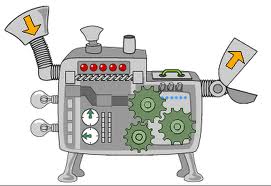
magic-machine1There’s a geeky thought experiment I used to ponder with friends to pass the time in the pre-smart phone world. It came back to mind as a way to plot how a world of AI, robots and infinite computing power may shape our future. It went like this. Imagine we perfect a brilliant machine, called the Transmorpher. The Transmorpher takes any material you feed into it, breaks it down into sub-atomic matter and then reassembles it however you instruct it to. You could shovel a pile of garbage, sand, or dirt into the machine, and it could reassemble it into a pile of precious metals. Now further imagine this machine not only generates basic elements, but assembles them together in the order and form you instructed. In today’s terms, it’s like the ultimate recycling machine combined with the ultimate 3-D printer. So, the right size pile of garbage would not only be transformed into various pure metals and plastics, but with the right instructions, combined in such a way that it was a fully-operational automobile. The first Transmorpher would be enormously expensive of course. Yet once it was up and running, it could be used to cheaply turn out duplicates of itself for anyone with stuff to pour into it. Eventually every person on earth would own their own Transmorpher.

What would be the social, political and economic effects of worldwide Transmorpher ownership? Hey, I said it was geeky. But think about it for a minute. Everyone with access to a supply of garbage, dirt, or any other physical substance can now own a Mercedes Maybach. They could also make all the gas they need to run it. The same goes for food, furniture, computers, clothes, gold, diamonds, and anything physical thing in the world. Who would win and who would lose in a world where most everything was nearly free?

Winners

Status and wealth would rely less on pure mass of ownership since everybody could own most any thing they wanted. People could no longer differentiate themselves on how many things they owned or how expensive those things were. They’d have to own unique or better things. In this environment, people would seek out the instructions to things nobody else had or had thought of yet. Transmorpher instructions would be more valuable than Transmorpher outputs. So designers and engineers who knew how to build those instructions would be in high demand.

Since the Transmorpher can only make things, human experiences would also remain at a premium. Singers, actors, professional athletes, comedians and party planners would escape commoditization in this world and would likely increase in value because of the comparative scarcity of experiences in a world of infinite stuff

Not all physical assets would lose value. Real property holdings would remain valuable. The Transmorpher couldn’t make the world any bigger. I could use the Transmorpher to make a house, but if I didn’t have anywhere to put it, it wouldn’t be of much use. Assuming we still value places to live, interact, and work together, land would retain its desirability as long as property rights were maintained.

Losers

Clearly manufacturers would lose. Knowledge about how to make things would remain valuable, but the actual making of things would be taking over by the Transmorphers. The making of things, both skilled and unskilled would lose its added value worth. Retailers would also lose out. There’d be little benefit to having a centralized provider of things when anything you want is available immediately from your Transmorpher. Distributors would then fall in that domino chain.  The Transmorpher world would severely reduce the need for things to be made in one place and then shipped to another.

In Between

 The future of service providers would be murky. On one hand, Transmorphers don’t do things, they only make things. They couldn’t paint your house, execute a marketing plan, or figure out if that lingering cough was anything serious. In that direct sense, services would not be replaced by Transmorphers. But the question would be whether designers, freed from cost constraints, could design new things to perform those services.

Government would probably both win and lose. It would be harder to regulate things in a world where anyone with a set of instructions could make whatever they pleased, whether it be narcotics, small arms, or patented products. Imagine how hard it would be to police controlled substances when there are infinite untraceable sources of supply. As a result, the job of government would get harder. Yet these same factors would lead to higher demand for just this type of enforcement. People wouldn’t want their neighbors making mini-nuclear reactors for their backyards. The size and role of government would likely expand to replace the restraints previously enforced by physical limits.

The Transmopher is a fantasy of course. But it’s a useful fantasy to plot the possible paths our world is headed, for good and bad. We’ll never arrive at the Transmorpher, but that’s the path we’re currently on. The most interesting implication for us is that many of the things that determine our social and economic order are based on the natural constraints of our physical world. As we engineer ourselves beyond those constraints, we’ll have to choose how and whether we replace them with a self-imposed order.

Leave a comment

Filed under Artificial Intelligence, Innovation, trends, Uncategorized

Marketers’ Quest for the Infinite Conversation

conversationThe most important dynamics of the modern marketplace flow from our moving ever closer to a world of infinite choice. As consumers, we’re both overwhelmed and delighted by the expanding ability to obtain whatever we want, at almost every possible time and place. As marketers, we’re both overwhelmed and delighted by the expanding ability to connect with whomever we want, at almost every possible time and place. So consumers and marketers alike face the conundrum of a world of infinite choice – infinite channels, infinite competitors, infinite sources of influence, and infinite decisions.

In that context, we see a marketing universe still defined by the finite thinking of campaigns. It’s become embedded in our culture. It’s not an unusual cocktail party topic to recall “that great campaign that so-and-so did” back in the day. Lord knows marketers think in campaigns too. We give each other awards for campaigns; nominate colleagues to various Hall of Fames based on their association with great campaigns. Even sophisticated marketers think this way most times, referring to the launch of social programs much like most do about TV shows.  A campaign is a natural way for us to talk about what we do because it fits an easy narrative arc – it has a beginning and an end.  But that is why campaigns have become less useful as the way to think about marketing. They come from a time when the brand was the sole storyteller – deciding the story, the pace, and the order of the narrative arc.

But if you look at the marketers who are succeeding in our evolved marketplace, they’re not bound by a campaign mentality. They’re crafting their stories to come from many places besides directly from the brand. Brands like Zappos, Heineken, and Über are benefitting in different ways from  surprise and serendipity more than from crafting clear consistent narratives. Their stories unfold on different threads spread across time and channels that defy neat categorization into well-defined beginnings and ends.  As the different authors intersect, contradict, and overlap each other, the metaphor of Brand as Storyteller falls short.  Stories are still an essential part of brand building, but the emphasis is on the plural.  Brands are drawing power from the energy generated by the exchange of new stories  from multiple sources.  When you exchange stories, and share your reactions to them, that is more than storytelling. For the brands that do it best, it’s a conversation that never stops, that is constantly building on itself and moving in different directions.  In today’s environment, it turns out the power of stories to build brands is as much in the sharing as in the telling.

So, adroit marketers push to build and refresh a continuous conversation for the brand. Their real measure of success is not in the initial impact of what they put out into the world, but in the total amount of interactions, sharing or responses that it provokes. We too often only measure the initial impact of a message delivered  (ASI score, 2+ Reach, Ad Views) when we should be measuring the total impact of the secondary effects it generates. The goal is to create and shape a growing stream of exchanges that make the brand the subject of an infinite conversation. In this model, the best marketer is not the one who creates the biggest splash but the one who consistently makes the most waves.

Leave a comment

Filed under 21st Century Marketing, Innovation, Uncategorized

Has Marketing Truly Changed?

Retro-Telephone-And-Charger-For-Smartphone-Amazon-460x3842014 has brought the usual proclamations of  trends and predictions for marketers in the year ahead. Most of them take the tack of asserting how the world will be transformed and marketing forever changed.  There are, of course, the contrarians who dismiss everything as hype, asserting that the only thing that has changed is the buzzwords.

As always, there is truth in both views when viewed in the proper context. Here is a short list of what isn’t changing and what has changed for marketers across every industry.

WHAT ISN’T CHANGING

1. The Importance of Emotional Connections

The best brands foster an emotional connection with people that transcends product attributes. We are emotional animals in the end, and we want to feel an attachment with the things we use and own. It does not matter how quickly a brand adopts the latest social network if it doesn’t have a reason people want to connect.

2. The Discipline of Strategic Brand Behavior

People want their brands to stay in character. The tactics can be wide-ranging and innovative as long as they are rooted in what people come to the brand for in the first place. I don’t want my sportscar fantasy interrupted by a message of responsibility and I don’t want my warm family moment put off by a sexy flirtation. Regardless of the venue, a brand still needs to be rooted in a strategic reason for being.

3. The Quest for Differentiation

No matter what media we pursue, the marketing environment is characterized by clutter. The noise of life  creates the constant challenge to find ways to meaningfully stand out not just from competitors but from the hum we’ve taught ourselves to ignore.

WHAT HAS CHANGED

1. Consumer Expectations

We expect far more interaction with the companies we transact with. We expect them to respond in individualized ways . We expect to them to be where we are instead of searching out where they are. We bring an attitude to all our brand interactions that we used to only  bring  to our calls to customer service.

2. Performance Expectations

The rise of addressable media has increased the emphasis on measurement. Quarterly awareness tracking is increasingly inadequate for both marketers and the people they’re accountable too. Understanding and weighing the contribution of the marketing mix will continue to get more sophisticated and rigorous.

3. Expanding Toolsets

The explosion of channels has created a nearly infinite toolset for marketers. This will only continue. The idea of 360 marketing will be rendered increasingly irrelevant for its sheer impossibility. Marketers will need to strategically identify the tools and channels that make the most sense for them and their customers.

4. The Demands of Me.Here. Now

The world will keep speeding up on every level. On the cultural level, brands wanting to tap into social trends will require the means to respond in days not weeks. On the individual level, we’ll grow increasingly impatient with companies that don’t respond to us immediately. The continued rise of mobile technology will march hand-in-hand with a rising demand to engage when and where we want.

In short, the principles of brand marketing remain intact. The value of clear brand vision and a rich customer understanding is eternal. But the application of those principles demands a new mode of action that is rooted less in an architectural mindset (plan, design, build) and more in a software development mindset (build, learn, rebuild).

Leave a comment

Filed under 21st Century Marketing, Innovation, Market Strategy, Mobile, Uncategorized

Complexity is the New Clutter for CMOs

ImageTen years ago, the most pressing challenge facing CMOs was how to break through the clutter of mass advertising. So they partnered with agencies who developed a reputation for getting noticed in the noise. The Burger King work developed with Crispin Porter epitomized this world. Many found the plasticized King off-putting, but it definitely got noticed. In a world of advertising overload, that was no small feat.

The need to connect emotionally with people will always be fundamental to brand building, but clutter is no longer the CMO’s chief adversary. Today’s market is ruled more by complexity than clutter. Marketers face consumer expectations that are increasing exponentially. We now insist that companies respond instantly to us in the channels of our choosing. We don’t call or email their service department; we put a hashtag in front of their name and expect a prompt response.  We want sales and service to move easily between offline and online worlds.  At the same time, the means to meet these expectations are expanding. Established players like Twitter, Google and Facebook are introducing new features weekly, and players with new models arrive by the dozens every month. The infrastructure needed to support the effective use of these avenues That’s why Gartner predicted that CMOs would be spending more on IT than CIOs by 2017. 

Yet amid this exponential expansion, marketing budgets only increase linearly, if they increase at all. It’s little wonder that many CMOs feel they’re losing ground. Accenture reported earlier this year that the overall feeling among CMOs is that they are less prepared to compete in today’s marketplace than they were a year ago . About 4 in 10 CMOS said they lack the tools, people, and resources to meet their objectives. You know it’s tough going when you feel you’re moving backwards.

As a result, CMOs are looking for a new set of partners to help them manage a fundamental difference with the Complexity Challenge. Overcoming clutter meant figuring out how to use the same tools everybody else was using more creatively. Overcoming complexity means figuring out which tools to use and how to use them. This requires not just creative insight, but business, technical and channel insight. Today’s CMO needs partners who can:

  • Sort through the flood of new offerings to constantly update the right strategic portfolio of tools that will deliver the most impact
  • Orchestrate the use of those tools so they inform and reinforce each other
  • Harness the value of advanced analytics to generate the right feedback on where and how to win more hearts, minds, and business from the people who matter most to the business

Leave a comment

Filed under Uncategorized

Mobile: Moments that Matter

The rise in mobile communications signals a change in marketing that is more significant than a shift in channels. It represents a profound reconsideration in how to think about effective targeting. The principles that drive the prevailing wisdom on targeting are based on the historical move from mass advertising to direct marketing. Mass advertising provided a low CPM, but for most marketers it involved a good deal of waste. With TV, radio and print, in order to capture the people you really wanted, you had to expose your message to a larger audience of people you didn’t want. You could reduce that somewhat by seeking out narrower audiences in niche programs or titles, but it was still casting a wide net.

The promise of direct marketing was that you could deliver your communications only to the people you really wanted to reach. If you wanted affluent Moms in households with kids under 12, that’s all you had to buy. The higher CPMs that came with this approach were justified by the efficiency and higher response rates. There was a shift from seeking out as many people as possible to seeking out only the people that mattered. It was a shift from focusing on “Places that Matter” to “People That Matter.”

The arrival of digital performance marketing took the principle of “People that Matter” to an even higher degree of precision. You could go beyond demographics and customer data in targeting, and include even finer distinctions revealed by online behavior. Now you could target Moms in affluent households with kids under 12, who seek out photography tips, love Gwen Stefani videos, and visited your website two days ago. At first, Mobile seemed like an opportunity to take that specificity even further. But as the nature of mobile usage evolved, it turns out a difference in degree became a difference in kind.

Mobile shifts targeting from a focus on “People that Matter” to a focus on “Moments that Matter.” Digital media maven Dave Marsey coined that phrase to signal the new challenges and opportunities Mobile provides beyond more precise targeting of individuals. Both the explicit and implicit data around Mobile allows marketers to market to the situation rather than just a person. For many brands, the moment is more important than the person. If you are in the QSR business, for example, would you rather connect with someone in the heart of your demographic target, or with someone stepping out of work for lunch at 11:50am within a walking distance of one of your restaurants? The first choice is a person that matters, the second is a moment that matters. Ideally, you’d want both, but the power of knowing the context of the moment has the potential to trump what you know about the person.

Yet the advantage of knowing the moment is only useful if you manage to it. People generally use mobile with more intent than traditional media, and marketers will be successful to the extent that they are seen as relevant to that intent. Relevance used to be defined in terms of what you said. In the mobile ecosystem, relevance is what you provide. In the QSR example, the lunch-seeking office worker is focused on what to eat. So she’s more interested in a new menu item and much less in a concert promotion. The situation would be reversed when that same worker is headed home chilling out with Pandora.  That’s why the argument about the screen size of mobile devices and such miss the point. Mobile marketing is not about how to stand out on a screen, but how to provide people with value in that moment. Value can take many forms:  education, entertainment, shopping, etc. Taking full advantage of Moments that Matters doesn’t require more pixels; it requires more thought.


Leave a comment

Filed under Digital Marketing, Innovation, Mobile, Uncategorized

Digital Marketing is Dead – Long Live Digital Marketing

The marketing services community is undergoing yet another spin as the world’s cultural and functional landscape grows ever more digital.  On one side, so-called traditional agencies continue striving to prove that they get digital with all the subtlety of an American Idol audition. On the other side, digital agencies are equally eager to show they can take center stage after years of playing support roles. Both sides fear irrelevance as the “digital” label becomes as redundant to marketing as the word “hard” is to “rock.” When almost every communication medium is technically being created or transmitted digitally, what does it mean to be digital?

You can see the challenge of this realization in how larger agencies are repositioning themselves and their digital arms. Large legacy agencies that excitedly established separate digital arms 8-10 years ago, like Tribal DDB or G2, are now figuring out how to reel them back in. What was seen as innovative then is now seen as damning evidence that your mother company doesn’t understand the digital space. Digital agencies are dealing with different ramifications of the same issue. If all marketing is becoming digital, and some agencies like Weiden and Goodby show themselves to be as creative in the digital arena as they were in  broadcast, are digital agencies starting to look too specialized to drive big brand ideas?

For marketers trying to sort this all out, it’s best to avoid the labels of traditional and digital. They may have been helpful for understanding what these places did in the past, but they are not helpful for what they can do for a brand now. The world may be going digital, but that does not mean that digital agencies are the best choice for marketers going forward. Too many digital agencies got that title because of their expertise with a particular toolset – websites, mobile apps or social community management. The current rise of digital goes beyond the toolset. It is the influence on our culture and expectations where digital is now having the most impact. People who’ve never redeemed a GroupOn or tweeted a word are thinking and behaving differently because of the impact the digital world is having on everything we do. In that sense, being digital is no longer about a toolset, it is about a mindset.

Marketers looking for a partner who can help then succeed in the modern marketplace want an agency with a digital mindset regardless of their historical toolset. In a marketing sense, a digital mindset means:

Invitations vs. Performances

When you think of your potential customers in terms of an audience, you think in terms of performing for them. It’s your show, and they are there to enjoy it.  You’re looking for feedback, but only of a limited kind — applause, cheers, laughter, boos.  If you think of  your customers as participants in your brand, you think in terms of inviting them to join with what you’re doing. Sometimes you’ll both be in the audience together, sharing common interests. Sometimes you’ll both be on stage, sharing new product ideas. In these and every situation in between, an invitation-mentality reflects the digital sensibility of marketing with people instead of to them.

2.1 vs. Ta Da

A traditional mindset sees success as an event, whereas a digital mindset sees it more as a process. The traditional campaign mentality treats each new effort as one-time attempt to get it right. You work on pulling work together for six months or so, then unveil it to the world like a movie or a book launch. The digital mentality sees a world that is more iterative. In the digital experience, you don’t expect to get everything right in your first version. You build it as best you can, and you expect to have to issue new versions to address issues or opportunities you did not foresee, or that may not have been there when you started.  No success is expected to continue without continual refinement and improvement. A traditional mindset tends to see the world in discrete episodes. A digital mindset sees the world more as real-time stream.

Speed Skating vs Figure Skating

Figure skating and speed skating both involve competitions on ice, but success takes different paths. In figure skating, you are the best in the world to the extent that you can convince an influential panel of judges that you are the best. In many ways, it is equivalent to how agencies used to get ranked. If you won a lot of awards from judges who thought you were good, that meant you were good. In speed skating, you are the best if you go faster than anybody else. Digital agencies love measuring. They’re hungry to prove what’s working. They don’t only use data at the end to build the case study, they use it in the beginning to shape the work. Marketing will always constitute some measure of both art and science, but digital agencies look for inspiration from them both.

Architects vs. Authors

If  I ask  who wrote “The Great Gatsby,” many could tell me it was F. Scott Fitzgerald. If I ask  who built the Empire State Building, the answer is both less well-known and less clear. An author takes satisfaction in literally crafting every word of their work. Owning the idea in the literary world means owning both the overarching concept and each detail of its execution. You rarely see books credited to more than one author. The traditional mindset has a similar instinct around enshrining the auteur. Architects, on the other hand,  know that their craft requires collaboration across many fields. They put forward the vision, but recognize the critical need for fellow engineers, builders, interior designers, and a host of others to make the idea come to life. The architect parallels the digital mindset that naturally looks to partnership as the operative model.

Digital marketing is entering a new phase where is less about mastering the technology and more about mastering the cultural dynamic. The tools will constantly be changing, so the toolset becomes less relevant. The digital mindset is what will drive marketing into the next phase.

Leave a comment

Filed under 21st Century Marketing, Innovation, Uncategorized

How Markets Create the Need for Tea Parties

As the anti-incumbent story rumbles  across the mediascape, there is a familiar theme — call it the “I’m mad as hell and I’m not going to take it anymore” movement. Congress is at its lowest approval ratings of all time, political distrust is at an all-time high, and new activist fervor is sweeping the land. Politics as we know it is about to change.

Don’t believe the hype.  Whether it’s the Know Nothings of the 1840’s, the Term Limit supporters of the 1990’s,  or today’s Tea Party, they are all a response to the fundamental structure of the American political market.

I worked on political campaigns, and it is important to learn that there is a fundamental difference between the political marketplace and the consumer marketplace.  Both are ruthlessly competitive, so it is not a difference in ethics or morality. It has to do with what I call “category effects.”  Consumer markets have them, and political markets don’t.  Here’s why.

In simple game theory terms, there are four general outcomes between two competitors in the consumer marketplace:

  • Both gain
  • Both lose
  • Competitor 1 gains, Competitor 2 loses
  • Competitor 1 loses, Competitor 2 gains

For an example where both gain, look at Adidas and Nike. Both doing well financially, both well-regarded major brands, and benefiting to a large extent from the fact that they have a major competitor helping them drive the market and mythology of athletes and athletic gear.

For an example where both lose, look at United and American Airlines. Even before the recession, the two largest US carriers were losing share to Southwest-like competitors on the discount end and Virgin on the high-end. Neither gained from the struggles of the other, and both added to each other’s  problems by pricing and service policies that soured people on the airline travel experience.

In both situations, individual players face consequences for how the whole category performs.  If companies compete in such a way that the category grows, they may both win.  If they compete in a way that the category suffers, they may both lose. It is in their self-interest to have people think well of the category.

By contrast, political competition has only two outcomes:

  • Competitor 1 gains, Competitor 2 loses
  • Competitor 1 loses, Competitor 2 gains

In a campaign, it does not matter if you have two great candidates or two terrible candidates, one person gets elected.  There is no outcome where both gain or both lose.  There are 100 Senators in the US Congress, and short of a change to the Constitution or an overthrow of the US government, that number is not going to change based on people’s approval ratings.   In other words, there are no category effects for politicians. If doesn’t matter if people love or hate the category, 50 people still win the same prize either way. There is no self-interest for politicians to make people feel better about the category.

That is why negative advertising is frowned upon in the consumer marketplace, and embraced in the political marketplace.  In politics, if people hate the category I’m in, I can still win as long as they dislike my opponent more than me.  It doesn’t matter if the population is so put off that only 3 people even bother to vote. If two of them vote for me, I win.   In the supermarket, if people hate the my category, it does not help if they hate me less.  I still lose. If two people buy my product  and only one buys my competitor’s, we both go out of business.

As long as there are no category effects in politics, there is no incentive within the system for the candidates to improve the institution.  Efforts like the Tea Party represent an external effort from outside the system,  attempting to impose category effects on a market that inherently lacks them.  If patterns are true to form, one of the political parties will absorb their key tenets into their platforms, and the system will continue to chug along as it always has.

1 Comment

Filed under 21st Century Marketing, Branding, Market Strategy, Uncategorized