What’s in Store: The Transmorpher Experiment

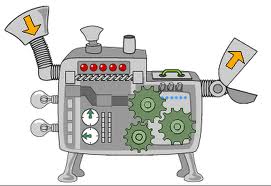
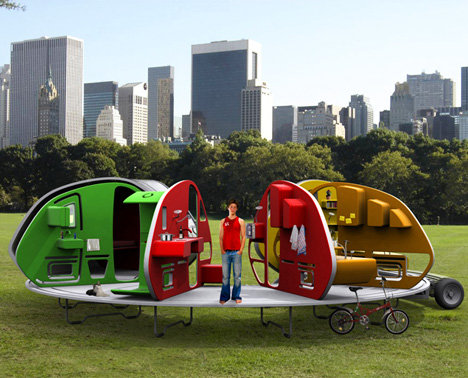
magic-machine1There’s a geeky thought experiment I used to ponder with friends to pass the time in the pre-smart phone world. It came back to mind as a way to plot how a world of AI, robots and infinite computing power may shape our future. It went like this. Imagine we perfect a brilliant machine, called the Transmorpher. The Transmorpher takes any material you feed into it, breaks it down into sub-atomic matter and then reassembles it however you instruct it to. You could shovel a pile of garbage, sand, or dirt into the machine, and it could reassemble it into a pile of precious metals. Now further imagine this machine not only generates basic elements, but assembles them together in the order and form you instructed. In today’s terms, it’s like the ultimate recycling machine combined with the ultimate 3-D printer. So, the right size pile of garbage would not only be transformed into various pure metals and plastics, but with the right instructions, combined in such a way that it was a fully-operational automobile. The first Transmorpher would be enormously expensive of course. Yet once it was up and running, it could be used to cheaply turn out duplicates of itself for anyone with stuff to pour into it. Eventually every person on earth would own their own Transmorpher.

What would be the social, political and economic effects of worldwide Transmorpher ownership? Hey, I said it was geeky. But think about it for a minute. Everyone with access to a supply of garbage, dirt, or any other physical substance can now own a Mercedes Maybach. They could also make all the gas they need to run it. The same goes for food, furniture, computers, clothes, gold, diamonds, and anything physical thing in the world. Who would win and who would lose in a world where most everything was nearly free?

Winners

Status and wealth would rely less on pure mass of ownership since everybody could own most any thing they wanted. People could no longer differentiate themselves on how many things they owned or how expensive those things were. They’d have to own unique or better things. In this environment, people would seek out the instructions to things nobody else had or had thought of yet. Transmorpher instructions would be more valuable than Transmorpher outputs. So designers and engineers who knew how to build those instructions would be in high demand.

Since the Transmorpher can only make things, human experiences would also remain at a premium. Singers, actors, professional athletes, comedians and party planners would escape commoditization in this world and would likely increase in value because of the comparative scarcity of experiences in a world of infinite stuff

Not all physical assets would lose value. Real property holdings would remain valuable. The Transmorpher couldn’t make the world any bigger. I could use the Transmorpher to make a house, but if I didn’t have anywhere to put it, it wouldn’t be of much use. Assuming we still value places to live, interact, and work together, land would retain its desirability as long as property rights were maintained.

Losers

Clearly manufacturers would lose. Knowledge about how to make things would remain valuable, but the actual making of things would be taking over by the Transmorphers. The making of things, both skilled and unskilled would lose its added value worth. Retailers would also lose out. There’d be little benefit to having a centralized provider of things when anything you want is available immediately from your Transmorpher. Distributors would then fall in that domino chain.  The Transmorpher world would severely reduce the need for things to be made in one place and then shipped to another.

In Between

 The future of service providers would be murky. On one hand, Transmorphers don’t do things, they only make things. They couldn’t paint your house, execute a marketing plan, or figure out if that lingering cough was anything serious. In that direct sense, services would not be replaced by Transmorphers. But the question would be whether designers, freed from cost constraints, could design new things to perform those services.

Government would probably both win and lose. It would be harder to regulate things in a world where anyone with a set of instructions could make whatever they pleased, whether it be narcotics, small arms, or patented products. Imagine how hard it would be to police controlled substances when there are infinite untraceable sources of supply. As a result, the job of government would get harder. Yet these same factors would lead to higher demand for just this type of enforcement. People wouldn’t want their neighbors making mini-nuclear reactors for their backyards. The size and role of government would likely expand to replace the restraints previously enforced by physical limits.

The Transmopher is a fantasy of course. But it’s a useful fantasy to plot the possible paths our world is headed, for good and bad. We’ll never arrive at the Transmorpher, but that’s the path we’re currently on. The most interesting implication for us is that many of the things that determine our social and economic order are based on the natural constraints of our physical world. As we engineer ourselves beyond those constraints, we’ll have to choose how and whether we replace them with a self-imposed order.
Leave a comment

Filed under Artificial Intelligence, Innovation, trends, Uncategorized

Taking the Artificial Out of AI

In case you haven’t noticed, Artificial Intelligence is the It Girl for marketers these days. Just about every ad tech tool now claims to be powered by AI components. Agencies and consultants are touting their AI capabilities. CMOs are bragging on their AI initiatives. As a result, the definition of AI has become stretched beyond recognition. Many people are defining it by what it does (language processing, data manipulation, visual recognition, etc.). But the real mark of artificial intelligence is how it does it. A chess-playing computer could be AI or not. If it plays chess by analyzing every possible move on the board, assigning it probability of success, and selecting the move with the highest probability, then it isn’t Artificial Intelligence. If it plays chess by applying certain principles, and refining those principles through feedback gained from multiple games, then it is AI.

While the more technically-minded would have more specific and accurate definitions, marketers can practically characterize Artificial Intelligence applications by two things:

  • The ability to perform tasks for which they’re not explicitly programmed
  • The self-directed capacity to improve that ability as it is exposed to more tasks.

At the core of the computing age is the power of If-Then processing: If a certain condition is true, then perform a defined operation. For example, you might program a traditional application by coding “if Speed is greater than 55mph, Road = Expressway and Weather = Rain, then reset Speed to 45mph.” This is an explicit direction. Using AI, you could effectively program an application more along the lines of “If driving conditions become less safe, then slow down to meet the conditions.” Using the definition outlined above, AI would use a variety of input (weather, traffic, type of road) to determine what is “less safe” and the speed appropriate to the conditions.  Based on feedback(e.g. how many accidents occurred), it would improve its definition of “less safe” over time without a developer having to go in and explicitly recode every conceivable definition of “less safe”. So while the first explicit program will never change its behavior, an AI program would learn to distinguish between rain falling at 70F and rain falling at 32F. In essence, AI allows applications to refine their If/Then engine autonomously.

There are many things being touted as AI that really aren’t. For example, increased processing power is allowing for even more extensive and sophisticated searches of ever larger databases. So, if you ask a Dinner Bot for recipes using tofu, asparagus and mayonnaise that’s quick to make, it can search multiple recipe databases, correlate those ingredients with preparation times under 20 minutes and send you back the 10 most popular recipes fitting that description. It can do all that using explicit instructions. While it may be impressive, it is not AI. Here’s one test to apply to see if something is really powered by AI. Will the results of the applications change over time depending on who is using it? The answer should be “yes.” In other words, two identical AI applications should start to yield different results if they are used by two distinct groups of users. That’s because they’ll be exposed to different situations and different feedback that should affect its autonomous development.

For marketers looking how to start thinking about applying AI to their businesses, Shelly Palmer provides a typically insightful view of the topic.


Leave a comment

Filed under Artificial Intelligence, Data Science, Innovation

The Rise of Access Over Ownership

modular houseThere’s an old saying that if you like sailing, don’t buy a boat, just make friends with someone who owns one. That saying goes a long way towards describing one of the most interesting long-term cultural shifts underway. Ownership is becoming less of a benefit across a variety of goods and services. That’s particularly interesting because ownership used to seem like such a bedrock of our genetic makeup. Like a toddler proclaiming “mine,” it’s deep in the human psychology to declare what’s ours.

Yet the trend away from ownership is unmistakable. The valuation of Uber isn’t based on replacing taxis but on replacing car ownership. With an increasing percentage of the world’s population moving into cities, there’s less appetite for the rising costs of individual car ownership. Pride of ownership has been deeply rooted in our homes for generations.  Yet home ownership is falling among millennials. The recession and related mortgage crisis were the original explanation, but rental prices have risen significantly in the past two years and the trend continues. Airbnb is focused on vacation and short-term rentals for now, but it’s clear long-term mission is the Uberization of housing as well.

The trend trickles down through numerous categories. The rise of the cloud has made software ownership obsolete. Businesses and consumers alike now see it as less useful to have software on their own computers. The ability to access software from anywhere and avoid the hassle of upgrades and backups make it a preferred option. Music is yet another example. iTunes is scrambling to develop their own streaming Beats service as they’ve watched their once revolutionary purchase model lose share to Pandora and Spotify users. The benefits of ownership have been supplanted by the benefits of access. Being able to get a ride in minutes to wherever I want to go is more important than owning a car. Being able to listen to my favorite band whenever I want is more important than having them in my personal music collection.

Interestingly, this is a trend that often moves from the bottom up economically. The path to Uber started with car leasing in the 1980s as a way to give people the means to drive cars they otherwise couldn’t afford. But when the trend moves up to premium items, it’s less about avoiding cost constraints than avoiding the constraints of ownership. One source calculates that it takes a family over three years (600 loads) to justify purchasing a washer and dryer. If companies make it cheaper and more convenient to do your laundry on their machines, why bother? This hints at how this trend will impact every consumer durable. In this light, we’ll see access overtake ownership in appliances (Lavanda), clothing (Crossroads Trading), and furniture (Furlenco). People will increasingly switch among homes and the things in them with the same mindset they apply to switching tracks on their Pandora soundtrack.

2 Comments

Filed under 21st Century Marketing, Innovation

The Two Most Important Words in Marketing

if-then*The most dramatic advances in human development over the past century can be summed up in two words: “if then.” That phrase sums up all the power unleashed by the age of computing. Fueled by Moore’s law, the path from the Babbage Machine curiosity of 1822 to IBM’s Watson is an exponential acceleration in the if/then processes we can manipulate in a given time. The algorithm, or the ability to perform complex tasks with a cascade of simpler If/Then actions, has yielded stunning advances in machinery, medicine, communications and artificial intelligence that are redefining our lives on several levels.

It may seem a stretch to tie those lofty heights to the earthier world of marketing. Yet it’s as true for marketing as it is for any human endeavor that future advances lie in more fully harnessing the force of If/Then. We see the early effects in the rise of programmatic media. Programmatic advertising allows marketers to perform instantaneous if/then decisions across millions of potential customers and thousands of destinations. It is now a question of when, not if, all media will be programmatic. As significant as that is, media purchase and delivery is not the full extent of its impact.

With only a small degree of oversimplification, all marketing can be translated into the If/Then processes. In fact, it harnesses the two areas that are currently most at the tip of every CMO’s tongue: Data and Content. That’s because Data feeds the If, and Content provides the Then. Data signals the people and the context around them that spur an adept marketer to act. Content is the action the marketer takes to react to that signal. So if Home Depot sees a suburban homeowner within a mile of their store on a warm April day, then it forwards Spring planting tips and an offer from their Gardening Center. The response generates data that sets up the follow-on If/Then. If the Spring planting tips led to a purchase, then gauge their interest in a Loyalty program for the summer ahead. The effectiveness of the marketing correlates with the depth and breadth of If/Then branches the marketer can meaningfully define.

The Art vs. Science group might argue that applying the If/Then paradigm to its logical extreme overlooks the human factor that underlies the best marketing. In that view, the most successful brands, the ones that inspire deep-seated passion and loyalty like Harley Davidson and Nike, exist in an emotional territory above the mechanical abilities of If/Then algorithms. And of course, they’d be wrong. If/Then unleashes creativity rather than constrains it. It’s true that you’ll get mechanical transactional marketing if all you feed into the If is mechanical transactional data. But if you feed individual interests and passions into the Ifs, you uncover ways to forge even more meaningful human connections. Imagine how much more value a marketer could deliver to a runner who just had a child, or who’s on a business trip away from their regular running route, then it could to just a runner who is due for a new pair of shoes. The If/Then approach allows marketers to deliver on that kind of potential at a scale and sophistication that evades today’s most intimate marketer.

* this topic was inspired by a discussion with Baba Shetty, a brilliant thinker on various topics including commercial media

1 Comment

Filed under 21st Century Marketing, Digital Marketing, Innovation

The Treasure of 3D Data

People As DataThe promise of digital marketing keeps crawling closer in tantalizing steps. The ability to market to individuals at scale still has obstacles, and the best of the current digital case studies tend to major in being one or the other – a truly personal idea delivered to a narrow audience or the mass delivery of a rich homogeneous idea. Nonetheless, problems that once seemed insurmountable in marrying the two together now seem merely expensive and difficult. The future is clear to even the least imaginative people in the field.

In that future, the winners will be those who can deliver on the oft-cited ideal of the “segment of one.” It doesn’t take the most brilliant of minds to understand that in a world of individualized marketing, the primary asset of a marketer will be individuals. As obvious as that sounds, it’s not the current state of affairs. Most marketers borrow or rent their individuals. Whether it’s the subsciptions of YouTube, the social graph of Facebook, or the databases of Acxiom, the asset of individuals is largely in the hands of others.

In some ways, this has been the premise of CRM systems for a while. But CRM has usually been restricted to current customers, loyalty programs, and first party data sources. As a result, these internal systems don’t describe three-dimensional individuals as much as shadows of them projected on a wall. The other panacea of punditry is to say this is all about Big Data. But that’s not really true. There’s a lot of noise in data.  A good deal of what we generate is not meaningful. We may know people’s demographics and shopping history in great detail. Those may hint at their motivations. Yet knowing their actual interests is many times more useful to both the marketer and the marketed. Knowing where someone lives is far less important than knowing what they love. Any marketer of worth should be willing to trade every demographic detail they have on a potential customer – age, address, income, zip code, education, family status – for their music playlist.  3D Data shapes an individual in real dimensions.

The marketer who can connect first party information with the type of 3D Data that gives shape to a person can unlock value for both themselves and their customers. True individual data assets contain deep value for marketers to mine in the marketplace that’s fast arriving. It’s too valuable to cede to third parties. Prudent marketers will work to take ownership of that asset for themselves.

Leave a comment

Filed under Digital Marketing, Innovation

Marketers’ Quest for the Infinite Conversation

conversationThe most important dynamics of the modern marketplace flow from our moving ever closer to a world of infinite choice. As consumers, we’re both overwhelmed and delighted by the expanding ability to obtain whatever we want, at almost every possible time and place. As marketers, we’re both overwhelmed and delighted by the expanding ability to connect with whomever we want, at almost every possible time and place. So consumers and marketers alike face the conundrum of a world of infinite choice – infinite channels, infinite competitors, infinite sources of influence, and infinite decisions.

In that context, we see a marketing universe still defined by the finite thinking of campaigns. It’s become embedded in our culture. It’s not an unusual cocktail party topic to recall “that great campaign that so-and-so did” back in the day. Lord knows marketers think in campaigns too. We give each other awards for campaigns; nominate colleagues to various Hall of Fames based on their association with great campaigns. Even sophisticated marketers think this way most times, referring to the launch of social programs much like most do about TV shows.  A campaign is a natural way for us to talk about what we do because it fits an easy narrative arc – it has a beginning and an end.  But that is why campaigns have become less useful as the way to think about marketing. They come from a time when the brand was the sole storyteller – deciding the story, the pace, and the order of the narrative arc.

But if you look at the marketers who are succeeding in our evolved marketplace, they’re not bound by a campaign mentality. They’re crafting their stories to come from many places besides directly from the brand. Brands like Zappos, Heineken, and Über are benefitting in different ways from  surprise and serendipity more than from crafting clear consistent narratives. Their stories unfold on different threads spread across time and channels that defy neat categorization into well-defined beginnings and ends.  As the different authors intersect, contradict, and overlap each other, the metaphor of Brand as Storyteller falls short.  Stories are still an essential part of brand building, but the emphasis is on the plural.  Brands are drawing power from the energy generated by the exchange of new stories  from multiple sources.  When you exchange stories, and share your reactions to them, that is more than storytelling. For the brands that do it best, it’s a conversation that never stops, that is constantly building on itself and moving in different directions.  In today’s environment, it turns out the power of stories to build brands is as much in the sharing as in the telling.

So, adroit marketers push to build and refresh a continuous conversation for the brand. Their real measure of success is not in the initial impact of what they put out into the world, but in the total amount of interactions, sharing or responses that it provokes. We too often only measure the initial impact of a message delivered  (ASI score, 2+ Reach, Ad Views) when we should be measuring the total impact of the secondary effects it generates. The goal is to create and shape a growing stream of exchanges that make the brand the subject of an infinite conversation. In this model, the best marketer is not the one who creates the biggest splash but the one who consistently makes the most waves.

Leave a comment

Filed under 21st Century Marketing, Innovation, Uncategorized

The Dumbing Down of Online Video Advertising

dumb-and-dumber1In the past week’s NewFront gathering in NYC, AOL, Hulu, YouTube and Yahoo all bragged on their new measurement offerings with some combination of comScore and Nielsen. The common message is that advertisers can now evaluate online and offline video in an apples-to-apples comparison. There is a decades long history of buying TV based on ratings. So the online video giants who want to tap into those enormous TV budgets are giving those buyers what they need to switch offline dollars to online.

The only problem is that it takes the industry backwards.  TV ratings are the vestige of 1950’s technology. It measures that the TV was on a certain channel at a certain time. There’s no measure of whether the ads were watched, let alone engaged with in some fashion.  As Baba Shetty puts it, we need HPAs (Humans Paying Attention) more than GRPs (Gross Rating Points). The recent New York Times article about how few online video ads are even visible aptly reinforces the point. Whether an ad runs alongside some content is at best a rough measure and at worst a deceit. Advertisers should push traditional TV networks to smarten their measures rather than reward online networks for dumbing theirs down.

Leave a comment

Filed under 21st Century Marketing, Digital Marketing

Has Marketing Truly Changed?

Retro-Telephone-And-Charger-For-Smartphone-Amazon-460x3842014 has brought the usual proclamations of  trends and predictions for marketers in the year ahead. Most of them take the tack of asserting how the world will be transformed and marketing forever changed.  There are, of course, the contrarians who dismiss everything as hype, asserting that the only thing that has changed is the buzzwords.

As always, there is truth in both views when viewed in the proper context. Here is a short list of what isn’t changing and what has changed for marketers across every industry.

WHAT ISN’T CHANGING

1. The Importance of Emotional Connections

The best brands foster an emotional connection with people that transcends product attributes. We are emotional animals in the end, and we want to feel an attachment with the things we use and own. It does not matter how quickly a brand adopts the latest social network if it doesn’t have a reason people want to connect.

2. The Discipline of Strategic Brand Behavior

People want their brands to stay in character. The tactics can be wide-ranging and innovative as long as they are rooted in what people come to the brand for in the first place. I don’t want my sportscar fantasy interrupted by a message of responsibility and I don’t want my warm family moment put off by a sexy flirtation. Regardless of the venue, a brand still needs to be rooted in a strategic reason for being.

3. The Quest for Differentiation

No matter what media we pursue, the marketing environment is characterized by clutter. The noise of life  creates the constant challenge to find ways to meaningfully stand out not just from competitors but from the hum we’ve taught ourselves to ignore.

WHAT HAS CHANGED

1. Consumer Expectations

We expect far more interaction with the companies we transact with. We expect them to respond in individualized ways . We expect to them to be where we are instead of searching out where they are. We bring an attitude to all our brand interactions that we used to only  bring  to our calls to customer service.

2. Performance Expectations

The rise of addressable media has increased the emphasis on measurement. Quarterly awareness tracking is increasingly inadequate for both marketers and the people they’re accountable too. Understanding and weighing the contribution of the marketing mix will continue to get more sophisticated and rigorous.

3. Expanding Toolsets

The explosion of channels has created a nearly infinite toolset for marketers. This will only continue. The idea of 360 marketing will be rendered increasingly irrelevant for its sheer impossibility. Marketers will need to strategically identify the tools and channels that make the most sense for them and their customers.

4. The Demands of Me.Here. Now

The world will keep speeding up on every level. On the cultural level, brands wanting to tap into social trends will require the means to respond in days not weeks. On the individual level, we’ll grow increasingly impatient with companies that don’t respond to us immediately. The continued rise of mobile technology will march hand-in-hand with a rising demand to engage when and where we want.

In short, the principles of brand marketing remain intact. The value of clear brand vision and a rich customer understanding is eternal. But the application of those principles demands a new mode of action that is rooted less in an architectural mindset (plan, design, build) and more in a software development mindset (build, learn, rebuild).

Leave a comment

Filed under 21st Century Marketing, Innovation, Market Strategy, Mobile, Uncategorized

Mobile Gaming Crossing the Line

Online-OfflineOne of the benefits of the holidays is having time to observe the full force of the marketing onslaught. While gauging the pulse of retailers pre-Christmas and post-Christmas marketing plans, I was struck by two television ads that I saw aired repeatedly. One was for Supercell’s Clash of Clans and the other for King’s Candy Crush Saga.

These two games represent the hottest properties in mobile gaming, as most any peek over the shoulder of fellow airline passengers could tell you. Candy Crush alone hit over half a billion downloads before the end of 2013. They follow in the line of crazes that extend back to the historical days of Words with Friends and Angry Birds. Yet, I don’t recall seeing any of those franchises using broadcast TV to feed their respective runs. Unlike console games, the rise and fall of previous mobile gaming hits took place almost entirely in the digital/social realms it was designed for.

The use of TV to drive online downloads is consistent with a trend that is increasingly erasing the divide between offline and online marketing approaches. You can also see this in the refined sales pitches coming from Facebook and Twitter. They are increasingly touting the synergistic effects of their platforms. Pitches that used to be be about the unique effectiveness of online marketing now emphasize the ways that online advertising enhances the effectiveness of offline marketing.  Like most marketing trends, it’s a move that shows marketers catching up with human behaviors. As we increasingly jump the line in our real lives, it’s natural that our consumer lives would follow.

Leave a comment

Filed under Digital Marketing, Innovation, Mobile

Good vs. Great Brands = To vs. Through

HD TattooWe in the marketing game are constantly looking for ways to attract people to brands. Yet when you look at the brands that are the most successful and most enduring, a subtle truth emerges. People connect to good brands, but they connect through great brands.

Many marketers fantasize about having an asset that’s as iconic as the Harley Davidson brand. The ultimate success, many say, is when your customers are willing to tattoo your logo onto their bodies.  It’s worth thinking for a moment about why they are doing that. Is it to commemorate the great relationship they’ve developed with the brand? Are they doing it as a tribute to the Harley worker or dealer who made their great ride possible? Of course not. They do it to signal to other people.  The brand becomes a way for them to define themselves to others. They are going through the brand to connect with other people about what matters to them.

The Apple logo on the Powerbook computer is an apt metaphor. There was an extensive debate among Apple designers as to the best orientation for the logo on the computer.  Because of Apple’s emphasis on the user experience, the logo was originally placed on the computer so that it was right side up to the user as the computer was opened. But after a few years, the logo was flipped. They decided it was more important for others to see the logo right side up when the computer was opened. Apple recognized that the relationship between the user and the product was less important than the relationship between the user and other people.

This truth is especially applicable as brands continue to adapt to the world of social media. Ambitious marketers should look beyond metrics that measure direct interactions with the brand and strive to enable interactions people can have with others through their brand.  For example, in this framework, Pinterest repins are far more valuable than visits and even more than clickthroughs. In this context, the most important role of the brand is not the direct relationship it develops with the customer, but the relationships it helps that person define with others.

2 Comments

Filed under 21st Century Marketing, Branding, Innovation