Tag Archives: big data

Taking the Artificial Out of AI

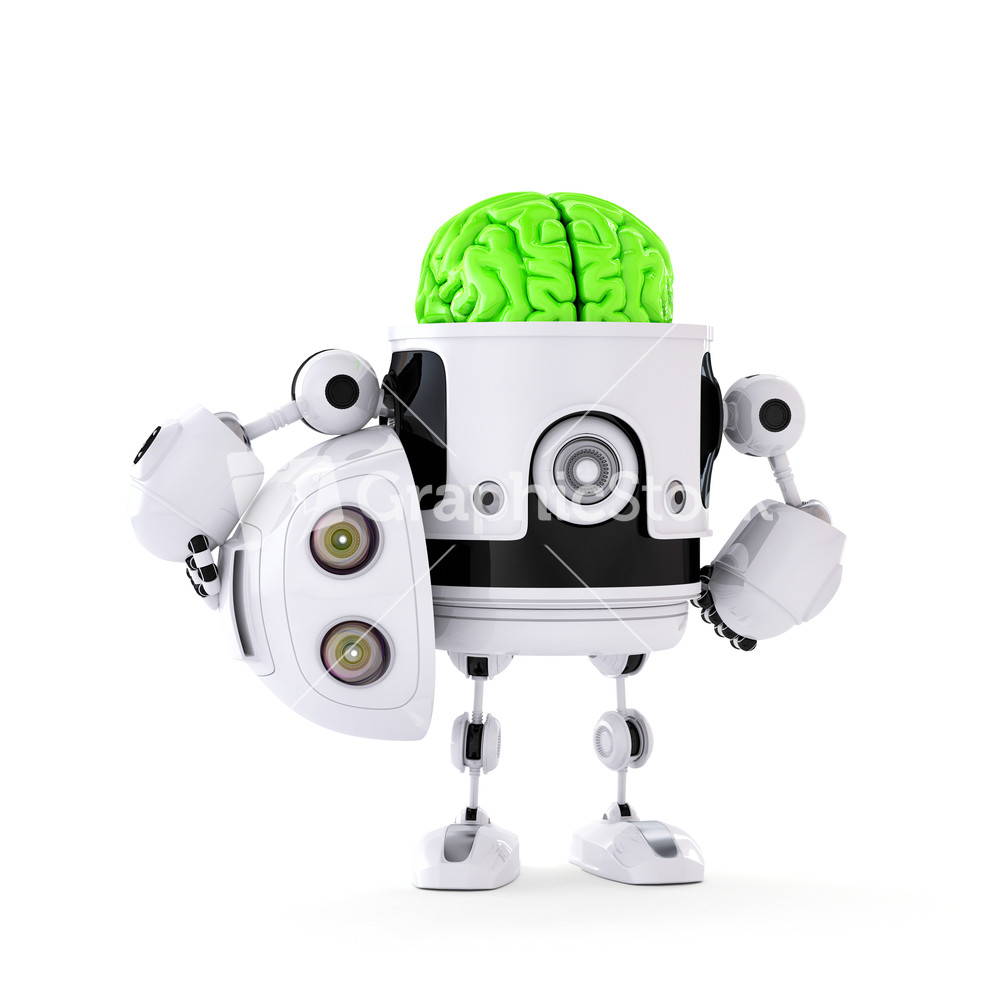
In case you haven’t noticed, Artificial Intelligence is the It Girl for marketers these days. Just about every ad tech tool now claims to be powered by AI components. Agencies and consultants are touting their AI capabilities. CMOs are bragging on their AI initiatives. As a result, the definition of AI has become stretched beyond recognition. Many people are defining it by what it does (language processing, data manipulation, visual recognition, etc.). But the real mark of artificial intelligence is how it does it. A chess-playing computer could be AI or not. If it plays chess by analyzing every possible move on the board, assigning it probability of success, and selecting the move with the highest probability, then it isn’t Artificial Intelligence. If it plays chess by applying certain principles, and refining those principles through feedback gained from multiple games, then it is AI.

While the more technically-minded would have more specific and accurate definitions, marketers can practically characterize Artificial Intelligence applications by two things:

  • The ability to perform tasks for which they’re not explicitly programmed
  • The self-directed capacity to improve that ability as it is exposed to more tasks.

At the core of the computing age is the power of If-Then processing: If a certain condition is true, then perform a defined operation. For example, you might program a traditional application by coding “if Speed is greater than 55mph, Road = Expressway and Weather = Rain, then reset Speed to 45mph.” This is an explicit direction. Using AI, you could effectively program an application more along the lines of “If driving conditions become less safe, then slow down to meet the conditions.” Using the definition outlined above, AI would use a variety of input (weather, traffic, type of road) to determine what is “less safe” and the speed appropriate to the conditions.  Based on feedback(e.g. how many accidents occurred), it would improve its definition of “less safe” over time without a developer having to go in and explicitly recode every conceivable definition of “less safe”. So while the first explicit program will never change its behavior, an AI program would learn to distinguish between rain falling at 70F and rain falling at 32F. In essence, AI allows applications to refine their If/Then engine autonomously.

There are many things being touted as AI that really aren’t. For example, increased processing power is allowing for even more extensive and sophisticated searches of ever larger databases. So, if you ask a Dinner Bot for recipes using tofu, asparagus and mayonnaise that’s quick to make, it can search multiple recipe databases, correlate those ingredients with preparation times under 20 minutes and send you back the 10 most popular recipes fitting that description. It can do all that using explicit instructions. While it may be impressive, it is not AI. Here’s one test to apply to see if something is really powered by AI. Will the results of the applications change over time depending on who is using it? The answer should be “yes.” In other words, two identical AI applications should start to yield different results if they are used by two distinct groups of users. That’s because they’ll be exposed to different situations and different feedback that should affect its autonomous development.

For marketers looking how to start thinking about applying AI to their businesses, Shelly Palmer provides a typically insightful view of the topic.


Leave a comment

Filed under Artificial Intelligence, Data Science, Innovation

The Treasure of 3D Data

People As DataThe promise of digital marketing keeps crawling closer in tantalizing steps. The ability to market to individuals at scale still has obstacles, and the best of the current digital case studies tend to major in being one or the other – a truly personal idea delivered to a narrow audience or the mass delivery of a rich homogeneous idea. Nonetheless, problems that once seemed insurmountable in marrying the two together now seem merely expensive and difficult. The future is clear to even the least imaginative people in the field.

In that future, the winners will be those who can deliver on the oft-cited ideal of the “segment of one.” It doesn’t take the most brilliant of minds to understand that in a world of individualized marketing, the primary asset of a marketer will be individuals. As obvious as that sounds, it’s not the current state of affairs. Most marketers borrow or rent their individuals. Whether it’s the subsciptions of YouTube, the social graph of Facebook, or the databases of Acxiom, the asset of individuals is largely in the hands of others.

In some ways, this has been the premise of CRM systems for a while. But CRM has usually been restricted to current customers, loyalty programs, and first party data sources. As a result, these internal systems don’t describe three-dimensional individuals as much as shadows of them projected on a wall. The other panacea of punditry is to say this is all about Big Data. But that’s not really true. There’s a lot of noise in data.  A good deal of what we generate is not meaningful. We may know people’s demographics and shopping history in great detail. Those may hint at their motivations. Yet knowing their actual interests is many times more useful to both the marketer and the marketed. Knowing where someone lives is far less important than knowing what they love. Any marketer of worth should be willing to trade every demographic detail they have on a potential customer – age, address, income, zip code, education, family status – for their music playlist.  3D Data shapes an individual in real dimensions.

The marketer who can connect first party information with the type of 3D Data that gives shape to a person can unlock value for both themselves and their customers. True individual data assets contain deep value for marketers to mine in the marketplace that’s fast arriving. It’s too valuable to cede to third parties. Prudent marketers will work to take ownership of that asset for themselves.

Leave a comment

Filed under Digital Marketing, Innovation

Big Data Meets the Zombies

The field of robotics and 3D animation generated a counter-intuitive theory in the 1970’s called the Uncanny Valley. The premise was that as non-human things, like robots and cartoons,  initially  become more human in their appearance and behavior, people tended to empathize with them and enjoy interacting with them more. But as they became very close but not quite human, a creep factor comes in that actually generates a feeling of revulsion. So things that are 100% human or 60% human get a warm positive reaction, while things that are 90% human get a strongly negative reaction.

Things that fall into the Uncanny Valley include corpses, zombies, and Polar Express-like animations. Early previews of the Shrek movie actually led the makers to make the Princess Fiona character less realistic and more cartoony to avoid falling into the Uncanny Valley. The effect has been noted many times, and various theories abound as to what causes it. The most popular explanation is that it triggers our evolutionary impulse to identify unhealthy humans. Our genes don’t want to mate with or catch a contagious disease from a sick human. So when we sense something that’s really close but not quite human, it triggers an instinctual reaction to avoid it.

Big Data is about to enter an Uncanny Valley of its own. As we get better at tracking people’s behavior and interests, the potential is to create an individualized experience. We can be more relevant, responsive, and more human. But the better we get at doing that, the closer we get to the creep out factor.  An experience that falls in-between partially individualized and entirely individualized will likely generate the most negative reaction.  Ironically, this pattern would predict the complaints around data-based marketing will increase as we get better at creating more human interactions. To avoid falling into the Uncanny Valley, marketers will have to take a lesson from Dreamworks, and focus less on what the technology can do and more on how people truly experience it.

Leave a comment

Filed under 21st Century Marketing

The Four Tenets of A Digital Mindset

The Digital New Fronts showed another maturing stage in the development of online content. It demonstrated the continued blurring of the offline and online worlds. Television series and web series are increasingly utilizing the same talent, pursuing the same audience, and selling to the same advertisers. This blurring will continue as advances in addressable television, tablets, and over-the-top video make the distinction between digital and broadcast content disappear.

This represents both a victory and a conundrum for proponents of digital marketing. The victory rests in the growing importance of social, mobile, and online marketing in the plans of even the most traditional marketers. Several global brands are being built almost entirely on digital marketing strategies.  So, as far as rising to the ranks of market importance, digital has “won.”  But the conundrum is rooted in this same success for digital practitioners of every stripe.  When everything and everyone is using digital, is there any meaningful distinction left in being a digital marketer?

Digital marketers used to distinguish themselves based on their mastery of channels that most other people didn’t understand. They knew how to design websites, build rich media banners, and bid on search terms. That knowledge is both more widespread and easier to tap into than ever before.  That said, there is still something quite valuable about true digital marketing. It’s not about the toolset; it’s about the mindset. What is still lacking for many marketers and agencies is the mindset that comes from a digital way of looking at that world.  There are four core tenets underlying the digital mindset:

Everything is Connected

The digital imperative is to constantly seek new points of connection. In marketing, digital brands find new ways to connect across multiple levels.  Those connections can be made across time, people, information, and interests.  In that way, it can connect brand building with sales, existing customers with potential customers, R&D with Customer Service, etc. Where traditional marketing tends to separate into channels, digital marketing is always finding new ways to link together.

Actions Trump Impressions

Traditional marketers often measure the effectiveness of their efforts by the impressions they generate. Even experiential efforts like live events are reported in terms of how many equivalent impressions they generated. The digital mindset sees value in actions. An action is a measure of commitment, while an impression is only a measure of exposure.  If you’re looking to make a friend, interacting with someone will get far better results than being seen by someone. Similarly, if you can get someone to post something, share something, or like something then you are far more likely to sell something, either to that person or someone they know.  In that view, getting a thousand people to do something is more valuable than getting a million people to see something.

Always Optimizing

The traditional marketing cycle is like a movie release. The marketers spend months developing a new story, work behind the scenes to perfect the details, and after several months, launch it to the world in a glorious finale. If it succeeds, you make a sequel; it if fails you start over with a new one. The digital mindset embraces the beta view of software development. The launch is seen as more a beginning than an end. By gathering feedback and measuring reactions, the first release gets tweaked and upgraded.  In the digital view, a release does not have the rigidity of a final cut, but the malleability of software code.

Data is Currency

All of these elements are driven by data. To be digital, you need to be know how to harvest, process, and analyze data.  And it’s not just for performance metrics. Performance measurement is vital, but data provides much more than that. Digital marketers are excited by data because it reveals new connections, shows what people are really doing, and points the way to building deeper relationships. The digital mindset not only recognizes the awesome business potential of data, but the amazing creative potential of data as well.

Having the latest digital tools doesn’t make you a digital marketer anymore than owning a chessboard makes you a chess player.  For both qualifications, the proof is in how you play the game.

Leave a comment

Filed under 21st Century Marketing, Digital Marketing, Innovation

The Growing Reality of Always On Marketing

It’s said that the future lies clearly in the present, as long as you know where to look. If you look at the underpinnings of today’s rising brands, a pattern emerges. There is, of course, the by-now standard dictum of a shared brand experience.  The idea of talking with people instead of at them is no less true for now being common wisdom. What’s less common are brands who have taken it to the next step.  It is one thing to have a Twitter manager lobbing out pseudo-conversational tidbits such as “what’s your favorite Super Bowl snack?” It is another thing entirely to know to whom you’re talking to and being able to share something with them of real interest based on the context of that particular moment. This is at the heart of Always On marketing.  Like most marketing innovations, Always On marketing started with small niche brands finding new ways to build buzz outside traditional approaches. Now you see established brands like AMEX, JetBlue and Gatorade adopting Always On principles.

What is Always On?

At its heart, it’s a simple premise. Always On marketing is the ability to respond in real-time to an individual customer with the most relevant brand content.  If I’m in the market for a new smartphone, and I don’t know whether I want an iPhone or Android model, a carrier who serves up reviews of the two types of phone would have an advantage winning me over as a customer. If I’m away from home at my kid’s basketball tournament, and a quick-service restaurant sends me a coupon and directions to their place around the corner, they’re likely to get a sale.  While a simple idea in theory, in practice it requires a new set of capabilities.

What’s Driving It?

The drive for Always On marketing side is a combination of developments on both the producer and consumer side of the equation. In total, there are three overall developments driving the moves to Always On marketing.

1. The Death of the Funnel

The traditional sales funnel looked something like this:
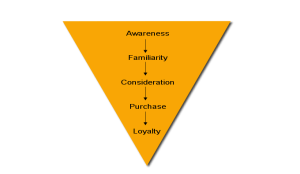
If this funnel were ever really true, it is not true now. Studies from Y&R, McKinsey Consulting and others show that the brand selection process does not involve a broad embrace of brands at the start, followed by a rational and linear winnowing down to a preferred brand. The McKinsey model suggests a path that looks more like this:
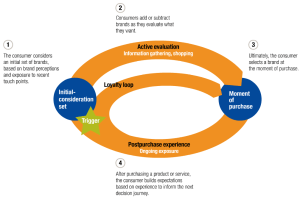
There are several significant differences between this model and the traditional funnel. Most notable are:

  • When something triggers our desire to make a purchase, we start with a narrow preconceived set of brands, not a wide view of the category
  • That initial set of brands may actually grow instead of narrow as we evaluate our choices.
  • The move from the initial trigger to the final purchase may skip a step at any point.

This revised view has important implications. For one, it emphasizes how critical it is to understand your brand’s place with a potential customer at each stage of the process. Contrary to traditional funnel thinking, a new challenger brand may have a better chance getting attention in the Active Evaluation stage than the Initial Consideration stage. For another, it encourages forging multiple paths to purchase. Each person goes through their own purchase journey, skipping over one stage to the next.  If that person is forced to confined to a predetermined path, you risk losing their interest and their business. Taken together, it requires a system that can spot when a personal trigger event happens  (e.g., visit to a car dealer, browsing an online catalog, moving to a new town) and act on it immediately. Consider that the average time from a trigger event to a purchase decision is 10-12  days for someone going on a vacation.  The time from trigger to purchase for a mobile phone is about 7 days. Always On marketers who can spot the trigger and market accordingly in that short span of time gain a huge advantage.

2. Great Expectations

Consumer expectations have changed significantly. If you can think back as long as five years ago, the idea that you would shout out a company’s name on the street and expect a personal reply would be grounds for psychiatric evaluation. But Twitter has created an expectation fairly close to that. People register complaints with no more than a company hashtag and are miffed if there is not a response.

This represents a ratcheting up in consumer expectations. People increasingly expect real-time interactions from the brands they care about.

3. Big Data

The burgeoning availability of actionable real-time data provides new opportunities to truly deliver on one-to-one marketing. The “one-to-one marketing “ label has been around for decades, but it was a way of thinking rather than an actual way of working. Traditional database marketing relies on segmentation schema that group people by common characteristics.  Segmentation is a way to break a mass group up into smaller groups, but is not truly individualized.  It creates proxies for real knowledge of the person.  For example, a battery manufacturer would create a “gadget lovers” segment based on demographic and survey data, and design marketing programs targeted in various degrees of specificity to that group. That approach is several times more effective that simple mass marketing. Yet their effectiveness would be even several factors higher than that if they knew nothing about a person’s demographic and survey responses, but did know how many times an individual had purchased batteries in the past six months, what devices they owned, the last time they bought a batteries, and where they were shopping for electronics right now.  In that way, Big Data renders group segmentation obsolete. Always On marketing operates on a segment-of one-philosophy.

What Does Always it Require?

An Always On marketing platform require four major components.

1. A Powerful Marketing Engine

The most critical component of Always On marketing is the ability to gather, process, and act on large amounts of data. Big Data generates a continuous fire hose of data that cannot be meaningfully processed by traditional analytic methods. A Marketing Engine is a collection of tools, partners, and processes that enable a brand to:

  • Combine multiple data sources to construct an actionable profile of each individual they encounter.
  • Apply business rules that allow real-time matches between individuals and brand content
  • Track responses of individuals to brand contacts and pursue different paths with that individual based on the nature of that response
  • Monitor performance across channels in a way that allows for constant optimization

2. Deep Reservoir of Brand Content

Even with the most powerful Marketing Engine in place, it is not effective if the interactions with people aren’t compelling and relevant. That’s why brands need to build and update sources of content that can be at the ready. That content can be constructed dynamically (e.g. customized offers),  pre-produced (e.g. how-to videos), or human (e.g. a customer service representative).  As brands embrace an Always On approach, the content needs will become apparent as their interactions grow and patterns emerge.

3. A Clear Brand Story

One thing that hasn’t changed about effective marketing is the importance of having a compelling brand story.  This is what establishes the fundamental human attraction to brands. In fact, it is even more critical in an Always On environment. That’s because the brand story has to be told in so many more ways that it used to be. As a result, more people are involved in telling the brand story than ever before. Community managers, customer service agents, other employees and brand fans join brand managers as promoters of the brand. They need a clear story that can guide their efforts in concert without centralized control.  While it may seem put of place in a discussion about Marketing Engines and Big Data, the core truth is that storytelling is more essential than ever. Now,  it not only has to inspire the people who hear it, but also inspire the people who tell it.

4. A Different Mindset

All of the above components are critical to deliver Always On marketing. Yet, they won’t work without an accompanying shift in mindset. Many marketing organizations are built to deliver tightly structured campaigns that require extensive time for deliberation, review and testing behind the scenes before each launch. Always On requires a “constant beta” approach where the testing and enhancements are being made in market.  While it is no less rigorous strategically, it embraces a quicker and less predictable cadence. More effort has to be into crafting playbooks and operating principles, and less into approvals of individual executions. In this way, marketing organizations may come to look more like the best customer service organizations, both highly disciplined and highly flexible.

Leave a comment

Filed under 21st Century Marketing, Activation, Innovation