
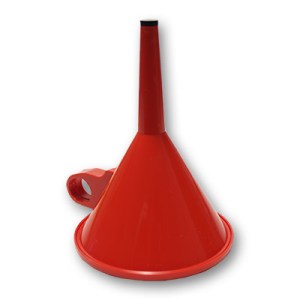
 The Purchase Funnel is more than a metaphor. Many companies actually use it as a tool to shape their sales and marketing programs. It is simple, intuitive, and wrong. At least it is wrong for most products in developed economies of the Western world.
It is like physics , in that Newtonian physics is accurate for objects much larger than atoms and much slower than light. But it falls apart for describing subatomic particles moving at great speed. Similarly, the Purchase Funnel is accurate for markets with a limited set of products and information sources. But it falls apart in a world of overwhelming product choice and a constant bombardment of brand messaging.
Think about the last time you decided to try something new. Did you survey all the product choices of which you were aware? Did you narrow that list to a subset of products you would consider? Did you sample the products within that set, and then determine which one to adopt? You may have done something close to that for a new house or a car, but most people would not describe that process for how they purchased a new shampoo, soft drink, or candy bar.
If your own behavior doesn’t convince you, take a look at Y&R’s Brand Asset Valuator. Y&R has been a marketing laggard for the last decade, but their brand tool is the most comprehensive brand database in the world in terms of both the number of brands it tracks, how many countries it tracks them in, and how long it has been tracking them (full disclosure: I used to work for Y&R). While they are hesitant to say it, it provides empirical proof that the sales funnel is flawed. Time and time again, it tracks the rise and fall of brands. It shows a consistent pattern. They track four main characteristics of a brand:
- Knowledge – How well you feel you know the brand
- Relevance – How relevant you think the brand is to you
- Esteem – How well you think of the brand
- Differentiation – How unique you think the brand is
If the Purchase Funnel were an accurate model, you would expect to see a brand’s profile to develop in the order they are listed above. First, you’d get to know something about the brand, then you would determine its relevance to you, and so on. But it turns out that is not the case. In almost every case, the first element that people register about the brand is Differentiation. That may seem counter-intuitive at first, but not after you consider our environment. We are overwhelmed by brand choices and messages. We don’t seek them out, we avoid them. We have to filter things out in order to stay sane. So what gets through our filters? Something that is different, unique. That’s what we notice first. Only after we notice something different do we evaluate whether it is for us or not.
Forrester recently took on the Purchase Funnel as well, but they ascribed its demise to the internet (good discussion of this and McKinsey’s alternative model from Robin Grant at We Are Social) . That is true to the extent that social media helps us manage our filtering process even more efficiently. But the underlying cause is something deeper. In our world, interest comes before awareness.
 The Ryan Report