Tag Archives: business model

Planning is Everything. Plans are Nothing.

The title above is from a quote usually ascribed to Dwight Eisenhower.  Though he was referring to battle plans, it is an apt lesson for business plans as well. His point was that the battle never goes as planned. Weather conditions, enemy reactions and human mistakes conspire to ensure that every military action usually goes off plan before the first shot is fired.  But if the planning process is done with the proper rigor, leaders can react more effectively to unexpected developments. They can assess how changes impact their overall strategy, and better judge the consequences of their subsequent decisions.

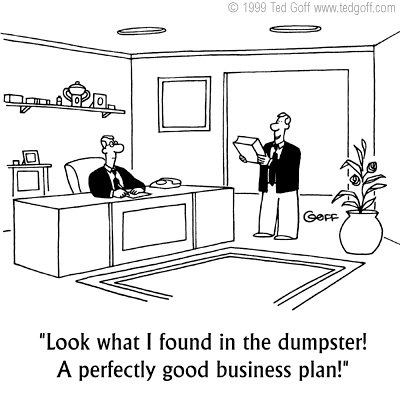
I recalled this quote after seeing an interesting discussion on LinkedIn debating the value of business plans for new companies.  Some potential entrepreneurs were dismissing the value of business plans for start-ups because they rarely had any relevance to the business once they hit the  realities of actually going to market. General Eisenhower reminds us how this argument misses the point. The value of a business or marketing plan is not in the plan itself, but in forcing you to think in a rigorous way about how best to deploy your resources. Who is your target? What’s your value to them? Who’s your competition? What kind of human and financial resources will you need to make a go of it? Of course, unless you are the first true psychic, most of what you come up with will be wrong.  The details of the plan may be mere historical artifacts within months of launch. But if you planned well, you are better able to identify and react to what you were wrong about.

The same lesson was delivered in another context by an accomplished climber I once heard speak. He described the meticulous planning process that his team followed before a major climb. They literally mapped out every step. He went on to say that they almost never followed the predetermined path once the actual climbing began, but it was the planning that allowed them to make intelligent choices under stress about what they could afford to change.

Whether you are crafting a business plan for a new company or a marketing plan for an established brand, there are three important lessons in this.  One is that a plan is worth what you put into it.  If you just go through the motions in order to be able to point to an official-looking plan, it will be of no value. Second, you shouldn’t dismiss the planning process just because the plans themselves are rarely executed.  A well-constructed plan will make you a smarter leader and manager for the unexpected turns that inevitably come your way. The final related lesson is that you should not treat the plan as anything but your best current guess. If the plan isn’t working, don’t be afraid to change it. Too many marketing managers disregard new information and new opportunities because it’s “not in the plan.” A plan is not a substitute for thinking. Plans should be treated more like boyfriends than husbands. You should always be open to a better one.

Leave a comment

Filed under Activation, Business Management, Market Strategy

Business Culture: Family vs. Team

I often encounter business leaders who try to capture the positive aspects of their company culture by referring to their “family” environment.  These are often managers who want to distinguish themselves from a cutthroat or unethical work environment.  Nonetheless, whenever I hear an executive  refer to the company family, I can’t help but wince. Inevitably, they are undermining their own credibility, integrity, and success.

While I appreciate the sentiment, companies cannot operate like families. At their best, they are teams. Managers often confuse the analogies of family and team, because many of their positive values overlap.  They both require sacrifice for the good of the group, and being able to rely on that same sacrifice from others.  They both thrive in a spirit of tolerance, where we acknowledge each other’s different styles and strengths. Both strong families and strong teams share common core values, such as trust, honesty, and loyalty.

But they diverge in a meaningful way. Family is an unconditional commitment. A  family should remain a family no matter what they do.  A family does not have an explicit mission, other than its own survival. A team is a conditional commitment. It exists because of a mutual commitment of its members to support an explicit mission, be it completing a project, defeating a competitor, or providing a service.  This creates different expectations and different obligations on its members.

A family leader is expected to support his family in every way possible. If a child is engaging in behavior that is destructive or embarrassing to the family, the parents’ first obligation is to support that child, and do everything they can to overcome whatever is at the root of their child’s  problem. If an employee is engaging in behavior that is destructive or embarrassing to the firm, a manager’s obligation is to minimize the negative  effect on the mission. If that can be accomplished by helping the employee, all the better. But if it can only be addressed by replacing the employee, that’s an acceptable alternative.

If a family member’s temperament is a poor fit with the rest of the family, the unconditional commitment of the family should overlook those differences, and accept them as they are. If an employee’s work style is at odds with the rest of the company, and manager needs to either work with that employee or find a replacement that will make a better fit.  A manager who accepts people as they are to the detriment of the firm is incompetent.

There was a sad story about a family that adopted a child, and then sent the child back after they found out he was going to be challenging to take care of. The universal reaction was that it was unethical to reject a child from the family simply because he was too hard to take care of. In a business situation, the ethics are practically reversed. If an employee was taking up disproportionate resources to support and manage, other employees would consider it unfair. One of the most common worker complaints is management that tolerates dead wood employees who don’t pull their weight at work.

Sports are the most obvious examples of team. If a wide receiver on a football team can’t catch a football, a coach would not keep him on the team. But you would never think of replacing a sibling for lack of performance.  A football team doesn’t pay its starting quarterback the same salary as its backup kicker. A team rightfully gives more attention to the people who are most critical to its success. A family’s love and attention should not be doled out on the basis of some performance measures. With a family, the family unit itself is paramount. With a team, the mission of the team is paramount.

Managers who promote their teams as families do themselves and their employees a disservice.  As in the recent downturn, it can cause additional bitterness when it requires letting people go. It makes a lie out of everything the manager claimed to stand for. Families don’t disown other family members in bad times. The same disillusionment happens if someone is passed over for a promotion or gets a smaller bonus.

Employees lose trust in their leaders if they see them violating the principles they espouse. The differences between family and team are subtle but profound, and managers who confuse them risk being seen as hypocritical or dishonest when those values are put to the test.

Leave a comment

Filed under Business Management, Market Strategy

Ten Things Your Agency Prefers You Don’t Know: #2

Square Peg in a Round Hole_0565The agency structure dictates the ideas you get.

Every agency makes the claim that they are media-neutral, fully integrated, 360, or some other catchphrase implying ideas that are bigger than any one channel. The intent is certainly there, but the very structure of the agency prevents it from happening.  Agencies have accumulated a full-time staff of people who need to be allocated if that agency is to survive as a business.  This is true for almost any type of agency, be it traditional, digital, or social. If you have a dozen copywriters on staff, you better be generating ideas that require a lot of copywriting. Similarly, it you have 3 Flash programmers on staff, you better be doing some Flash development.  So imagine a situation in which a traditional agency is on retainer with a client.  What is the likelihood that the agency will come back and recommend moving most of the budget into shopper marketing? Sure, the agency has shopper marketing in their holding company network, but moving the budget to them means the agency loses the bulk of their retainer. Will the agency reward the Account Director for slashing their retainer and putting agency staff in jeopardy? Of course not.  That’s why you’ll get the ideas that match the resources of the agency.

Related to this structural issue is the myth that agency creatives are focused on ideas that transcend channels. It reminds me of the “IT expert” that only shows up in movies. This fictional guy is equally adept at every computer application ever written, knows both hardware and software, has a PhD level understanding of encryption algorithms, and immediate access to every database on the planet.  Meanwhile, in real life, if you need help with a Mac version of Office, the PC guy in tech support can’t help you. Similarly, a creative brought up to think in terms of websites is not likely to start thinking about a marketing problem in terms of retail events. Another one highly skilled in the art of scripted :30 stories isn’t going to be comfortable crafting a social media program.

It is not a question of smarts, talent, or even intent. Architect Louis Sullivan expressed the adage that “form follows function.” In the case of agencies, function follows form.

Leave a comment

Filed under 21st Century Marketing, Agency Management

Ten Things Your Agency Prefers You Don’t Know: #3

ATM Out of OrderThe business model is backwards.

The agency business has evolved to a state where there is little relation between the value they add and the compensation they get. This is a historical problem. The original commission system rewarded agencies for how much their clients spent, not for the actual work the agencies did. The fee-based compensation that is most common today rewards agencies for how many people they can get to work on the account. Neither system is related to the strength or effectiveness of the ideas and programs that they develop. In fact, the most valuable thing that agencies do is often given away for free. In the typical new business pitch, agencies get their best people to work feverishly on developing their best ideas to the point where they’re ready to be executed. They do all this for free, and then hope that if selected, the client will compensate them after the fact by paying a premium price to manage the production and execution of those ideas. It’s like a restaurant giving the food away for free, and hoping to make it back on the valet parking.

This model might have made sense when marketer-agency relationships averaged 10 years or more. But now that the best relationships last only 3-5 years, it doesn’t. Marketers may think they’re getting something for free, and initially that’s true. But whenever the compensation model of the seller is out of sync with the objectives of the buyer, something is lost. Can marketers really think they are getting the best service and advice from a provider who gets penalized if they can develop and execute programs more quickly and cheaply?

Agencies have been shy to take on results-based compensation because there are so many factors beyond their control, like sales and distribution, that effect the outcome in the marketplace. But some may come to realize that facing the same market risks and rewards as their client puts them in a far better business and financial situation than constantly justifying monthly retainers with procurement.

1 Comment

Filed under Agency Management