
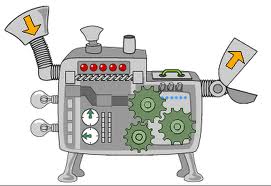
 There’s a geeky thought experiment I used to ponder with friends to pass the time in the pre-smart phone world. It came back to mind as a way to plot how a world of AI, robots and infinite computing power may shape our future. It went like this. Imagine we perfect a brilliant machine, called the Transmorpher. The Transmorpher takes any material you feed into it, breaks it down into sub-atomic matter and then reassembles it however you instruct it to. You could shovel a pile of garbage, sand, or dirt into the machine, and it could reassemble it into a pile of precious metals. Now further imagine this machine not only generates basic elements, but assembles them together in the order and form you instructed. In today’s terms, it’s like the ultimate recycling machine combined with the ultimate 3-D printer. So, the right size pile of garbage would not only be transformed into various pure metals and plastics, but with the right instructions, combined in such a way that it was a fully-operational automobile. The first Transmorpher would be enormously expensive of course. Yet once it was up and running, it could be used to cheaply turn out duplicates of itself for anyone with stuff to pour into it. Eventually every person on earth would own their own Transmorpher.
What would be the social, political and economic effects of worldwide Transmorpher ownership? Hey, I said it was geeky. But think about it for a minute. Everyone with access to a supply of garbage, dirt, or any other physical substance can now own a Mercedes Maybach. They could also make all the gas they need to run it. The same goes for food, furniture, computers, clothes, gold, diamonds, and anything physical thing in the world. Who would win and who would lose in a world where most everything was nearly free?
Winners
Status and wealth would rely less on pure mass of ownership since everybody could own most any thing they wanted. People could no longer differentiate themselves on how many things they owned or how expensive those things were. They’d have to own unique or better things. In this environment, people would seek out the instructions to things nobody else had or had thought of yet. Transmorpher instructions would be more valuable than Transmorpher outputs. So designers and engineers who knew how to build those instructions would be in high demand.
Since the Transmorpher can only make things, human experiences would also remain at a premium. Singers, actors, professional athletes, comedians and party planners would escape commoditization in this world and would likely increase in value because of the comparative scarcity of experiences in a world of infinite stuff
Not all physical assets would lose value. Real property holdings would remain valuable. The Transmorpher couldn’t make the world any bigger. I could use the Transmorpher to make a house, but if I didn’t have anywhere to put it, it wouldn’t be of much use. Assuming we still value places to live, interact, and work together, land would retain its desirability as long as property rights were maintained.
Losers
Clearly manufacturers would lose. Knowledge about how to make things would remain valuable, but the actual making of things would be taking over by the Transmorphers. The making of things, both skilled and unskilled would lose its added value worth. Retailers would also lose out. There’d be little benefit to having a centralized provider of things when anything you want is available immediately from your Transmorpher. Distributors would then fall in that domino chain. The Transmorpher world would severely reduce the need for things to be made in one place and then shipped to another.
In Between
The future of service providers would be murky. On one hand, Transmorphers don’t do things, they only make things. They couldn’t paint your house, execute a marketing plan, or figure out if that lingering cough was anything serious. In that direct sense, services would not be replaced by Transmorphers. But the question would be whether designers, freed from cost constraints, could design new things to perform those services.
Government would probably both win and lose. It would be harder to regulate things in a world where anyone with a set of instructions could make whatever they pleased, whether it be narcotics, small arms, or patented products. Imagine how hard it would be to police controlled substances when there are infinite untraceable sources of supply. As a result, the job of government would get harder. Yet these same factors would lead to higher demand for just this type of enforcement. People wouldn’t want their neighbors making mini-nuclear reactors for their backyards. The size and role of government would likely expand to replace the restraints previously enforced by physical limits.
The Transmopher is a fantasy of course. But it’s a useful fantasy to plot the possible paths our world is headed, for good and bad. We’ll never arrive at the Transmorpher, but that’s the path we’re currently on. The most interesting implication for us is that many of the things that determine our social and economic order are based on the natural constraints of our physical world. As we engineer ourselves beyond those constraints, we’ll have to choose how and whether we replace them with a self-imposed order.
 The Ryan Report