 It’s said that the future lies clearly in the present, as long as you know where to look. If you look at the underpinnings of today’s rising brands, a pattern emerges. There is, of course, the by-now standard dictum of a shared brand experience. The idea of talking with people instead of at them is no less true for now being common wisdom. What’s less common are brands who have taken it to the next step. It is one thing to have a Twitter manager lobbing out pseudo-conversational tidbits such as “what’s your favorite Super Bowl snack?” It is another thing entirely to know to whom you’re talking to and being able to share something with them of real interest based on the context of that particular moment. This is at the heart of Always On marketing. Like most marketing innovations, Always On marketing started with small niche brands finding new ways to build buzz outside traditional approaches. Now you see established brands like AMEX, JetBlue and Gatorade adopting Always On principles.
What is Always On?
At its heart, it’s a simple premise. Always On marketing is the ability to respond in real-time to an individual customer with the most relevant brand content. If I’m in the market for a new smartphone, and I don’t know whether I want an iPhone or Android model, a carrier who serves up reviews of the two types of phone would have an advantage winning me over as a customer. If I’m away from home at my kid’s basketball tournament, and a quick-service restaurant sends me a coupon and directions to their place around the corner, they’re likely to get a sale. While a simple idea in theory, in practice it requires a new set of capabilities.
What’s Driving It?
The drive for Always On marketing side is a combination of developments on both the producer and consumer side of the equation. In total, there are three overall developments driving the moves to Always On marketing.
1. The Death of the Funnel
The traditional sales funnel looked something like this:
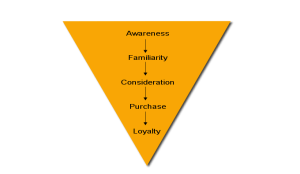
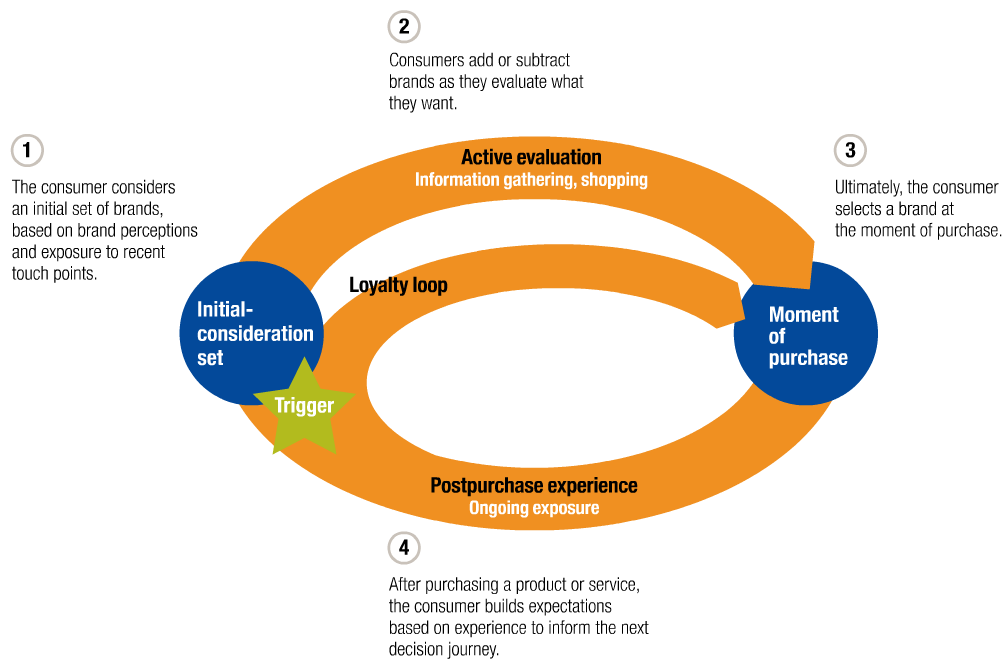
If this funnel were ever really true, it is not true now. Studies from Y&R, McKinsey Consulting and others show that the brand selection process does not involve a broad embrace of brands at the start, followed by a rational and linear winnowing down to a preferred brand. The McKinsey model suggests a path that looks more like this:
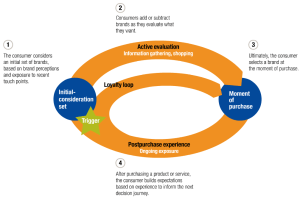
There are several significant differences between this model and the traditional funnel. Most notable are:
- When something triggers our desire to make a purchase, we start with a narrow preconceived set of brands, not a wide view of the category
- That initial set of brands may actually grow instead of narrow as we evaluate our choices.
- The move from the initial trigger to the final purchase may skip a step at any point.
This revised view has important implications. For one, it emphasizes how critical it is to understand your brand’s place with a potential customer at each stage of the process. Contrary to traditional funnel thinking, a new challenger brand may have a better chance getting attention in the Active Evaluation stage than the Initial Consideration stage. For another, it encourages forging multiple paths to purchase. Each person goes through their own purchase journey, skipping over one stage to the next. If that person is forced to confined to a predetermined path, you risk losing their interest and their business. Taken together, it requires a system that can spot when a personal trigger event happens (e.g., visit to a car dealer, browsing an online catalog, moving to a new town) and act on it immediately. Consider that the average time from a trigger event to a purchase decision is 10-12 days for someone going on a vacation. The time from trigger to purchase for a mobile phone is about 7 days. Always On marketers who can spot the trigger and market accordingly in that short span of time gain a huge advantage.
2. Great Expectations
Consumer expectations have changed significantly. If you can think back as long as five years ago, the idea that you would shout out a company’s name on the street and expect a personal reply would be grounds for psychiatric evaluation. But Twitter has created an expectation fairly close to that. People register complaints with no more than a company hashtag and are miffed if there is not a response.
This represents a ratcheting up in consumer expectations. People increasingly expect real-time interactions from the brands they care about.
3. Big Data
The burgeoning availability of actionable real-time data provides new opportunities to truly deliver on one-to-one marketing. The “one-to-one marketing “ label has been around for decades, but it was a way of thinking rather than an actual way of working. Traditional database marketing relies on segmentation schema that group people by common characteristics. Segmentation is a way to break a mass group up into smaller groups, but is not truly individualized. It creates proxies for real knowledge of the person. For example, a battery manufacturer would create a “gadget lovers” segment based on demographic and survey data, and design marketing programs targeted in various degrees of specificity to that group. That approach is several times more effective that simple mass marketing. Yet their effectiveness would be even several factors higher than that if they knew nothing about a person’s demographic and survey responses, but did know how many times an individual had purchased batteries in the past six months, what devices they owned, the last time they bought a batteries, and where they were shopping for electronics right now. In that way, Big Data renders group segmentation obsolete. Always On marketing operates on a segment-of one-philosophy.
What Does Always it Require?
An Always On marketing platform require four major components.
1. A Powerful Marketing Engine
The most critical component of Always On marketing is the ability to gather, process, and act on large amounts of data. Big Data generates a continuous fire hose of data that cannot be meaningfully processed by traditional analytic methods. A Marketing Engine is a collection of tools, partners, and processes that enable a brand to:
- Combine multiple data sources to construct an actionable profile of each individual they encounter.
- Apply business rules that allow real-time matches between individuals and brand content
- Track responses of individuals to brand contacts and pursue different paths with that individual based on the nature of that response
- Monitor performance across channels in a way that allows for constant optimization
2. Deep Reservoir of Brand Content
Even with the most powerful Marketing Engine in place, it is not effective if the interactions with people aren’t compelling and relevant. That’s why brands need to build and update sources of content that can be at the ready. That content can be constructed dynamically (e.g. customized offers), pre-produced (e.g. how-to videos), or human (e.g. a customer service representative). As brands embrace an Always On approach, the content needs will become apparent as their interactions grow and patterns emerge.
3. A Clear Brand Story
One thing that hasn’t changed about effective marketing is the importance of having a compelling brand story. This is what establishes the fundamental human attraction to brands. In fact, it is even more critical in an Always On environment. That’s because the brand story has to be told in so many more ways that it used to be. As a result, more people are involved in telling the brand story than ever before. Community managers, customer service agents, other employees and brand fans join brand managers as promoters of the brand. They need a clear story that can guide their efforts in concert without centralized control. While it may seem put of place in a discussion about Marketing Engines and Big Data, the core truth is that storytelling is more essential than ever. Now, it not only has to inspire the people who hear it, but also inspire the people who tell it.
4. A Different Mindset
All of the above components are critical to deliver Always On marketing. Yet, they won’t work without an accompanying shift in mindset. Many marketing organizations are built to deliver tightly structured campaigns that require extensive time for deliberation, review and testing behind the scenes before each launch. Always On requires a “constant beta” approach where the testing and enhancements are being made in market. While it is no less rigorous strategically, it embraces a quicker and less predictable cadence. More effort has to be into crafting playbooks and operating principles, and less into approvals of individual executions. In this way, marketing organizations may come to look more like the best customer service organizations, both highly disciplined and highly flexible.

 The Digital New Fronts showed another maturing stage in the development of online content. It demonstrated the continued blurring of the offline and online worlds. Television series and web series are increasingly utilizing the same talent, pursuing the same audience, and selling to the same advertisers. This blurring will continue as advances in addressable television, tablets, and over-the-top video make the distinction between digital and broadcast content disappear.



 The Ryan Report