Tag Archives: Innovation

Three Ways AI Will Start Impacting Marketing in 2024

Wave Images - Free Download on Freepik

As the old quip goes, “predictions are difficult, especially about the future.” That witticism serves to remind us of the hazards of predicting the future of AI and its impact on marketing. But there are three outcomes that seem self-evident as we witness the early applications of AI to the marketing toolkit.

The size of marketing and agency staffs will decline

There are debates about whether AI will inspire more or less creativity. On one hand, AI is a great enabler that will allow ideas to develop with less constraints on executional limits on bringing them to life. On the other hand, AI is a great imitator that will respond to prompts with a tedious recycling of what’s already been done. Agency viewpoints have tended to emphasize the second view as a basis for saying that the creativity they bring to clients will be in more demand than ever. Whether most agencies actually are truly a source of creativity or are just human recyclers is beside the point. The point is that the business model of agencies is based on the executional effort rather than the intellectual effort of marketing. Most agencies have an hours or people-based model similar to that of a law firm. They may attract clients through the strength of their creative ideas, but they make money from those clients by how many bodies they can assign to produce and distribute those ideas. Clients may value the “big ideas” of the agencies even more in an AI world, but they won’t need large staffs to produce the marketing materials, create the media plan, and optimize media channels.  Agencies have given lip service to getting paid for their ideas in the past. But they’ve never convinced clients or themselves to adopt that model. The role of agencies may be enhanced or degraded by AI, but their billable revenue will decline as more human tasks become automated.

For the same reasons, company marketing departments should grow smaller in number as well. The relative scale of the ipact will depend on how they were organized. Marketers than built large in-house teams to handle creative and media tasks will shrink in line with agencies. Brand managers will be less affected but their skill set and responsibilites will change as they spend less time and task management and more on true brand development.

The best marketers will shift their focus from local optima to global optima

That’s an admittedly jargon-filled phrase. But these mathematical terms do the right job for describing the main marketing challenge of the early AI era. The figure below illustrates the general idea. Imagine you’re kicking off a marketing campaign represented by the blue dot. As you move to optimize your messaging, target, and channels, you move nicely along increasing your performance until you get to the top of the first curve. As you move beyond that peak, the metrics will tell you that you are going in the wrong direction and push you back to the first peak. But there may be a new audience, a new selling point, or a new channel strategy further down the path that would actually get you to an even higher maximum return. But the data won’t take you there incrementally. You’ll have to push past the optimization signals to move from a local optimization to a global optimization.
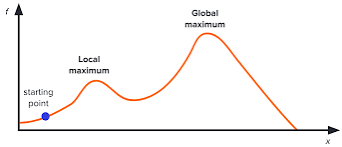
The challenge is that you’ll never know if you’re at a global maximum or a local maximum. You can’t tweak yourself to the highest outcome. Marketers will rely more and more on AI to get them to an optimal local maximum. But to unlock superior performance, they’ll have to explore ideas that are beyond the A/B testing mentality to constantly explore whether there is a better outcome than the current approach can give you.

The best job of humans will be to interface with other humans

There has been a lot of conversation around the jobs that will be lost to AI. If historical trends are a meaningful precedent, AI will eliminate many jobs and create many others. But of course, the losses and gains will be spread unequally. Middle-skilled physical laborers bore the brunt of machines and manufacturing robots. Similarly, middle-skilled and many high-skilled administrative jobs will quickly fall away in AI. Media planning, optimization and reporting will become mostly automated. A good portion of pre- and post-production workers will also be replaced by AI. The jobs that will survive or even grow are those related to human tastes and connections. Humans are a mess of reason, emotions, and instinctual quirks. How we react to things is difficult to interpret or predict. Taylor Swift was not named Person of the Year because of the accuracy of her pitch and efficiency of her lyrics. She created a cultural moment that people wanted to be a part of. The ultimate goal of any brand is to create a human connection that transcends the attributes of the product. The nature of that connection is elusive. But humans recognize when it happens and, more importantly, are the mechanism by which it happens. The people who can inject humanity into customer service, product design, and marketing strategy will always be in demand. To the extent that AI frees up people for more human-centered thinking, there is even potential for growth.
1 Comment

Filed under 21st Century Marketing, Artificial Intelligence, Innovation

Taking the Artificial Out of AI

In case you haven’t noticed, Artificial Intelligence is the It Girl for marketers these days. Just about every ad tech tool now claims to be powered by AI components. Agencies and consultants are touting their AI capabilities. CMOs are bragging on their AI initiatives. As a result, the definition of AI has become stretched beyond recognition. Many people are defining it by what it does (language processing, data manipulation, visual recognition, etc.). But the real mark of artificial intelligence is how it does it. A chess-playing computer could be AI or not. If it plays chess by analyzing every possible move on the board, assigning it probability of success, and selecting the move with the highest probability, then it isn’t Artificial Intelligence. If it plays chess by applying certain principles, and refining those principles through feedback gained from multiple games, then it is AI.

While the more technically-minded would have more specific and accurate definitions, marketers can practically characterize Artificial Intelligence applications by two things:

  • The ability to perform tasks for which they’re not explicitly programmed
  • The self-directed capacity to improve that ability as it is exposed to more tasks.

At the core of the computing age is the power of If-Then processing: If a certain condition is true, then perform a defined operation. For example, you might program a traditional application by coding “if Speed is greater than 55mph, Road = Expressway and Weather = Rain, then reset Speed to 45mph.” This is an explicit direction. Using AI, you could effectively program an application more along the lines of “If driving conditions become less safe, then slow down to meet the conditions.” Using the definition outlined above, AI would use a variety of input (weather, traffic, type of road) to determine what is “less safe” and the speed appropriate to the conditions.  Based on feedback(e.g. how many accidents occurred), it would improve its definition of “less safe” over time without a developer having to go in and explicitly recode every conceivable definition of “less safe”. So while the first explicit program will never change its behavior, an AI program would learn to distinguish between rain falling at 70F and rain falling at 32F. In essence, AI allows applications to refine their If/Then engine autonomously.

There are many things being touted as AI that really aren’t. For example, increased processing power is allowing for even more extensive and sophisticated searches of ever larger databases. So, if you ask a Dinner Bot for recipes using tofu, asparagus and mayonnaise that’s quick to make, it can search multiple recipe databases, correlate those ingredients with preparation times under 20 minutes and send you back the 10 most popular recipes fitting that description. It can do all that using explicit instructions. While it may be impressive, it is not AI. Here’s one test to apply to see if something is really powered by AI. Will the results of the applications change over time depending on who is using it? The answer should be “yes.” In other words, two identical AI applications should start to yield different results if they are used by two distinct groups of users. That’s because they’ll be exposed to different situations and different feedback that should affect its autonomous development.

For marketers looking how to start thinking about applying AI to their businesses, Shelly Palmer provides a typically insightful view of the topic.


Leave a comment

Filed under Artificial Intelligence, Data Science, Innovation

The Two Most Important Words in Marketing

if-then*The most dramatic advances in human development over the past century can be summed up in two words: “if then.” That phrase sums up all the power unleashed by the age of computing. Fueled by Moore’s law, the path from the Babbage Machine curiosity of 1822 to IBM’s Watson is an exponential acceleration in the if/then processes we can manipulate in a given time. The algorithm, or the ability to perform complex tasks with a cascade of simpler If/Then actions, has yielded stunning advances in machinery, medicine, communications and artificial intelligence that are redefining our lives on several levels.

It may seem a stretch to tie those lofty heights to the earthier world of marketing. Yet it’s as true for marketing as it is for any human endeavor that future advances lie in more fully harnessing the force of If/Then. We see the early effects in the rise of programmatic media. Programmatic advertising allows marketers to perform instantaneous if/then decisions across millions of potential customers and thousands of destinations. It is now a question of when, not if, all media will be programmatic. As significant as that is, media purchase and delivery is not the full extent of its impact.

With only a small degree of oversimplification, all marketing can be translated into the If/Then processes. In fact, it harnesses the two areas that are currently most at the tip of every CMO’s tongue: Data and Content. That’s because Data feeds the If, and Content provides the Then. Data signals the people and the context around them that spur an adept marketer to act. Content is the action the marketer takes to react to that signal. So if Home Depot sees a suburban homeowner within a mile of their store on a warm April day, then it forwards Spring planting tips and an offer from their Gardening Center. The response generates data that sets up the follow-on If/Then. If the Spring planting tips led to a purchase, then gauge their interest in a Loyalty program for the summer ahead. The effectiveness of the marketing correlates with the depth and breadth of If/Then branches the marketer can meaningfully define.

The Art vs. Science group might argue that applying the If/Then paradigm to its logical extreme overlooks the human factor that underlies the best marketing. In that view, the most successful brands, the ones that inspire deep-seated passion and loyalty like Harley Davidson and Nike, exist in an emotional territory above the mechanical abilities of If/Then algorithms. And of course, they’d be wrong. If/Then unleashes creativity rather than constrains it. It’s true that you’ll get mechanical transactional marketing if all you feed into the If is mechanical transactional data. But if you feed individual interests and passions into the Ifs, you uncover ways to forge even more meaningful human connections. Imagine how much more value a marketer could deliver to a runner who just had a child, or who’s on a business trip away from their regular running route, then it could to just a runner who is due for a new pair of shoes. The If/Then approach allows marketers to deliver on that kind of potential at a scale and sophistication that evades today’s most intimate marketer.

* this topic was inspired by a discussion with Baba Shetty, a brilliant thinker on various topics including commercial media

1 Comment

Filed under 21st Century Marketing, Digital Marketing, Innovation

Real-Time Marketing Takes Real Character

Open 24 HoursReal-time Marketing is a catch phrase of the moment. There are arguments as to what it means and how far it will go, but no one can argue with these basic premises:

  • Response times are shrinking for marketers who want to play in the currents of popular culture. The velocity of change in everything from bestseller lists to tourist destinations has accelerated the cycle from up-and-comer to has-been. Marketers have to act more quickly, frequently, and astutely to earn cultural relevance.
  • People expect brands to respond to them in multiple forums of their choosing. Today’s marketers can look with jealously at the ancient world where customer interactions were handled primarily in-store or through 800 numbers. People now assume that companies will respond to them wherever they happen to be – In-store, Facebook, Twitter, website, etc
  • People tap into a wider spectrum of company behaviors in forming their brand perceptions. While advertising still commands considerable power, people are increasingly influenced by a broader range of company activities. Apple suppliers’ working conditions, Chick-A-Fils political views, and Zappo’s sales agents have exhibited powerful affects on their brands.

These trends affect the most primary foundations of successful brand building. More specifically, they shed a new perspective on the concept of brand storytelling.  Any student of marketing knows that great brands are built on great stories. Stories are the means by which we understand, remember, and connect with things that are important to us. When we recall great people or great events, we do so with stories. It’s why American Idol and its variants don’t use their airtime to merely judge the talent. What draws viewers in are the stories they construct about what got them there (the obstacles they overcame, the people who inspired them, the dreams they’re chasing) and the stories that unfold as they progress through the natural drama provided by the multiple rounds of competition.

Traditional advertising rightly celebrates well-crafted stories. From Mean Joe Green and the kid with a Coke to Nike’s Jogger.  successful brands have harnessed stories to conjure the highest level of connection with their audience. Yet these tight, well-contained, highly produced stories don’t mesh easily with the trends we just described. How do you craft stories in the world of tweets, snapchats and user-generated content?

The answer is that today’s brand stories must rely more on characters than on plot. Stories that rely on plots don’t have the malleability to meet the emerging forms of marketing.  One can think of a movie like The Sixth Sense, composed with precision to deliver a steady dose of suspense that ends in a wonderful collision of surprise and inevitability. Compare that to a James Bond movie. Outside of a few twists, we already know how it is going to turn out in the end. Yet we embrace the ride in order to revel in experiencing the character we love. That is the advantage of character-based stories. They lend themselves to endless sequels.  No one is pressing for Sixth Sense II but the James Bond franchise keeps churning on.  Characters allow the stories to pour out in endless variation. They inspire Fan Fiction and fierce loyalties.  The common quality in people’s passionate embrace of Star Trek, Sex in the City, House of Cards, and similar properties is not in the plots, but in the characters.

This is not the “brand character” often listed on a standard marketing brief. Those usually list a short collection of well-worn adjectives. Character needs to be richer than that. We feel genuine attachment for entirely opposite types:  because they are the same as us, because they are different from us, because of their glamour, because of their humanity, because of their goodness, because of their badness.  We are drawn less by type than by depth. A real character is the fuller expression of the drives, instincts and world view that shape how you act in the world.  We want to be in the company of that kind of character, to interact with it, even to add to it. With this character firmly in place, a brand can more easily weave stories across channels, and let people tell stories on its behalf. This is the character that brands require to prosper in today’s real-time marketing environment.

(This topic was inspired by a discussion with Mark Figliulo on the nature of character in stories).

Leave a comment

Filed under 21st Century Marketing, Digital Marketing, Innovation

The Four Tenets of A Digital Mindset

The Digital New Fronts showed another maturing stage in the development of online content. It demonstrated the continued blurring of the offline and online worlds. Television series and web series are increasingly utilizing the same talent, pursuing the same audience, and selling to the same advertisers. This blurring will continue as advances in addressable television, tablets, and over-the-top video make the distinction between digital and broadcast content disappear.

This represents both a victory and a conundrum for proponents of digital marketing. The victory rests in the growing importance of social, mobile, and online marketing in the plans of even the most traditional marketers. Several global brands are being built almost entirely on digital marketing strategies.  So, as far as rising to the ranks of market importance, digital has “won.”  But the conundrum is rooted in this same success for digital practitioners of every stripe.  When everything and everyone is using digital, is there any meaningful distinction left in being a digital marketer?

Digital marketers used to distinguish themselves based on their mastery of channels that most other people didn’t understand. They knew how to design websites, build rich media banners, and bid on search terms. That knowledge is both more widespread and easier to tap into than ever before.  That said, there is still something quite valuable about true digital marketing. It’s not about the toolset; it’s about the mindset. What is still lacking for many marketers and agencies is the mindset that comes from a digital way of looking at that world.  There are four core tenets underlying the digital mindset:

Everything is Connected

The digital imperative is to constantly seek new points of connection. In marketing, digital brands find new ways to connect across multiple levels.  Those connections can be made across time, people, information, and interests.  In that way, it can connect brand building with sales, existing customers with potential customers, R&D with Customer Service, etc. Where traditional marketing tends to separate into channels, digital marketing is always finding new ways to link together.

Actions Trump Impressions

Traditional marketers often measure the effectiveness of their efforts by the impressions they generate. Even experiential efforts like live events are reported in terms of how many equivalent impressions they generated. The digital mindset sees value in actions. An action is a measure of commitment, while an impression is only a measure of exposure.  If you’re looking to make a friend, interacting with someone will get far better results than being seen by someone. Similarly, if you can get someone to post something, share something, or like something then you are far more likely to sell something, either to that person or someone they know.  In that view, getting a thousand people to do something is more valuable than getting a million people to see something.

Always Optimizing

The traditional marketing cycle is like a movie release. The marketers spend months developing a new story, work behind the scenes to perfect the details, and after several months, launch it to the world in a glorious finale. If it succeeds, you make a sequel; it if fails you start over with a new one. The digital mindset embraces the beta view of software development. The launch is seen as more a beginning than an end. By gathering feedback and measuring reactions, the first release gets tweaked and upgraded.  In the digital view, a release does not have the rigidity of a final cut, but the malleability of software code.

Data is Currency

All of these elements are driven by data. To be digital, you need to be know how to harvest, process, and analyze data.  And it’s not just for performance metrics. Performance measurement is vital, but data provides much more than that. Digital marketers are excited by data because it reveals new connections, shows what people are really doing, and points the way to building deeper relationships. The digital mindset not only recognizes the awesome business potential of data, but the amazing creative potential of data as well.

Having the latest digital tools doesn’t make you a digital marketer anymore than owning a chessboard makes you a chess player.  For both qualifications, the proof is in how you play the game.

Leave a comment

Filed under 21st Century Marketing, Digital Marketing, Innovation

The Growing Reality of Always On Marketing

It’s said that the future lies clearly in the present, as long as you know where to look. If you look at the underpinnings of today’s rising brands, a pattern emerges. There is, of course, the by-now standard dictum of a shared brand experience.  The idea of talking with people instead of at them is no less true for now being common wisdom. What’s less common are brands who have taken it to the next step.  It is one thing to have a Twitter manager lobbing out pseudo-conversational tidbits such as “what’s your favorite Super Bowl snack?” It is another thing entirely to know to whom you’re talking to and being able to share something with them of real interest based on the context of that particular moment. This is at the heart of Always On marketing.  Like most marketing innovations, Always On marketing started with small niche brands finding new ways to build buzz outside traditional approaches. Now you see established brands like AMEX, JetBlue and Gatorade adopting Always On principles.

What is Always On?

At its heart, it’s a simple premise. Always On marketing is the ability to respond in real-time to an individual customer with the most relevant brand content.  If I’m in the market for a new smartphone, and I don’t know whether I want an iPhone or Android model, a carrier who serves up reviews of the two types of phone would have an advantage winning me over as a customer. If I’m away from home at my kid’s basketball tournament, and a quick-service restaurant sends me a coupon and directions to their place around the corner, they’re likely to get a sale.  While a simple idea in theory, in practice it requires a new set of capabilities.

What’s Driving It?

The drive for Always On marketing side is a combination of developments on both the producer and consumer side of the equation. In total, there are three overall developments driving the moves to Always On marketing.

1. The Death of the Funnel

The traditional sales funnel looked something like this:

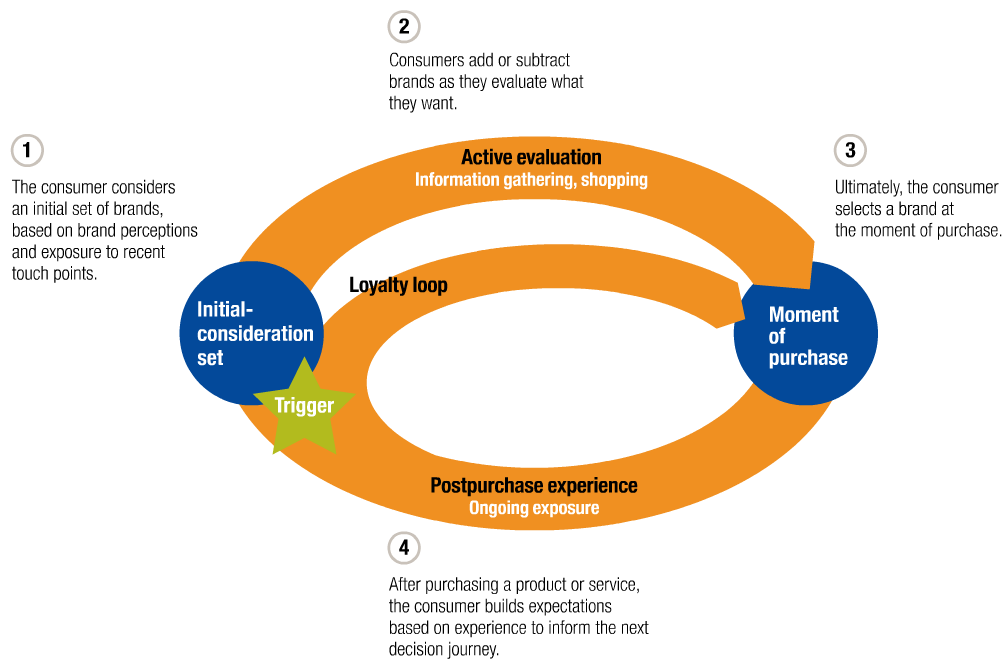
If this funnel were ever really true, it is not true now. Studies from Y&R, McKinsey Consulting and others show that the brand selection process does not involve a broad embrace of brands at the start, followed by a rational and linear winnowing down to a preferred brand. The McKinsey model suggests a path that looks more like this:

There are several significant differences between this model and the traditional funnel. Most notable are:

  • When something triggers our desire to make a purchase, we start with a narrow preconceived set of brands, not a wide view of the category
  • That initial set of brands may actually grow instead of narrow as we evaluate our choices.
  • The move from the initial trigger to the final purchase may skip a step at any point.

This revised view has important implications. For one, it emphasizes how critical it is to understand your brand’s place with a potential customer at each stage of the process. Contrary to traditional funnel thinking, a new challenger brand may have a better chance getting attention in the Active Evaluation stage than the Initial Consideration stage. For another, it encourages forging multiple paths to purchase. Each person goes through their own purchase journey, skipping over one stage to the next.  If that person is forced to confined to a predetermined path, you risk losing their interest and their business. Taken together, it requires a system that can spot when a personal trigger event happens  (e.g., visit to a car dealer, browsing an online catalog, moving to a new town) and act on it immediately. Consider that the average time from a trigger event to a purchase decision is 10-12  days for someone going on a vacation.  The time from trigger to purchase for a mobile phone is about 7 days. Always On marketers who can spot the trigger and market accordingly in that short span of time gain a huge advantage.

2. Great Expectations

Consumer expectations have changed significantly. If you can think back as long as five years ago, the idea that you would shout out a company’s name on the street and expect a personal reply would be grounds for psychiatric evaluation. But Twitter has created an expectation fairly close to that. People register complaints with no more than a company hashtag and are miffed if there is not a response.

This represents a ratcheting up in consumer expectations. People increasingly expect real-time interactions from the brands they care about.

3. Big Data

The burgeoning availability of actionable real-time data provides new opportunities to truly deliver on one-to-one marketing. The “one-to-one marketing “ label has been around for decades, but it was a way of thinking rather than an actual way of working. Traditional database marketing relies on segmentation schema that group people by common characteristics.  Segmentation is a way to break a mass group up into smaller groups, but is not truly individualized.  It creates proxies for real knowledge of the person.  For example, a battery manufacturer would create a “gadget lovers” segment based on demographic and survey data, and design marketing programs targeted in various degrees of specificity to that group. That approach is several times more effective that simple mass marketing. Yet their effectiveness would be even several factors higher than that if they knew nothing about a person’s demographic and survey responses, but did know how many times an individual had purchased batteries in the past six months, what devices they owned, the last time they bought a batteries, and where they were shopping for electronics right now.  In that way, Big Data renders group segmentation obsolete. Always On marketing operates on a segment-of one-philosophy.

What Does Always it Require?

An Always On marketing platform require four major components.

1. A Powerful Marketing Engine

The most critical component of Always On marketing is the ability to gather, process, and act on large amounts of data. Big Data generates a continuous fire hose of data that cannot be meaningfully processed by traditional analytic methods. A Marketing Engine is a collection of tools, partners, and processes that enable a brand to:

  • Combine multiple data sources to construct an actionable profile of each individual they encounter.
  • Apply business rules that allow real-time matches between individuals and brand content
  • Track responses of individuals to brand contacts and pursue different paths with that individual based on the nature of that response
  • Monitor performance across channels in a way that allows for constant optimization

2. Deep Reservoir of Brand Content

Even with the most powerful Marketing Engine in place, it is not effective if the interactions with people aren’t compelling and relevant. That’s why brands need to build and update sources of content that can be at the ready. That content can be constructed dynamically (e.g. customized offers),  pre-produced (e.g. how-to videos), or human (e.g. a customer service representative).  As brands embrace an Always On approach, the content needs will become apparent as their interactions grow and patterns emerge.

3. A Clear Brand Story

One thing that hasn’t changed about effective marketing is the importance of having a compelling brand story.  This is what establishes the fundamental human attraction to brands. In fact, it is even more critical in an Always On environment. That’s because the brand story has to be told in so many more ways that it used to be. As a result, more people are involved in telling the brand story than ever before. Community managers, customer service agents, other employees and brand fans join brand managers as promoters of the brand. They need a clear story that can guide their efforts in concert without centralized control.  While it may seem put of place in a discussion about Marketing Engines and Big Data, the core truth is that storytelling is more essential than ever. Now,  it not only has to inspire the people who hear it, but also inspire the people who tell it.

4. A Different Mindset

All of the above components are critical to deliver Always On marketing. Yet, they won’t work without an accompanying shift in mindset. Many marketing organizations are built to deliver tightly structured campaigns that require extensive time for deliberation, review and testing behind the scenes before each launch. Always On requires a “constant beta” approach where the testing and enhancements are being made in market.  While it is no less rigorous strategically, it embraces a quicker and less predictable cadence. More effort has to be into crafting playbooks and operating principles, and less into approvals of individual executions. In this way, marketing organizations may come to look more like the best customer service organizations, both highly disciplined and highly flexible.

Leave a comment

Filed under 21st Century Marketing, Activation, Innovation

Getting It: Charmin vs. Cottonelle

One of the biggest mistakes that marketers make when attempting to use social media is focusing on the channel first. Many of them have been trained that success comes from tapping into what’s hot whether that be celebrities, television shows,  or urban slang.  So they go into social media by trying to figure out  the hot place to be.  First they went rushing into Second Life, then MySpace, then Facebook, and now iPhone apps.

That mentality misses the point of social media: it is not to intercept people on their way to what interests them,  it is to engage people so you are what interests them.  The first task is not to assess the popularity of something unrelated to who you are, it’s about finding something rooted in who you are as a brand that other people find interesting. And that’s where the real challenge lies.  Before you pick any social media channel, you need to figure out what makes you interesting to somebody. Sure, it’s easy to figure out why people would want to talk to you if you’re Nike, BMW, or Maxim. Who doesn’t want to talk about sports, cars or sex?

It’s a little harder when you’re a less naturally conversational product.  Even if it’s something people use a lot of, it doesn’t mean they want to have a conversation about it.  If you make socks, table salt or toilet paper, is there anything that could make a normal person seek you out?

It turns out there is, if you are smart about it. For proof, consider what Procter & Gamble has done with their Charmin toilet paper. By owning public restrooms, they found a reason for people to talk about them and with them.  In 2002, the brand team started Potty Palooza, a portable set-up of high-end public toilets that traveled around the country to concerts, festivals, and other events.  It became an attraction in its own right, and the subject of considerable buzz. They built on that momentum with the installation of luxurious public restrooms in key venues like Times Square. Most recently  they extended their idea into the sponsorship of a mobile app, SitorSquat, that maps out public washrooms around the world.  These efforts have helped strengthen Charmin’s place as the most popular toilet paper brand, and even to have its premium line cited as a leading economic indicator. They found a way to make  people want to talk about a toilet paper brand. They started by finding something inherently interesting about the brand, and then played it out in various channels where it fit.

They did not pick a channel and then shoehorn something into it. For an example of that, you can look at Cottonelle’s Facebook page. Here’s the mission of their page in their own words:

“The Cottonelle® Brand Facebook page is intended to provide a place for fans to discuss Cottonelle® products and promotions.”

There’s  no reason to go there unless you have some pre-existing connection to the brand. I can’t say what motivated this effort, but it seems like someone simply decided Cottenelle needed to be on Facebook.  They do a nice enough job trying to keep some kind of conversation going, but you can feel the strain like small talk between people who arrived too early for an office party.  It’s hard to have a meaningful conversation without something interesting to talk about.

(credit to Bill Hague of Magid Research for related insights)

2 Comments

Filed under 21st Century Marketing, Activation, Branding, Innovation

Ten Things Your Agency Prefers You Don’t Know: #9

There is no reason for an agency of record.

With the possible exception of a media agency, the agency of record status is of no benefit to marketers. A little historical context is useful to understand the situation. Back when ad agencies did everything for their clients, including buying their media space, the agency of record designation had a legal and business purpose. It meant that a newspaper, magazine, or TV station knew that an agency was authorized to make purchases on behalf of its client. It was in keeping with the technical definition of agent in commercial law: someone authorized to negotiate and enter contracts with a third-party on behalf of the principal. An agent provided clients the convenience of not having to deal directly with hundreds of media contracts associated with a large marketing campaign. For large marketers making frequent purchases of many types of media, this role still makes sense for their chosen media agency.

But after media agencies spun off into standalone entities, the other types of agencies worked to hold on to this title. There were now creative agencies of record, promotional agencies of record, or interactive agencies of record. These designation exist to this day, but solely for the benefit of the agencies. They are the basis for long-term contracts and associated retainers that make holding companies more attractive to their investors.  In short, they provide the assurance of a more reliable revenue stream, and create a barrier to entry to competing agencies. It is a sort of corporate engagement ring jammed onto the finger of a client to ward away other suitors.

But there’s no reason for marketers to wear that ring.  These agencies don’t play the business role of agent. As with production for example, pre-production estimate approvals and other mechanisms effectively make marketers a first-party to any contracts or external agreements. In fact, an agency of record can be a detriment to marketers because it hampers their ability to seek out ideas from whoever they like.  Forrester just predicted the demise of the interactive agency of record, but why stop there? It’s true that marketers may prefer the convenience of working on an ongoing basis with a single organization that understands their business and their way of working.  There may also be some efficiencies in having multiple projects run through a single provider.  Some marketers may find their agencies so valuable that they want to ensure they have a long-term relationship. But that should be a matter of choice and not a contractual obligation. Most marketers have to earn their customers loyalty every day.  So should their agencies.

1 Comment

Filed under 21st Century Marketing, Agency Management, Innovation

The Naming Game

RoseAt some point in every new product introduction, you have to come up with a name. Based on my experiences naming both products and companies, the naming process can be one of the biggest tail-chasing exercises a company can do. There is an unreasonable expectation that a 2-4 syllable combination can communicate on its face a list of a dozen qualities that various stakeholders think it is critical to convey. Brand identity firms create million-dollar projects out of this fallacy.
 The fallacy is quick to see if you spend a moment considering the brand names that are most familair to you.  Consider what the biggest brand names today would communicate if you knew nothing else about the company:

  • Amazon: Online store or adventure travel company
  • Microsoft: Software company or synthetic fabric manufacturer
  • Nike: Shoe company or defense contractor (and you’re supposed to pronounce the “e”?)

The truth is that a name is what you make it stand for.  The power of the biggest brand names, including those listed above, came from the work that went into them.  Names do not make the brand, brands make the name. The most you can hope for is that:

  1. You can own the name as a legal trademark as you expand and grow
  2. You will not be confused with another well-known brand, especially a competitor
  3. You don’t start by having to overcome an linguistic negative like being hard to pronounce or meaning something obscene in the languages of regions where you intend to do business
  4. You can tell some story about the name for those who are curious in order to help build some of your brand lore

The only other rule is that nobody really likes a name that they didn’t come
up with. So be prepared for second-guessing no matter what name you choose.

Leave a comment

Filed under Branding

Earning Interest

There is a simple way to sum up all the trends around social media, viral marketing, mobile apps and other developments in marketing — we are shifting from a world in which attention is bought to one in which attention must be earned.

I recall attending an AOL conference back in the day when AOL was bigger than the Web. One panelist whose name sadly escapes me, shared some amazingly prescient wisdom over a technical discussion of how to deal with the limits of dial-up internet access. He said “I think our biggest bandwidth problem is going to be people’s attention span.” That sums up the marketer’s challenge better than anything else I can think of.

The number one question all marketers should ask themselves before launching any program is “why would this be of interest to anyone in my target?” Interest can take many forms, so not everything has to work in the same way.  A great Superbowl ad and a great customer service experience can both engage people. Our basic human motivations provide multiple ways to attract our attention. Here are five broad categories that we look at to help design marketing programs that earn interest:

  • Passion – We all have passions that bring pleasure to our lives. It may be for fashion, the Green Bay Packers,  or Broadway musicals. Whether carnal or intellectual, we seek out avenues that allow us to feed and  indulge our passions.
  • Curiosity – We are naturally attracted to mysteries and riddles. There are few things in this world more seductive than an unopened package. Once something piques our curiosity, it’s like an itch we have to scratch.
  • Entertainment – As YouTube empirically proves every day, we seem to have a bottomless desire to be entertained. Whether it’s through humor, drama or pure spectacle, there are few better ways to endear yourself to someone than to entertain them.
  • Interaction – It is deep within our species to want to connect with others of our kind. Shared experiences give us more satisfaction than solitary endeavors. Bars and online forums both owe their existence to our inherent desire to interact with others.
  • Utility – We all feel like our lives should be easier. So we embrace tools that fulfill the promise of saving time, money, or effort. 

Successful marketers are those who can earn the interest of their target. Marketing plans sometimes still refer to “paid media” (advertising) and “earned media” (PR). It’s all earned media now.

1 Comment

Filed under 21st Century Marketing, Branding, Innovation