Tag Archives: management

Planning is Everything. Plans are Nothing.

The title above is from a quote usually ascribed to Dwight Eisenhower.  Though he was referring to battle plans, it is an apt lesson for business plans as well. His point was that the battle never goes as planned. Weather conditions, enemy reactions and human mistakes conspire to ensure that every military action usually goes off plan before the first shot is fired.  But if the planning process is done with the proper rigor, leaders can react more effectively to unexpected developments. They can assess how changes impact their overall strategy, and better judge the consequences of their subsequent decisions.

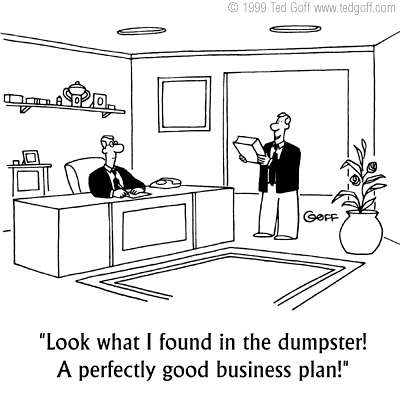
I recalled this quote after seeing an interesting discussion on LinkedIn debating the value of business plans for new companies.  Some potential entrepreneurs were dismissing the value of business plans for start-ups because they rarely had any relevance to the business once they hit the  realities of actually going to market. General Eisenhower reminds us how this argument misses the point. The value of a business or marketing plan is not in the plan itself, but in forcing you to think in a rigorous way about how best to deploy your resources. Who is your target? What’s your value to them? Who’s your competition? What kind of human and financial resources will you need to make a go of it? Of course, unless you are the first true psychic, most of what you come up with will be wrong.  The details of the plan may be mere historical artifacts within months of launch. But if you planned well, you are better able to identify and react to what you were wrong about.

The same lesson was delivered in another context by an accomplished climber I once heard speak. He described the meticulous planning process that his team followed before a major climb. They literally mapped out every step. He went on to say that they almost never followed the predetermined path once the actual climbing began, but it was the planning that allowed them to make intelligent choices under stress about what they could afford to change.

Whether you are crafting a business plan for a new company or a marketing plan for an established brand, there are three important lessons in this.  One is that a plan is worth what you put into it.  If you just go through the motions in order to be able to point to an official-looking plan, it will be of no value. Second, you shouldn’t dismiss the planning process just because the plans themselves are rarely executed.  A well-constructed plan will make you a smarter leader and manager for the unexpected turns that inevitably come your way. The final related lesson is that you should not treat the plan as anything but your best current guess. If the plan isn’t working, don’t be afraid to change it. Too many marketing managers disregard new information and new opportunities because it’s “not in the plan.” A plan is not a substitute for thinking. Plans should be treated more like boyfriends than husbands. You should always be open to a better one.

Leave a comment

Filed under Activation, Business Management, Market Strategy

Business Culture: Family vs. Team

I often encounter business leaders who try to capture the positive aspects of their company culture by referring to their “family” environment.  These are often managers who want to distinguish themselves from a cutthroat or unethical work environment.  Nonetheless, whenever I hear an executive  refer to the company family, I can’t help but wince. Inevitably, they are undermining their own credibility, integrity, and success.

While I appreciate the sentiment, companies cannot operate like families. At their best, they are teams. Managers often confuse the analogies of family and team, because many of their positive values overlap.  They both require sacrifice for the good of the group, and being able to rely on that same sacrifice from others.  They both thrive in a spirit of tolerance, where we acknowledge each other’s different styles and strengths. Both strong families and strong teams share common core values, such as trust, honesty, and loyalty.

But they diverge in a meaningful way. Family is an unconditional commitment. A  family should remain a family no matter what they do.  A family does not have an explicit mission, other than its own survival. A team is a conditional commitment. It exists because of a mutual commitment of its members to support an explicit mission, be it completing a project, defeating a competitor, or providing a service.  This creates different expectations and different obligations on its members.

A family leader is expected to support his family in every way possible. If a child is engaging in behavior that is destructive or embarrassing to the family, the parents’ first obligation is to support that child, and do everything they can to overcome whatever is at the root of their child’s  problem. If an employee is engaging in behavior that is destructive or embarrassing to the firm, a manager’s obligation is to minimize the negative  effect on the mission. If that can be accomplished by helping the employee, all the better. But if it can only be addressed by replacing the employee, that’s an acceptable alternative.

If a family member’s temperament is a poor fit with the rest of the family, the unconditional commitment of the family should overlook those differences, and accept them as they are. If an employee’s work style is at odds with the rest of the company, and manager needs to either work with that employee or find a replacement that will make a better fit.  A manager who accepts people as they are to the detriment of the firm is incompetent.

There was a sad story about a family that adopted a child, and then sent the child back after they found out he was going to be challenging to take care of. The universal reaction was that it was unethical to reject a child from the family simply because he was too hard to take care of. In a business situation, the ethics are practically reversed. If an employee was taking up disproportionate resources to support and manage, other employees would consider it unfair. One of the most common worker complaints is management that tolerates dead wood employees who don’t pull their weight at work.

Sports are the most obvious examples of team. If a wide receiver on a football team can’t catch a football, a coach would not keep him on the team. But you would never think of replacing a sibling for lack of performance.  A football team doesn’t pay its starting quarterback the same salary as its backup kicker. A team rightfully gives more attention to the people who are most critical to its success. A family’s love and attention should not be doled out on the basis of some performance measures. With a family, the family unit itself is paramount. With a team, the mission of the team is paramount.

Managers who promote their teams as families do themselves and their employees a disservice.  As in the recent downturn, it can cause additional bitterness when it requires letting people go. It makes a lie out of everything the manager claimed to stand for. Families don’t disown other family members in bad times. The same disillusionment happens if someone is passed over for a promotion or gets a smaller bonus.

Employees lose trust in their leaders if they see them violating the principles they espouse. The differences between family and team are subtle but profound, and managers who confuse them risk being seen as hypocritical or dishonest when those values are put to the test.

Leave a comment

Filed under Business Management, Market Strategy

Ten Things Your Agency Prefers You Don’t Know: #10

Only two things really matter when picking an agency.

If you are a major marketer, the type of agencies you’ll consider all have the same basic approach and capabilities.  Their processes, for better or worse, are all about the same as well.  Many claim to have proprietary tools or processes, but that’s just not the case. They may have different names and different labels for what they do, but the breadth and delivery of services is essentially the same at any holding company agency or major independent. Pricing is also not different. More accurately, if there is a pricing difference, agencies are quick to match their competitors in order to win or retain a client.

If the basic capabilities are the same at most every agency, what distinguishes them? In my experience there are two factors that really matter. The first factor is the quality of the people working directly on your business.  A great team at a mediocre agency will tend to do great work, and the opposite is true as well.

The second factor is the standards an agency sets for itself – standards for creativity, professionalism, and integrity. The agencies with higher standards make it harder for bad work to get out the door, and are quicker to realize when their work is falling short of what it should be.

If I had to choose a new agency as efficiently as possible, I would do three things.  First, I would look at all their work. Not just their highlights or major clients, but everything they’ve done in the past 6-12 months so I could judge their overall standard of work. For example, on a big retail account there is often a lot of little stuff that has to get churned out quickly and cheaply, like tent cards or shelf talkers.  Do they just jam their print ads into another format, or do they actually take a little time to design it for the environment it’s in.

Second, I would talk to each of their clients to see if they had more than the usual compliments and gripes so I could assess their standards of professionalism and integrity.  No client-agency relationship is without its spats and hiccups, but I’d listen to see if problems get addressed, or if  the same spats and hiccups keep recurring

Third, I would meet directly with the people who would be working on my business. I’d not only assess whether I like and trust their work, but also to sense if they are people who will champion my business back at their place. Big agencies have lots of people competing priorities and opinions, so I want someone who is going to advocate for me when I’m not there. Oh, and you can have them do some work too since most agencies are giving it away for free anyway.

The typical pitch process gets around to accomplishing these things indirectly, but generally takes a lot more money and time.

4 Comments

Filed under Agency Management

The Brand – Marketing Paradox

Over the past few years, there has been two converse trends that speak to an interesting shift in the marketing landscape. On the one hand, the benefits of a strong brand have become more discussed and desired than ever before. CEOs, politicians, athletes, and entertainers are obsessed with developing and shaping their respective brand.  Numerous self-help columns promise to help people develop their individual brands. Never before has branding been perceived as such a critical success factor by so many people in so many fields.

So these should be heady days for established branding experts. Marketers from brand managers to agency directors should be enjoying unprecedented status and influence. Yet the opposite situation seems to be the case. White papers for CMOs circulate around the struggle to get a seat at the decision-making table.  Agencies are increasingly treated as commodities, set out for bid in much the same way as office supply contracts.  Major consumer marketing companies have bypassed the professionals to embrace “user-generated content” and crowdsourcing to fuel their marketing campaigns.

One explanation for these contrasting trends is that branding has become too important to be left to the marketers. Supporters of this view argue that the limited toolset and mindset of traditional marketers has made them ill-equipped to deal with the challenges of the modern marketplace.  There is some isolated truth in this, but anyone who has dealt with a large sample of CMOs can attest that as whole they are as engaged, intelligent, and creative as anyone you could hope to meet.

The more credible explanation is that branding has become bigger than marketing.  The digital era has brought an unprecendented amount of information and transparency to products and the companies who make them. As a result, people are forming brand impressions from a far greater number of inputs than ever before.  A frustrating customer service experience becomes a viral video hit, a golf outing with clients sparks national outrage,  financing from an overseas bank results in a store boycott. So brand impressions are being formed less by the things marketers control and more by the corporate culture and its day-to-day operations. 

Branding used to cover a company like frosting on a cake. It was something you added at the end to make it look good. Now the branding is baked in. For branding experts to contribute, they have to make a positive impact on what goes into the cake, not on what comes out of the oven.

Leave a comment

Filed under 21st Century Marketing, Branding

Ten Things Your Agency Prefers You Don’t Know: #6

The agency network model is designed for investors, not clients.

Almost every agency pitch involves some bragging points about capabilities in which a list of sister companies demonstrates the agency’s ability to provide expertise in every marketing function known to civilization.  Inevitably, it is positioned as a way for clients to tap into whatever services they need while maintaining an integrated brand approach.

The Omnicom/WPP/Interpublic/Publicis model of accumulating multiple marketing agencies across different fields has little to do with integrated marketing and everything to do with market share. As different marketing fields developed over time, agencies saw revenue going out the door. First it was promotions, then it was direct marketing, then interactive, then social media,  and so on.  Publicly-held holding companies rightly decided that if you can’t  beat them, buy them.  Revenues must grow to grow stockholder value, so why not capture the revenue that is going elsewhere? Holding companies can capture a greater share of their clients’ total marketing spend if they have a broad range of companies to funnel work to.

But when a client works with a “sister company” within an agency network, there is no inherent financial or strategic efficiency.  For example, when a traditional agency brings in an interactive agency in their network, there is no staffing efficiency. The interactive agency doesn’t put less people on the account because they are working with another agency in the network.  Revenues are not shared between network companies, so there is no incentive for any agency to suggest that a client would get a better return by shifting money outside  of what that specific agency does.

As for strategic integration, try asking a few agencies within the same network to share their brand positioning models. Not only are the models rarely the same, even the vocabulary is different.  What one calls a Brand Position, another calls a Brand Proposition, and another calls a Brand Promise.  It’s unlikely a client will get a higher level of strategic integration among companies that don’t even share a common brand language. There is an advantage in working with companies that are used to working together. But you don’t have to be part of the same corporation to work together, and being in the same corporation doesn’t mean you have worked together. Any agency veteran will tell you they often meet their “integrated agency partners” for the first time a day or two before a pitch.

There are two potential advantages for a client working with a holding company network of agencies. There may be some comfort for a client in having what some call “one point of contact” and others call “one throat to choke.”  There also may be some financial benefit for very large marketers with big budgets in several channels.  In this case, a holding company may be willing to cut their overall margins across several agencies in order to capture more total revenue. But that is a by-product of clout, not of efficiency.

Until holding companies really work to integrate their companies financially and strategically, marketers would be well-served to find the fit that is best for them regardless of any shared corporate structure.

Leave a comment

Filed under Agency Management, Branding

Ten Things Your Agency Prefers You Don’t Know: #7

Agencies don’t have a lot of bench strength.
That’s mostly because they can’t afford to. Clients have gotten their procurement departments more involved in agency compensation over the past decade. This procurement movement helped in several respects and hurt in others. It helped reduce some inefficiencies and pushed agencies to be more forthcoming in their fee proposals. It has failed to create a lot more value for the client. It has failed because both agencies and marketers focused on reducing the costs of the inputs rather than increasing the value of the output. In order to reduce costs, agencies have had to reduce the total compensation for their staff. The dynamic has been similar to the effect of salary caps in professional sports. Now there are only so many stars an agency can afford to keep on the roster. So you get what few stars you can afford, and fill in the rest of the team with role players, or unproven rookies who you hope will rise to the occasion. This has pushed agencies to manage their clients like the old vaudeville spinning plate routine. They try to get all the plates spinning, and only give their attention to the ones that are really starting to wobble. The A-team is dispatched to get the plate spinning again, and then as soon as that’s done, they rush to the next wobbler. So for any marketer wondering whether they have a first-rate team dedicated to their business, the answer is probably no. They can’t afford to.

Leave a comment

Filed under 21st Century Marketing, Agency Management