

As the old quip goes, “predictions are difficult, especially about the future.” That witticism serves to remind us of the hazards of predicting the future of AI and its impact on marketing. But there are three outcomes that seem self-evident as we witness the early applications of AI to the marketing toolkit.
The size of marketing and agency staffs will decline
There are debates about whether AI will inspire more or less creativity. On one hand, AI is a great enabler that will allow ideas to develop with less constraints on executional limits on bringing them to life. On the other hand, AI is a great imitator that will respond to prompts with a tedious recycling of what’s already been done. Agency viewpoints have tended to emphasize the second view as a basis for saying that the creativity they bring to clients will be in more demand than ever. Whether most agencies actually are truly a source of creativity or are just human recyclers is beside the point. The point is that the business model of agencies is based on the executional effort rather than the intellectual effort of marketing. Most agencies have an hours or people-based model similar to that of a law firm. They may attract clients through the strength of their creative ideas, but they make money from those clients by how many bodies they can assign to produce and distribute those ideas. Clients may value the “big ideas” of the agencies even more in an AI world, but they won’t need large staffs to produce the marketing materials, create the media plan, and optimize media channels. Agencies have given lip service to getting paid for their ideas in the past. But they’ve never convinced clients or themselves to adopt that model. The role of agencies may be enhanced or degraded by AI, but their billable revenue will decline as more human tasks become automated.
For the same reasons, company marketing departments should grow smaller in number as well. The relative scale of the ipact will depend on how they were organized. Marketers than built large in-house teams to handle creative and media tasks will shrink in line with agencies. Brand managers will be less affected but their skill set and responsibilites will change as they spend less time and task management and more on true brand development.
The best marketers will shift their focus from local optima to global optima
That’s an admittedly jargon-filled phrase. But these mathematical terms do the right job for describing the main marketing challenge of the early AI era. The figure below illustrates the general idea. Imagine you’re kicking off a marketing campaign represented by the blue dot. As you move to optimize your messaging, target, and channels, you move nicely along increasing your performance until you get to the top of the first curve. As you move beyond that peak, the metrics will tell you that you are going in the wrong direction and push you back to the first peak. But there may be a new audience, a new selling point, or a new channel strategy further down the path that would actually get you to an even higher maximum return. But the data won’t take you there incrementally. You’ll have to push past the optimization signals to move from a local optimization to a global optimization.
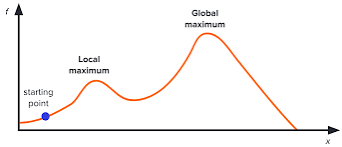
The challenge is that you’ll never know if you’re at a global maximum or a local maximum. You can’t tweak yourself to the highest outcome. Marketers will rely more and more on AI to get them to an optimal local maximum. But to unlock superior performance, they’ll have to explore ideas that are beyond the A/B testing mentality to constantly explore whether there is a better outcome than the current approach can give you.
The best job of humans will be to interface with other humans
There has been a lot of conversation around the jobs that will be lost to AI. If historical trends are a meaningful precedent, AI will eliminate many jobs and create many others. But of course, the losses and gains will be spread unequally. Middle-skilled physical laborers bore the brunt of machines and manufacturing robots. Similarly, middle-skilled and many high-skilled administrative jobs will quickly fall away in AI. Media planning, optimization and reporting will become mostly automated. A good portion of pre- and post-production workers will also be replaced by AI. The jobs that will survive or even grow are those related to human tastes and connections. Humans are a mess of reason, emotions, and instinctual quirks. How we react to things is difficult to interpret or predict. Taylor Swift was not named Person of the Year because of the accuracy of her pitch and efficiency of her lyrics. She created a cultural moment that people wanted to be a part of. The ultimate goal of any brand is to create a human connection that transcends the attributes of the product. The nature of that connection is elusive. But humans recognize when it happens and, more importantly, are the mechanism by which it happens. The people who can inject humanity into customer service, product design, and marketing strategy will always be in demand. To the extent that AI frees up people for more human-centered thinking, there is even potential for growth.
 The Ryan Report