
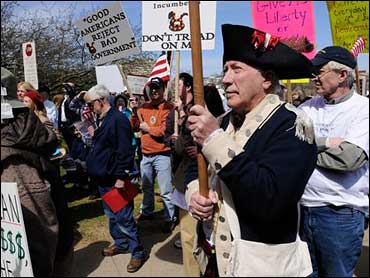
 As the anti-incumbent story rumbles across the mediascape, there is a familiar theme — call it the “I’m mad as hell and I’m not going to take it anymore” movement. Congress is at its lowest approval ratings of all time, political distrust is at an all-time high, and new activist fervor is sweeping the land. Politics as we know it is about to change.
Don’t believe the hype. Whether it’s the Know Nothings of the 1840’s, the Term Limit supporters of the 1990’s, or today’s Tea Party, they are all a response to the fundamental structure of the American political market.
I worked on political campaigns, and it is important to learn that there is a fundamental difference between the political marketplace and the consumer marketplace. Both are ruthlessly competitive, so it is not a difference in ethics or morality. It has to do with what I call “category effects.” Consumer markets have them, and political markets don’t. Here’s why.
In simple game theory terms, there are four general outcomes between two competitors in the consumer marketplace:
- Both gain
- Both lose
- Competitor 1 gains, Competitor 2 loses
- Competitor 1 loses, Competitor 2 gains
For an example where both gain, look at Adidas and Nike. Both doing well financially, both well-regarded major brands, and benefiting to a large extent from the fact that they have a major competitor helping them drive the market and mythology of athletes and athletic gear.
For an example where both lose, look at United and American Airlines. Even before the recession, the two largest US carriers were losing share to Southwest-like competitors on the discount end and Virgin on the high-end. Neither gained from the struggles of the other, and both added to each other’s problems by pricing and service policies that soured people on the airline travel experience.
In both situations, individual players face consequences for how the whole category performs. If companies compete in such a way that the category grows, they may both win. If they compete in a way that the category suffers, they may both lose. It is in their self-interest to have people think well of the category.
By contrast, political competition has only two outcomes:
- Competitor 1 gains, Competitor 2 loses
- Competitor 1 loses, Competitor 2 gains
In a campaign, it does not matter if you have two great candidates or two terrible candidates, one person gets elected. There is no outcome where both gain or both lose. There are 100 Senators in the US Congress, and short of a change to the Constitution or an overthrow of the US government, that number is not going to change based on people’s approval ratings. In other words, there are no category effects for politicians. If doesn’t matter if people love or hate the category, 50 people still win the same prize either way. There is no self-interest for politicians to make people feel better about the category.
That is why negative advertising is frowned upon in the consumer marketplace, and embraced in the political marketplace. In politics, if people hate the category I’m in, I can still win as long as they dislike my opponent more than me. It doesn’t matter if the population is so put off that only 3 people even bother to vote. If two of them vote for me, I win. In the supermarket, if people hate the my category, it does not help if they hate me less. I still lose. If two people buy my product and only one buys my competitor’s, we both go out of business.
As long as there are no category effects in politics, there is no incentive within the system for the candidates to improve the institution. Efforts like the Tea Party represent an external effort from outside the system, attempting to impose category effects on a market that inherently lacks them. If patterns are true to form, one of the political parties will absorb their key tenets into their platforms, and the system will continue to chug along as it always has.
 The Ryan Report